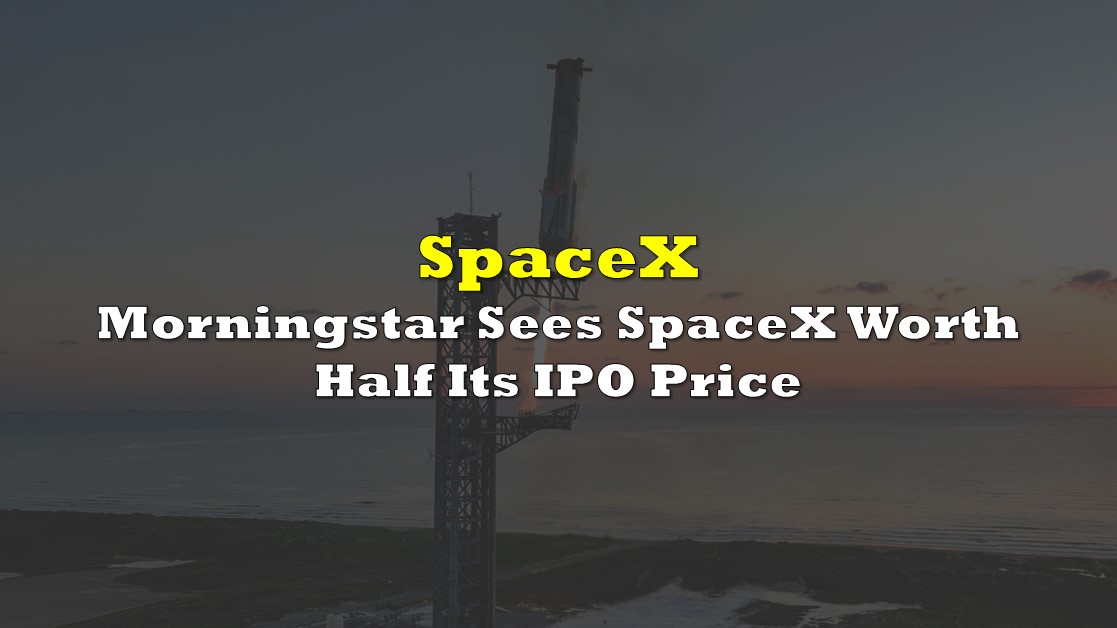

Morningstar thinks SpaceX is worth roughly half of what the rocket and satellite company is asking the public to pay.
In its first research coverage of the company, the firm pegged fair value at $780 billion, far below the roughly $1.75 trillion valuation SpaceX is targeting in its initial public offering. Analyst Nicolas Owens however says that the target, rather than be due to skepticism, is just simply due to math.
The firm values the rocket and satellite company at $63 a share, 53% short of the $135 offering price, and it gets there by mapping out three sharply different futures, assigning each a probability, and blending the results.
 Sponsored · Selkirk Copper Mines
Even at $63, analyst Nicolas Owens is being optimistic. Two of his three scenarios assume SpaceX cracks a reusable Starship capable of multiple launches a week and then commercializes data centers in orbit — engineering problems Morningstar doesn’t expect solved before 2028.
The most bullish path, dubbed “Moonshot,” imagines both bets paying off, with an orbital computing cluster of roughly 59,000 satellites throwing off $225 billion in annual revenue by the mid-2030s. That would value SpaceX at $1.97 trillion, or $154 a share, 14% above the IPO price. Morningstar gives it a 7% chance.
A downside “No Go” case, in which orbital data centers never justify the spending and the company walks away around 2028, carries a 43% probability. The middle “MVP” scenario, which estimates orbital computing works within limits, capturing a sliver of global capacity, is deemed most likely at 50%.
The building blocks are mundane by comparison. Morningstar credits the core launch and Starlink connectivity businesses with about $40 a share, the AI ambitions with $16.50 a share, then folds in cash, debt and IPO proceeds to land at $62.51 per share, rounded up. Those figures are based on the assumption that the company will raise $85.7 billion in proceeds from the IPO.
Owens frames the AI piece as something closer to a call option than a forecast, a wager on orbital infrastructure rather than a clear line of sight to it.
That sharpens the math at $135. Anyone paying the offering price is effectively adding $72 a share in “option premium” for the right to ride along on whatever SpaceX attempts next, from lunar chip fabrication to a city on Mars, none of which Morningstar bothered to value.
With a Very High uncertainty rating, the firm would want fair value near $270 before calling the stock a buy at $135.
Information for this story was found via the sources and companies mentioned. The author has no securities or affiliations related to the organizations discussed. Not a recommendation to buy or sell. Always do additional research and consult a professional before purchasing a security. The author holds no licenses.