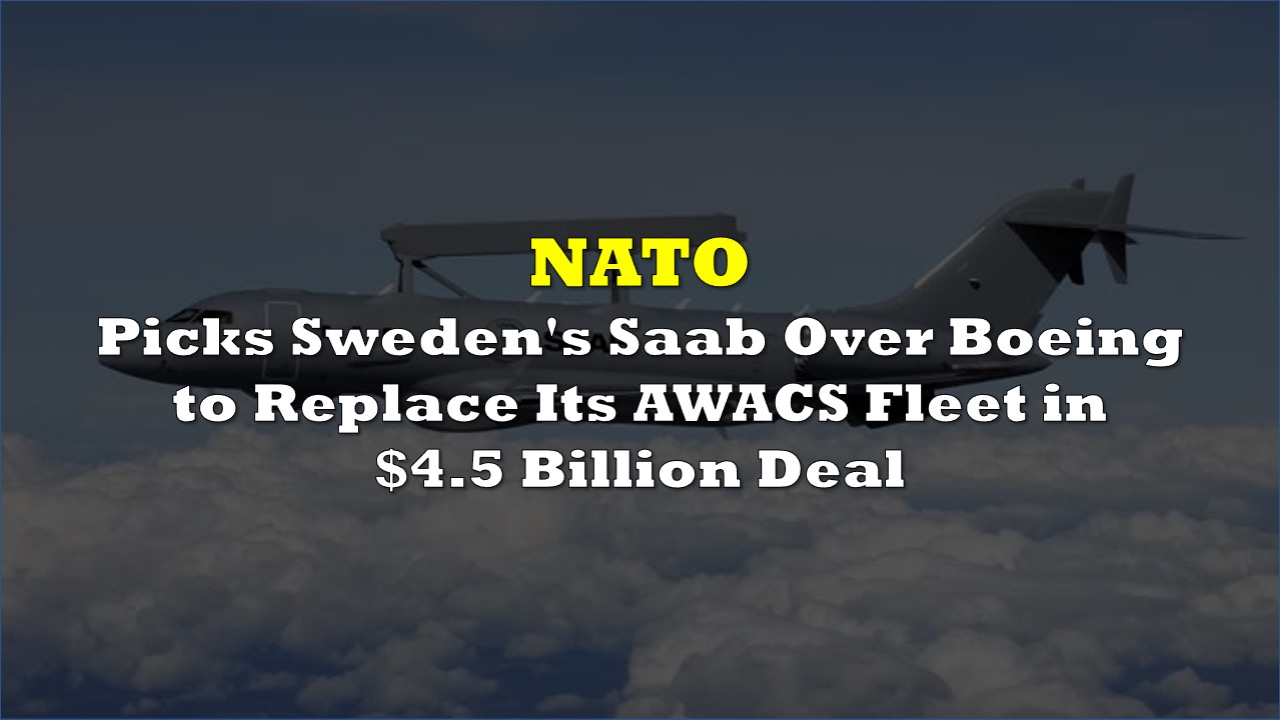

NATO announced plans Tuesday to buy up to 10 Saab GlobalEye surveillance aircraft, ending Boeing‘s roughly four-decade hold on the alliance’s airborne early warning fleet.
Secretary General Mark Rutte confirmed the selection at the alliance’s defense industry forum in Ankara, telling attendees, “Today we are announcing the joint procurement of up to 10 Saab GlobalEyes.” NATO will now begin formal negotiations with Saab; no contract has been signed yet, and Saab said in a statement it “has not signed a contract or received an order related to the announcement.”
The deal replaces NATO’s fleet of 14 Boeing E-3A Sentry AWACS aircraft, which have flown from Geilenkirchen Air Base in Germany since the early 1980s and are due to retire around 2035. Saab CEO Micael Johansson valued the purchase at up to $4.5 billion, with each aircraft priced between roughly $400 million and $450 million, and said deliveries could begin as early as 2030 if a deal is finalized soon.
 Sponsored · Silver47 Exploration Inc.
Eleven NATO members are participating in the joint procurement — Belgium, Canada, Denmark, Germany, Latvia, Lithuania, Luxembourg, the Netherlands, Norway, Romania, and Sweden — according to NATO’s own July 7 release. Notably absent are France, which already operates GlobalEye independently, and the United States, whose own manufacturer lost the competition.
The alliance had originally committed in 2023 to buy six Boeing E-7A Wedgetail aircraft under its Initial Alliance Future Surveillance and Control program, before scrapping that plan in 2025 after the Trump administration moved to cancel the US Air Force’s own E-7 order in favor of space-based surveillance.
Defense Secretary Pete Hegseth has since said the Pentagon is pushing to revive its E-7 purchase after pushback from US lawmakers, but the reversal came too late to keep NATO’s own plan alive. With Boeing’s Wedgetail effectively out of the running, GlobalEye, built on Bombardier’s Global 6500 business jet with Saab’s Erieye radar, became the only in-production Western jet-powered alternative.
Saab entered the competition with a growing order book that gave the selection momentum. France ordered two GlobalEye aircraft in December, with an option for two more; Sweden has ordered three, the UAE already operates the type, and Canada opened acquisition talks with Saab in May.
Reuters first reported the selection was coming on July 2, five days before Rutte’s announcement, and French outlet La Lettre had reported as early as April that NATO’s procurement agency favored Saab. Saab’s shares rose nearly 4% on the news, outperforming the broader European aerospace and defense index, which edged lower the same day.