
Oil prices jumped as attacks near the Strait of Hormuz raised the market’s estimate of short-term transport risk, pushing Brent crude up as much as 10% to above $82 a barrel on Monday.
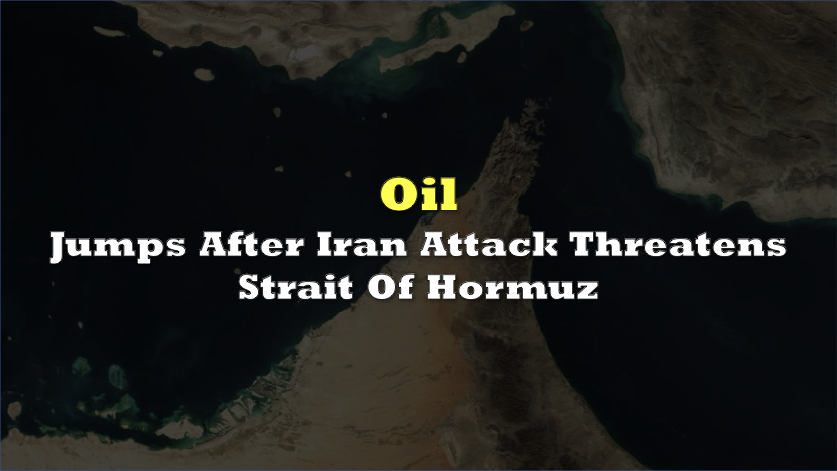
The price spike followed a weekend in which at least three ships were attacked near the strait and international shipping slowed sharply at its entrance.
Iran warned vessels not to pass through the southern waterway, through which roughly 20% of the world’s oil and gas is shipped.
Operationally, the disruption was significant even without confirmed large-scale damage to production assets. The UK Maritime Trade Operations Centre said two vessels were struck by unknown projectiles and caught fire, while an “unknown projectile” exploded in very close proximity to a third vessel. It also reported a fourth incident involving crew evacuation, though the cause remained unclear.
Kpler data reported at least 150 tankers anchored in open Gulf waters beyond the Strait of Hormuz, with only a handful of Iranian and Chinese vessels passing through on Monday. Homayoun Falakshahi of Kpler said the strait was “effectively closed” because vessels were avoiding entry due to high risks and sharply higher insurance costs.
Maritime operators moved quickly to reprice route risk. The UKMTO advised ships to transit with caution across the Arabian Gulf and Gulf of Oman. Private security firm Vanguard Tech said reported incidents matched vessels flagged to Gibraltar, Palau, Marshall Islands, and Liberia.
Separately, Maersk said it would pause sailings through the Bab el-Mandeb Strait and the Suez Canal, rerouting ships around the Cape of Good Hope, a diversion that lengthens voyage times and raises freight costs.
OPEC+ responded on Sunday by agreeing to raise output by 206,000 barrels a day, an attempt to cushion price gains. But the announced increase is small relative to the scale of flows at risk if a route carrying around 20% of global oil and gas shipments remains constrained.
Some analysts warned oil could move above $100 a barrel if the conflict drags on. Robin Mills of Qamar Energy said the jump in prices would feed through almost immediately because traders are closely following headlines, while also noting that current oil prices remain below levels seen two years ago.
Information for this story was found via BBC and the sources and companies mentioned. The author has no securities or affiliations related to the organizations discussed. Not a recommendation to buy or sell. Always do additional research and consult a professional before purchasing a security. The author holds no licenses.