
Saskatchewan will head into its March 2027 Supreme Court battle over its school pronoun law after four of Canada’s top judges rejected a constitutional argument the province advanced alongside Alberta, Ontario, and Quebec.
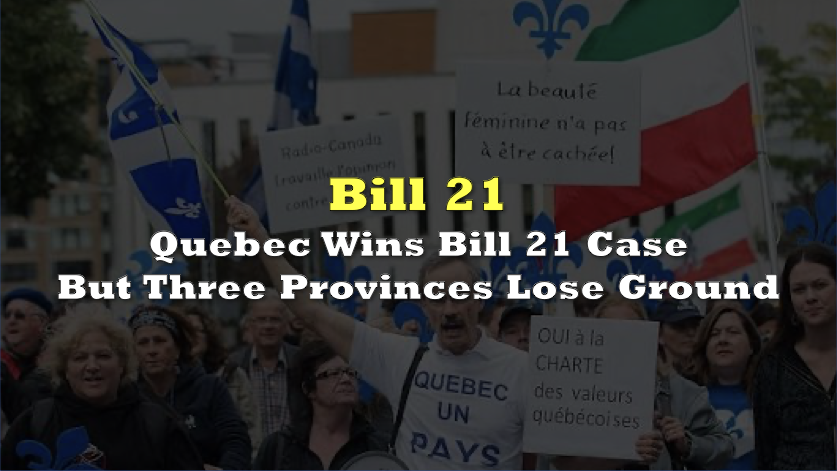
The Supreme Court of Canada on Friday upheld most of Quebec’s Bill 21, the province’s secularism law, but determined that governments cannot prevent courts from declaring that legislation infringes constitutional rights simply by invoking the notwithstanding clause.
The attorneys general of Alberta, Ontario, and Saskatchewan had supported Quebec’s position against such judicial declarations, according to The Catholic Register. The federal government, Manitoba, and British Columbia supported allowing courts to issue declarations without invalidating the legislation.
 Sponsored · Selkirk Copper Mines
The ruling produced four sets of reasons from seven judges, with justices Andromache Karakatsanis, Nicholas Kasirer, Sheilah Martin, and Michelle O’Bonsawin recognizing the judiciary’s authority to make such findings.
Only three judges, however, supported issuing a declaration in the Bill 21 case itself. No such declaration was ultimately issued.
The decision comes less than four months before the Supreme Court is scheduled to hear Saskatchewan’s appeal concerning its Parents’ Bill of Rights on March 22 and 23, 2027.
Saskatchewan introduced legislation in 2023 requiring parental consent before schools could use the preferred names or pronouns of students under 16. The province invoked the notwithstanding clause to shield the legislation from challenges under three sections of the Canadian Charter of Rights and Freedoms.
 Sponsored · Cambria Gold Mines
UR Pride Centre for Sexuality and Gender Diversity challenged the legislation, alleging violations of constitutional protections involving personal security and equality.
Saskatchewan’s Court of Appeal ruled in August 2025 that the litigation concerning the legislation could proceed despite the override. The provincial government subsequently brought the dispute before the Supreme Court.
Section 33 of the Charter allows Parliament and provincial legislatures to temporarily override certain constitutional protections, including freedom of religion, freedom of expression, and equality rights.
Each invocation lasts a maximum of five years unless renewed. Quebec renewed its federal Charter override protecting Bill 21 in June 2024, extending its protection until 2029.
The Supreme Court upheld Quebec’s use of that mechanism and maintained the religious symbols restrictions affecting public school teachers, police officers, and other designated public employees.
All seven judges, however, agreed that a provision requiring elected members of Quebec’s National Assembly to sit with their faces uncovered infringed democratic rights, which fall outside the notwithstanding clause’s reach.
The ruling preserves legislators’ authority to override eligible Charter protections while recognizing a separate power for courts to identify rights infringements.
Such declarations would not, on their own, invalidate protected legislation, but would establish a judicial record of constitutional infringements that remains available to lawmakers and voters when governments seek to renew an override.