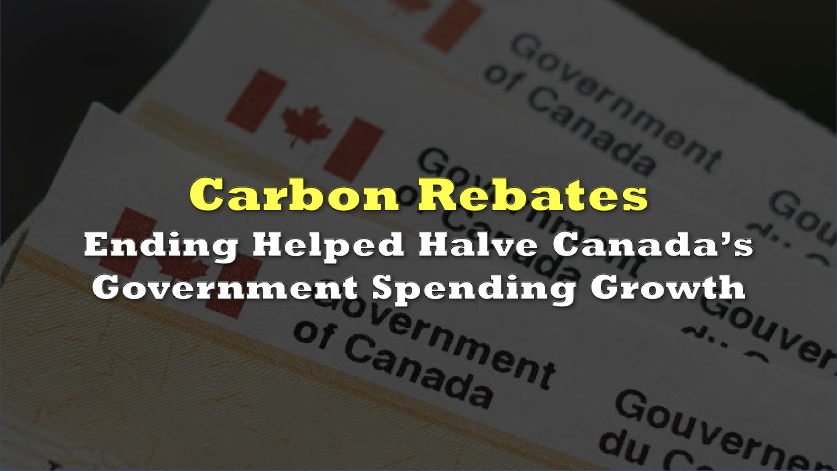

Canada’s government spending growth slowed by more than half in 2025, with the termination of payments returning carbon tax revenues to households and businesses emerging as a major factor behind the deceleration.
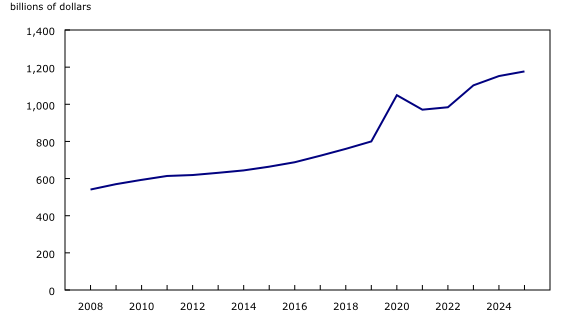
New figures released by Statistics Canada on Thursday showed that combined expenditures across federal, provincial, territorial, and local governments increased by 2.2% in 2025, compared with 4.5% in 2024. Total spending reached nearly $1.18 trillion, up $24.8 billion from the previous year.
The slowdown coincided with a deterioration in Canada’s public finances. Separate figures published on November 20 showed that the combined government deficit widened by $10.7 billion to $63.1 billion.
 Sponsored · Selkirk Copper Mines
The removal of the federal fuel charge, which took effect on April 1, 2025, reduced both government revenue and expenditures. Under the previous system, money collected through the charge was redistributed to eligible households and businesses.
Statistics Canada recorded those payments as environmental protection expenditures, specifically under pollution abatement.
The discontinuation of the rebate programs helped drive a $13.6 billion reduction in pollution-abatement spending, equivalent to a 61.5% annual decline. Overall environmental protection expenditures dropped 30.6% to $28.1 billion, making the category the largest contributor to the nationwide spending-growth slowdown.
Excluding environmental protection, combined government expenditures increased by approximately $37.2 billion, or 3.3%, based on Statistics Canada’s published figures.
 Sponsored · Cambria Gold Mines
Federal financial statistics released last week showed that expenditures associated with household carbon rebates fell by $9.8 billion, while small-business carbon rebates declined by another $1.9 billion.
However, federal revenue from taxes on the use of goods or permission to undertake activities also dropped from $14.1 billion to $700 million, primarily reflecting the removal of the fuel charge.
Ottawa’s overall expenses still increased by $11.2 billion, outpacing revenue growth of $3.8 billion. The federal deficit, as measured by Statistics Canada, consequently widened to $36.7 billion.
The financial implications of winding down the consumer carbon pricing system had previously been acknowledged in Budget 2025, which estimated a net fiscal cost of $4.2 billion for 2025–26, including expenses associated with the final rebate payment.
Meanwhile, spending on several environmental services continued to increase despite the steep decline in the broader environmental protection category.
Waste management expenditures rose by $610 million, while wastewater management received an additional $227 million. Spending on biodiversity and landscape protection increased by $370 million.
The redistribution of carbon tax proceeds had previously accounted for a substantial portion of recorded environmental expenditures, despite being delivered through financial transfers rather than direct environmental services.
Outside environmental protection, healthcare spending climbed 6.6% to $289.4 billion, while social protection expenditures increased 2% to approximately the same amount.
Together, healthcare and social protection accounted for 49.2% of Canadian government spending in 2025.