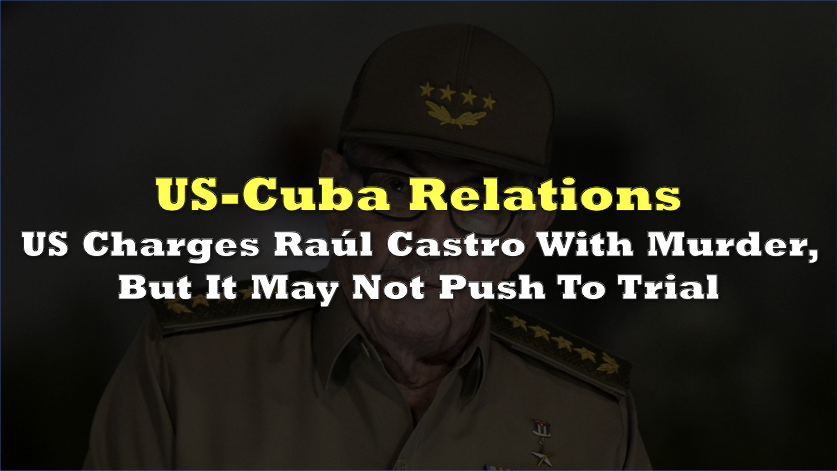

Washington has created a prosecution that may travel farther than the defendant, placing former Cuban President Raúl Castro under US murder charges three decades after the Brothers to the Rescue shootdown while leaving the central custody problem unresolved.
Castro, 94, was indicted in federal court in Miami on charges tied to the February 24, 1996, destruction of two civilian aircraft operated by the Cuban exile group Brothers to the Rescue. Reuters reported that the indictment includes one count of conspiracy to kill US nationals, four murder counts, and two aircraft-destruction counts. Five other people were also charged.
The indictment gives the Trump administration a new pressure point against Havana even if it never produces a trial. Castro remains in Cuba, and Reuters reported there is no evidence he has recently left the island or that Cuba would extradite him.
 Sponsored · Selkirk Copper Mines
The case reaches back to four deaths over the Florida Straits. Two Brothers to the Rescue Cessnas were destroyed by Cuban military aircraft, while a third plane returned to Miami. AP reported that the group had flown missions to aid Cuban rafters and had also angered Havana through flights near Cuban territory and leaflet drops.
The legal theory depends heavily on where the planes were when they were hit. Cuba has maintained that the aircraft violated its airspace, while the US has argued they were in international airspace. The International Civil Aviation Organization later supported the US position, according to Reuters.
Castro’s alleged exposure comes from his role at the time as defense minister, not from his later presidency, making him one of the most senior military officials in the chain of command when the shootdown occurred. Reuters reported that his brother, then-President Fidel Castro, later said Cuba’s military had general instructions to stop the flights but denied that he or Raúl Castro gave a specific shootdown order.
The indictment also reopens an old Washington question: why now. US authorities previously pursued Cuban agents and military figures linked to the episode, but the new case moves directly against one of the last surviving leaders of the Cuban revolution. CBS reported that two fighter pilots and the head of Cuba’s air force had previously been charged but were never tried, while one person was convicted in a murder-conspiracy case tied to spying on Brothers to the Rescue flights.
 Sponsored · Altamira Gold Corp.
The new filing arrives as the Trump administration is escalating pressure on Cuba across diplomatic, economic, and political channels. Reuters reported that Trump called Cuba a “rogue state” and that Secretary of State Marco Rubio offered $100 million in aid while criticizing Havana’s leadership. Cuba’s foreign minister Bruno Rodriguez rejected the US framing and attacked Rubio’s motives.
READ: Cuba Is Next? Trump Jokes Aircraft Carrier Could Pass Cuba On The Way Back From Iran
Declassified material released by the National Security Archive adds another layer to the case’s timing. The archive published FAA records from before the shootdown, including internal warnings about the risk of Cuban action against the flights.
For Miami’s Cuban exile community, the indictment marks a long-delayed attempt to attach criminal accountability to the 1996 deaths. For Havana, it is likely to be treated as another step in a US campaign to isolate Cuba’s leadership rather than as a neutral legal proceeding.
The practical result is a case with two tracks. In court, it cannot move far without Castro in US custody. In politics, it moves immediately, because any future deal with Cuba now has to account for a former president facing US murder charges.
Information for this briefing was found via the sources and the companies mentioned. The author has no securities or affiliations related to this organization. Not a recommendation to buy or sell. Always do additional research and consult a professional before purchasing a security. The author holds no licenses.