
China’s tightening grip on rare earth exports is leaving American companies with uneven and often inadequate access to materials critical to their operations, according to new survey data from the US-China Business Council.
Chinese export controls and sanctions have touched more than a third of US companies surveyed. The pain is not evenly distributed. Automotive and logistics firms report the highest impact at 50%, while industrial and manufacturing companies come in at 40% and life sciences at 38%.
Export controls have ranked as the fourth-largest challenge facing US businesses operating in or relying on China for three years running.
 Sponsored · Emerita Resources Corp.
April 2025 proved to be the most disruptive moment, when Beijing moved to restrict medium and heavy rare earth elements and magnets, sending shockwaves through supply chains across multiple industries. Subsequent bilateral talks produced some incremental relief, and China ultimately suspended its most extreme controls for one year, but the recovery has been uneven.
Severe shortages have emerged for certain elements, including yttrium and samarium, and some REEs have remained nearly unobtainable even after general licenses were issued covering recurring exports of controlled items.
Those licenses carry meaningful constraints. A typical license runs for one year, is calibrated to a company’s historical shipment volumes, and enforces rigid quarterly caps, all of which limit practical usefulness. Lengthy and opaque licensing processes, shipment delays, and increasingly complex supplier coordination add further friction.
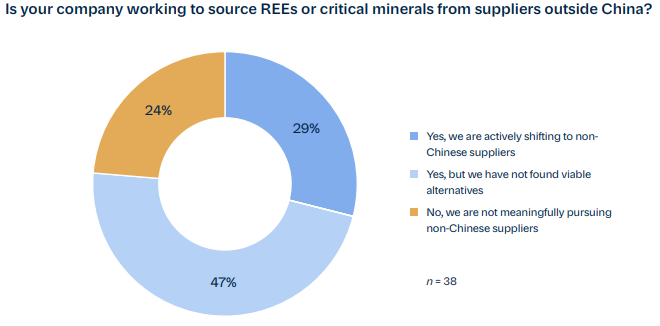
Faced with that uncertainty, roughly three quarters of survey respondents are actively pursuing rare earth and critical mineral suppliers outside China, and more than a third have already begun making concrete moves toward non-Chinese sources. The difficulty is that building credible alternative supply chains is neither fast nor inexpensive, and non-Chinese sources are unlikely to fill the gap without years of effort and meaningful government support.
With Beijing showing consistent commitment to its export control framework, there is little reason to expect conditions to ease on their own. Without greater transparency and predictability from Chinese authorities, US firms will have little choice but to push diversification forward wherever alternatives are technically and commercially feasible.
Information for this story was found via the sources and companies mentioned. The author has no securities or affiliations related to the organizations discussed. Not a recommendation to buy or sell. Always do additional research and consult a professional before purchasing a security. The author holds no licenses.