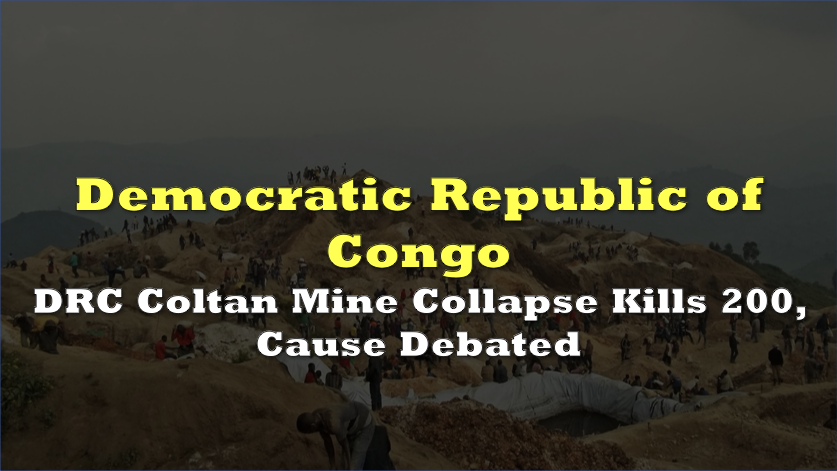

A deadly collapse at the Rubaya coltan mine in eastern Democratic Republic of the Congo has killed more than 200 people, according to the DRC Ministry of Mines, after heavy rains triggered a landslide at the site.
The ministry said on Wednesday that about 70 children were among the dead, and that injured survivors were evacuated to medical facilities in Goma, the capital of North Kivu province.
On the ground, Ibrahim Taluseke, a miner at the site, said he helped recover more than 200 bodies.
“We are afraid, but these are lives that are in danger,” Taluseke told The Associated Press. “The owners of the pits do not accept that the exact number of deaths be revealed.”
A senior official from the AFC (Congo River Alliance)/M23 group, described as Rwanda-backed and in control of the mine since 2024, told Reuters that continued operation at the site had been discouraged, pending securing the area and implementing protective measures for miners. The same official attributed the incident to heavy rains over the last few days.
M23’s public-facing account diverged sharply. Fanny Kaj, a senior M23 official, disputed the government’s figure and said the collapse was caused by “bombings,” with only five deaths.
“I can confirm that what people are publishing is not true. There was no landslide; there were bombings, and the death toll isn’t what people are saying. It’s simply about five people who died,” Kaj said.
A coltan mine is a mining site where workers extract coltan ore (short for columbite-tantalite), which is processed to produce tantalum and niobium. Tantalum is especially valuable because it’s used to make tiny, high-performance capacitors and other components found in electronics like smartphones and computers, as well as in aerospace and industrial equipment.
A similar collapse at Rubaya in late January, also following heavy rainfall, killed more than 200 people.
After that late-January incident, Congolese authorities blamed the rebels and said they were allowing illegal mining without sufficient safety standards, linking control of the site to weak enforcement and heightened risk.
The mine produces about 15% of the world’s coltan, which is processed into tantalum and used by manufacturing industries for mobile phones, computers, aerospace components, and gas turbines.
The mine’s strategic value is also intersecting with geopolitics. Rubaya was recently added to a shortlist of mining assets being offered to the US by the Congolese government under a minerals cooperation framework.
Information for this story was found via Al Jazeera and the sources and companies mentioned. The author has no securities or affiliations related to the organizations discussed. Not a recommendation to buy or sell. Always do additional research and consult a professional before purchasing a security. The author holds no licenses.