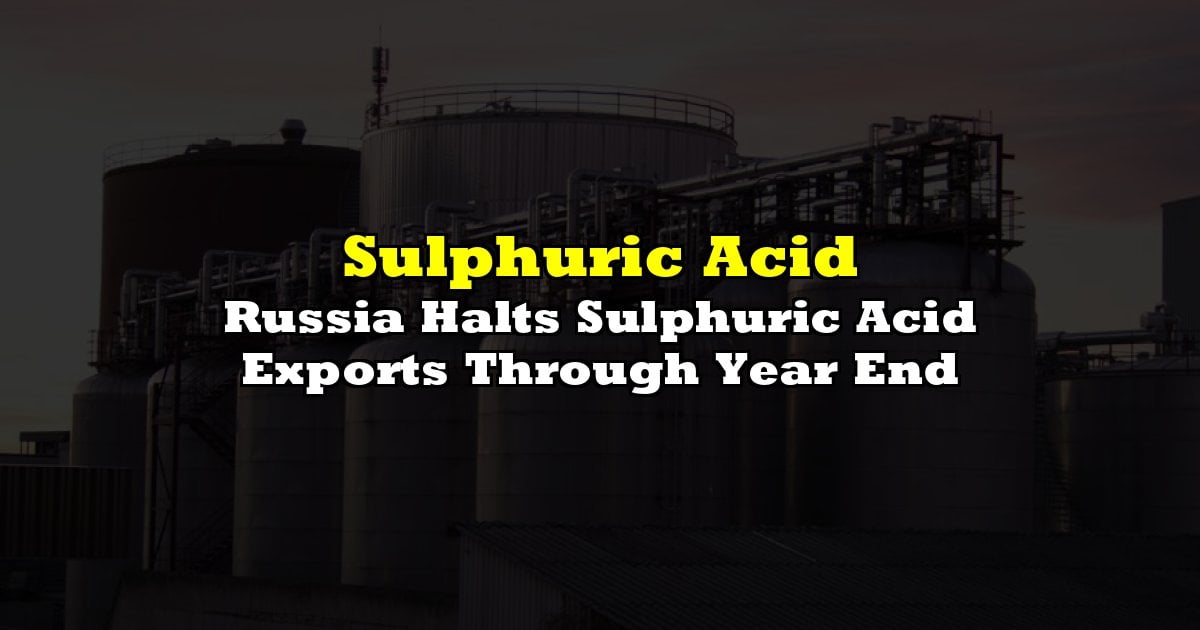

Extending a wave of raw material restrictions that has rattled fertilizer and metals supply chains, Russia has shut off exports of sulphuric acid through the end of the year.
The decree, signed by Prime Minister Mikhail Mishustin on September 12, takes effect 10 days after official publication and runs through December 31 inclusive.
Domestic supply concerns drove the decision, with the government casting the measure as a way to keep industrial enterprises and mineral fertilizer producers stocked. Exceptions do exist. Shipments can still proceed under decisions by the prime minister or his deputies, as international transit cargoes, and under intergovernmental agreements.
 Sponsored · Cambria Gold Mines
Beyond agriculture, the chemical carries strategic weight. Nitration processes rely on sulphuric acid as a dehydrating agent and reaction activator, which puts it into the production chain for nitro compounds such as TNT and nitroglycerin.
A comparable step came late last year, when Moscow blocked exports of technical-grade sulphur to shore up its domestic market. Sulphur exports out of Russia dropped 74.3% in 2024 to 1.04 million tonnes, a decline attributed in part to rising domestic demand.
Kazakhstan, the tenth largest copper producer in the world, is the destination for nearly all of Russia’s sulphuric acid exports, and Russia ranks as the 12th largest exporter globally. That leaves a single buyer, whose mining sector leans on steady acid supply, absorbing the brunt of the ban.
Mining financier Robert Friedland pointed to high-strength sulphuric acid in the Democratic Republic of Congo already trading above $1,000 per tonne, a figure that has more than doubled over the past three months. In his view the ban is unlikely to significantly dent copper output, though record prices for sulphur and sulphuric acid look set to persist.
Friedland framed the episode within a wider shift toward food security and domestic supply chains over free trade, arguing that any balkanizing of supply chains is inherently inflationary.