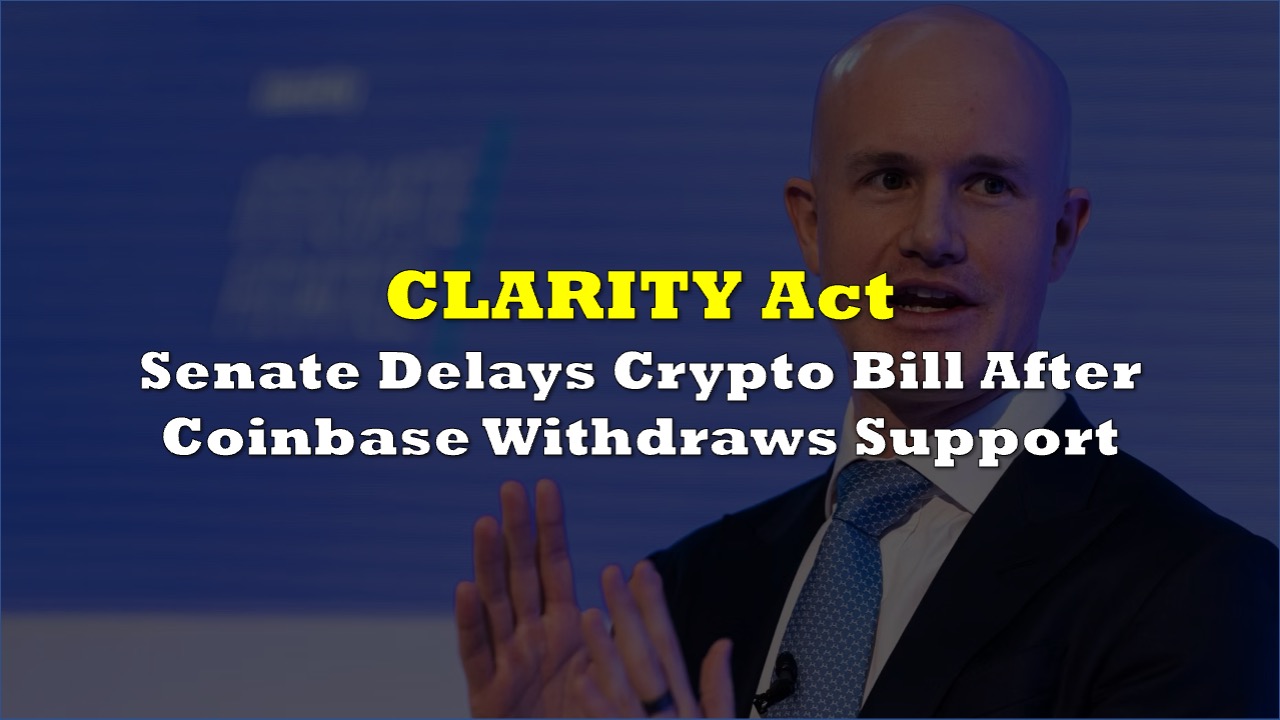

The Senate Banking Committee postponed a scheduled vote on major cryptocurrency legislation on Thursday after Coinbase (NASDAQ: COIN), the largest US crypto exchange, withdrew its support hours before the hearing.
Committee Chairman Tim Scott announced the delay late Wednesday, saying bipartisan negotiations would continue. Scott did not set a new date for the markup session.
I’ve spoken with leaders across the crypto industry, the financial sector, and my Democratic and Republican colleagues, and everyone remains at the table working in good faith.
— Senator Tim Scott (@SenatorTimScott) January 15, 2026
As we take a brief pause before moving to a markup, this market structure bill reflects months of…
The postponement came approximately five hours after Coinbase CEO Brian Armstrong announced his company could not support the bill as written.
“There are too many issues,” Armstrong wrote on X. “This version would be materially worse than the current status quo. We’d rather have no bill than a bad bill.”
After reviewing the Senate Banking draft text over the last 48hrs, Coinbase unfortunately can’t support the bill as written.
— Brian Armstrong (@brian_armstrong) January 14, 2026
There are too many issues, including:
– A defacto ban on tokenized equities
– DeFi prohibitions, giving the government unlimited access to your financial…
The legislation, known as the Digital Asset Market Clarity Act, aims to establish federal regulatory frameworks for cryptocurrencies. The nearly 300-page bill addresses how digital assets are classified and which federal agencies oversee different types of crypto tokens.
Armstrong cited several objections to the bill. He said provisions would effectively ban tokenized equities, restrict decentralized finance platforms, while expanding government access to financial records, weaken the Commodity Futures Trading Commission’s authority relative to the Securities and Exchange Commission, and eliminate rewards on stablecoins.
The stablecoin rewards issue emerged as a central point of conflict between crypto companies and traditional banks. More than 10,000 bankers sent letters to Senate offices calling for restrictions on crypto firms offering interest-like returns on dollar-backed digital tokens.
Apparently the US Senate now answers to the whim’s of Brian Armstrong to enact meaningful regulation on the parasitic crypto grift industry….
— Rho Rider (@RhoRider) January 15, 2026
This is like letting bank robbers make the laws on bank robbery.
The Fox isn’t just guarding the Henhouse now…it bought it. pic.twitter.com/rW7YOrtikB
Banking groups argue these programs could drain deposits from community banks and threaten lending to local businesses and homeowners. Coinbase reported $355 million in stablecoin-related revenue in the third quarter of 2025 and offers a 3.5% yield on its USDC stablecoin.
The Senate draft prohibits crypto platforms from paying rewards for passively holding stablecoins but allows activity-based incentives for transactions, payments or providing liquidity.
Not all crypto industry leaders agreed with Armstrong’s position. Kraken co-CEO Arjun Sethi said he supported the bill. “Walking away now would not preserve the status quo in practice,” Sethi wrote. “It would lock in uncertainty.”
The Digital Chamber, a crypto advocacy group, said it “strongly supports advancing market structure legislation” and remains committed to seeing a bill signed by President Donald Trump this year.
Scott said in his statement that lawmakers from both parties continue working on the legislation. “The goal is to deliver clear rules of the road that protect consumers, strengthen our national security, and ensure the future of finance is built in the United States,” he wrote.
The House passed its own version of crypto market structure legislation in July. Both Senate committees would need to reconcile their bills before a final version could advance to the full Senate and eventually to Trump’s desk.
Analysts at TD Cowen said Armstrong’s withdrawal likely derails the legislation in the current congressional session, calling it “negative for crypto and positive for banks.”
Information for this story was found via the sources and companies mentioned. The author has no securities or affiliations related to the organizations discussed. Not a recommendation to buy or sell. Always do additional research and consult a professional before purchasing a security. The author holds no licenses.