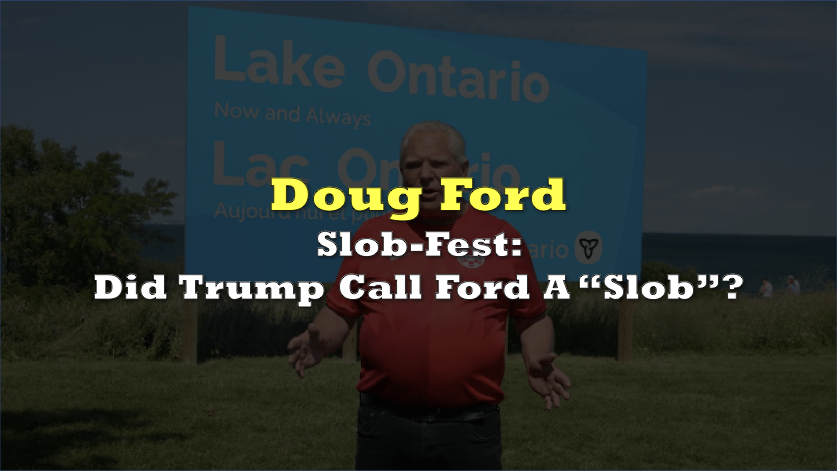

President Donald Trump has seemingly reopened his personal fight with Ontario Premier Doug Ford just days after Ford tried to lower the temperature, folding the insult into a broader warning that the US does not want Canadian-made cars.
Speaking Wednesday while meeting US travel executives, Trump argued that Canada has taken advantage of the US and said American policy should force automobile production back across the border. He then shifted from former Prime Minister Justin Trudeau to Prime Minister Mark Carney, whom he called a “nice guy,” before referring to “the other guy, the slob. I guess some people call him a slob.”
Trump did not name Ford in that sentence. The remark, however, comes after more than a week of direct exchanges between the two leaders.
Ford told Trump to “kiss my ass” on August 24 after the president threatened another round of tariffs. Trump responded by calling Ford a “flunky” and comparing him unfavorably with his late brother, former Toronto mayor Rob Ford.
 Sponsored · Selkirk Copper Mines
The premier subsequently backed away from the escalation. In an ABC News interview aired August 30, he acknowledged that the confrontation had “got heated” and said both countries should focus on reaching a free-trade agreement.
Trump’s latest attack came while again targeting the industry at the center of Ford’s economic exposure. He has threatened to raise tariffs on Canadian cars, trucks, and automotive parts to 50% beginning January 1, 2027.
Statistics Canada estimates that US demand supported 76.4% of Canadian automobile manufacturing payroll jobs in 2024. More than 93% of Canadian motor vehicle exports went to the US.
US-Canada trade negotiations have been suspended since August 21, when Carney said last-minute American demands had become “unfair” and “uneconomic.” The US subsequently imposed 50% tariffs on roughly $28 billion of Canadian goods, with Ottawa preparing matching counter-tariffs.