

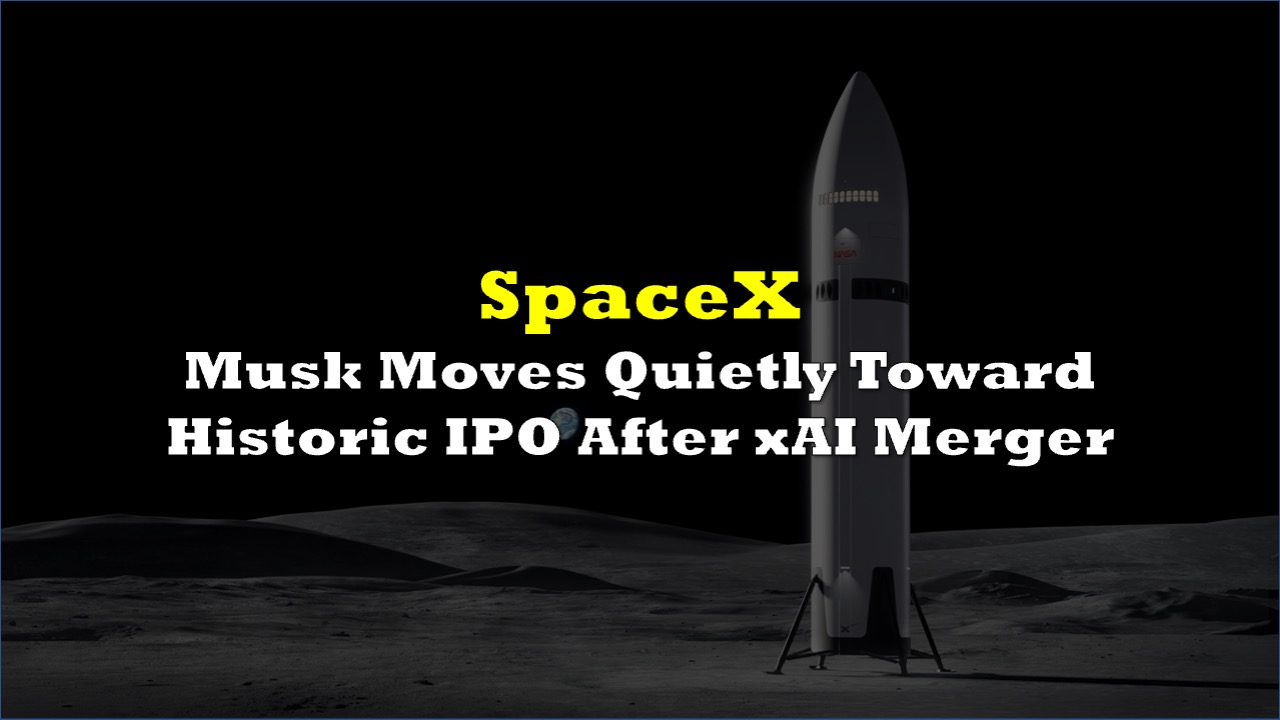

Months before the public knew an IPO was coming, SpaceX was already laying the groundwork. Nevada corporate filings dated January 21, 2026 — signed by SpaceX CFO Bret Johnsen — pointed to structural preparations for a public offering, according to Reuters. The paperwork drew little attention at the time. It does now.
In February, SpaceX confirmed its acquisition of xAI, folding rockets, the Starlink satellite network, and the Grok chatbot under a single corporate umbrella. Under the terms of the deal, xAI shareholders received 0.1433 SpaceX shares for each xAI share held, with some executives offered a cash alternative at $75.46 per share.
The transaction implied a $1.0 trillion valuation for SpaceX and $250 billion for xAI — a combined enterprise valued at $1.25 trillion.
That figure has since grown considerably. Bloomberg reported that SpaceX now targets a valuation exceeding $1.75 trillion in a potential public offering — more than double what the company fetched in secondary share sales just months earlier. The company plans to submit a confidential draft registration to the SEC as early as this month, which would position it for a June market debut.
If it proceeds, the listing would eclipse Saudi Aramco’s 2019 offering as the largest IPO in history and could raise up to $50 billion in primary capital.
SpaceX has retained Bank of America, Goldman Sachs, JPMorgan Chase, and Morgan Stanley for senior underwriting roles, people familiar with the matter said. The company also weighs a dual-class share structure that would preserve Musk’s control over major corporate decisions — a structure that has drawn scrutiny from institutional investors in past high-profile technology listings.
The Starlink business underpins much of the valuation case. The satellite internet service closed 2025 with 9.2 million active subscribers, having doubled its user base in 15 months, and crossed $10 billion in annual revenue.
Analysts at Quilty Space and Bloomberg project the unit generates between $15.9 billion and $24 billion in 2026.
The xAI acquisition repositions SpaceX not just as a launch company but as the funding chassis for Musk’s broader AI ambitions. A successful Starship test launch expected in late March would give institutional investors the technical validation they need before committing to a roadshow.
Information for this story was found via Bloomberg, and the sources and companies mentioned. The author has no securities or affiliations related to the organizations discussed. Not a recommendation to buy or sell. Always do additional research and consult a professional before purchasing a security. The author holds no licenses.







One Response
Ha! What, no comments??