
As part of his relentless tirades on trade relations, President Donald Trump has also set his focus on the automotive sector, calling for steep tariffs as a way to bring car manufacturing jobs back to the US. His most recent remarks target Canada’s car industry, which he accuses of having been built at America’s expense.
“We’re going to put big tariffs on those cars. I don’t want those cars. We can make those cars right here,” Trump said in a Fox News interview. “If you look at Canada, Canada has a very big car industry. They stole it from us. They stole it because our people were asleep at the wheel.”
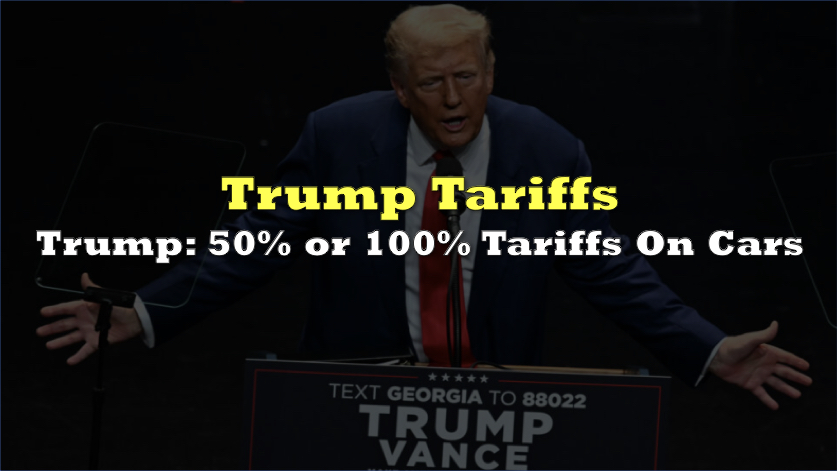
He then warned that if no favorable deal is reached, he would respond with drastic measures, adding that his administration would “put a big tariff on cars” that “could be 50% or 100%.”
 Sponsored · Cambria Gold Mines
“We don’t want their cars. We want to make the cars in Detroit,” he added.
These remarks come as Trump’s trade agenda manifests in China where additional import duties, increased by 10% and with the potential to go higher, now apply to a range of products, including auto parts and accessories. The effect on complete vehicles is limited—Chinese-assembled cars represent only 0.6% of new US vehicle sales—but analysts stress that the real impact is on parts, an area in which imports from China exceed $15-20 billion each year.
Ford Motor (NYSE: F) and General Motors (NYSE: GM) are particularly exposed due to crossovers like the Lincoln Nautilus and the Buick Envision, both produced in China for the US market. Such tariffs place additional pressure on production strategies, sourcing decisions, and ultimately, vehicle prices.
Ford CFO Sherry House noted that the company will “assess the situation” of tariffs on Chinese goods as it unfolds. GM has not provided details about any shifts in its strategy. Others with a smaller manufacturing footprint in China, including Volvo and Polestar, have already adapted their production plans to minimize tariff exposure.
The move could also affect Tesla (NASDAQ: TSLA), the automaker owned by Trump’s efficiency czar, Elon Musk. While the firm primarily builds vehicles for the US market at its facilities in California and Texas, it also maintains a substantial supply chain that extends overseas, including China. The company’s Gigafactory Shanghai produces vehicles mainly for export to markets in Asia and Europe, but Tesla still depends on key components—especially batteries and battery materials—that come from China.
Analysts contend that should the Trump administration impose tariffs on imports from Canada or Mexico—together accounting for roughly 23% of US vehicle sales—consumer prices could climb dramatically. Though tariffs on China are already raising parts costs, any extensive taxes on North American imports might be far more disruptive, given the volume of cars coming from those markets.
Electric vehicles complicate the picture further because while most electric cars sold in the US are assembled domestically, many key components, including batteries, come from China. Models from brands such as Hyundai, Kia, Nissan, Toyota, and Volkswagen often incorporate 20% to 50% Chinese-made parts.
Information for this story was found via CNBC and the sources and the companies mentioned. The author has no securities or affiliations related to the organizations discussed. Not a recommendation to buy or sell. Always do additional research and consult a professional before purchasing a security. The author holds no licenses.