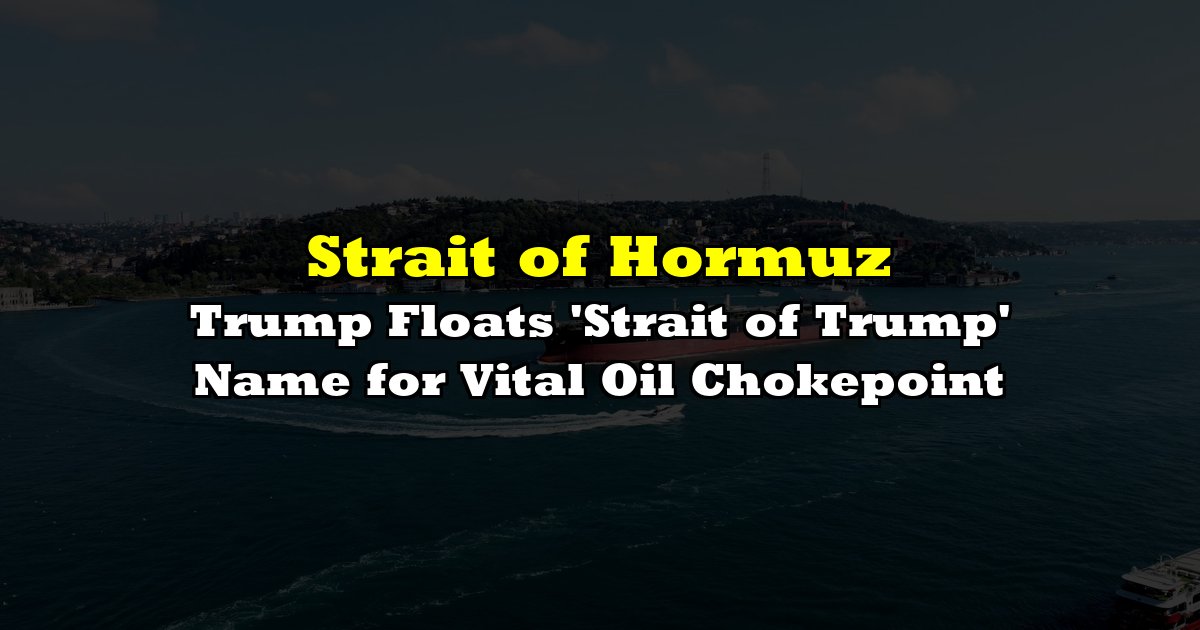

Donald Trump has proposed renaming the Strait of Hormuz, a critical global oil shipping lane, as the ‘Strait of Trump.’ The provocative suggestion, made during a recent public appearance, underscores his penchant for personal branding even in matters of international geopolitical significance.
The Strait of Hormuz, located between Iran and Oman, serves as a conduit for roughly 20% of the world’s oil supply, making it one of the most strategically important waterways on the planet. Trump’s remark, delivered with his characteristic flair, has drawn attention to the already tense dynamics surrounding the region, where U.S.-Iran relations remain a focal point of global concern. His comments come amid ongoing discussions with Iran that he has claimed could lead to ‘guaranteed peace,’ though he has avoided labeling any potential conflict as a ‘war.’
Trump joked about renaming the Strait of Hormuz to the "Strait of Trump," one of the world's most critical oil shipping chokepoints.pic.twitter.com/YJKTayW10o
— The Dive Feed (@TheDeepDiveFeed) March 27, 2026
Beyond the symbolic renaming, Trump’s broader rhetoric on Iran suggests a dual approach of diplomacy and posturing. During a recent Cabinet meeting, he emphasized the potential for dialogue while sidestepping questions about deploying ground troops to the region. This balancing act reflects the delicate nature of U.S. policy toward Iran, especially as military and economic pressures continue to shape interactions in the Gulf.
Market participants are already factoring in the uncertainty. Oil prices have shown sensitivity to geopolitical developments in the Strait, with even rhetorical escalations capable of triggering volatility. Trump’s latest comment, while seemingly offhand, adds another layer of unpredictability to an area where disruptions could have immediate global economic consequences.
Separately, Trump’s domestic messaging on energy remains consistent with his past tactics. His recent promotion of ‘I did that’ stickers on gas pumps, echoing a jab at the Biden administration, signals an intent to tie his political brand to energy policy debates ahead of future electoral cycles.
The Strait of Hormuz handles approximately 21 million barrels of oil per day, a figure that underscores its indispensable role in global energy markets. Any shift in perception—whether through diplomatic breakthroughs or symbolic gestures like a renaming—could ripple through commodity markets in the weeks ahead.
Information for this story was found via the sources and companies mentioned. The author has no securities or affiliations related to the organizations discussed. Not a recommendation to buy or sell. Always do additional research and consult a professional before purchasing a security. The author holds no licenses.