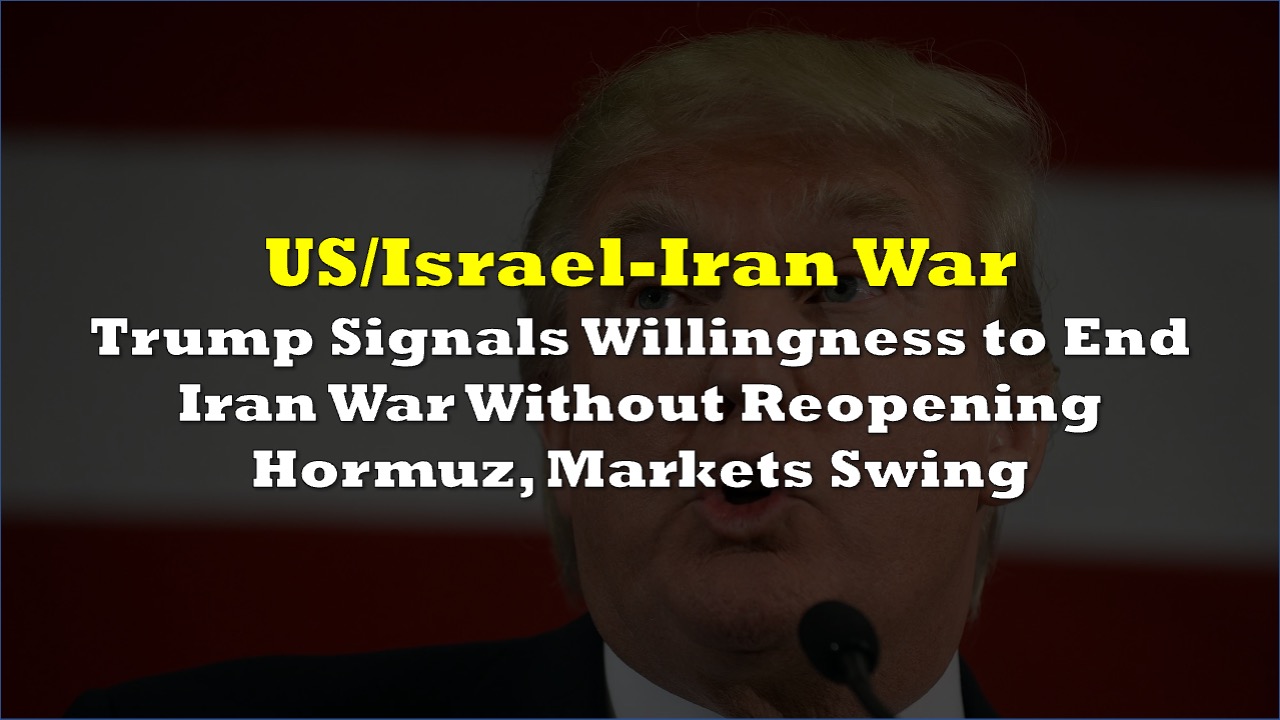

President Donald Trump told aides he is willing to end the US military campaign against Iran even if the Strait of Hormuz remains largely closed, the Wall Street Journal reported March 30, citing administration officials — a potential pivot in war aims that rattled financial markets Tuesday.
Trump and his team concluded that an operation to immediately reopen the strait would push the conflict beyond his preferred four-to-six-week timeline. The administration instead plans to achieve its core objectives — crippling Iran’s navy and missile capabilities — wind down active hostilities, and then pressure Tehran diplomatically to restore free navigation through the waterway.
JUST IN: 🇮🇷 Iranian official says no ship can pass through the Strait of Hormuz without Iran's approval. pic.twitter.com/6uSZxaafsr
— BRICS News (@BRICSinfo) March 31, 2026
If diplomacy falls short, Washington would press European and Gulf allies to lead any effort to reopen the strait, officials told the Journal. Military options remain under active consideration but are not Trump’s immediate priority.
BREAKING: President Trump is willing to end the Iran War even if the Strait of Hormuz remains closed, per WSJ.
— The Kobeissi Letter (@KobeissiLetter) March 31, 2026
Details include:
1. Trump and his aides assessed that a mission to reopen Hormuz would push the conflict beyond his timeline 4-6 weeks
2. Trump believes the US should…
Markets react
News of the potential pivot triggered an immediate response in financial markets Tuesday morning. Nasdaq futures climbed 1.4% within 40 minutes of the report spreading on social media, US crude oil fell 3%, and Bitcoin rose back above $67,000 as traders priced in the prospect of an earlier end to active hostilities.
BREAKING: President Trump Tells Aides He’s Willing to End War Without Reopening Strait of Hormuz, per WSJ
— Bull Theory (@BullTheoryio) March 31, 2026
Market react imediately.
Nasdaq Future up +1.4% in 40 min
US Oil dropped -3%
Bitcooin is Back above $67,000 pic.twitter.com/PelDLVfD6o
Ghalibaf’s pre-market warning
Roughly 16 hours before the WSJ story surfaced on social media, Iranian Parliament Speaker Mohammad Bagher Ghalibaf posted on X warning his 14.2 million followers that pre-market breaking news is “often just a setup for profit-taking.” He advised followers to trade against any market move the news triggers — short if it pumps, go long if it dumps.
Heads-up: Pre-market so-called “news” or “Truth” is often just a setup for profit-taking. Basically, it’s a reverse indicator.
— محمدباقر قالیباف | MB Ghalibaf (@mb_ghalibaf) March 29, 2026
Do the opposite: If they pump it, short it. If they dump it, go long.
See something tomorrow? You know the drill.
Trump confirmed March 30 that Washington has been engaging with Ghalibaf, calling him part of a “more reasonable regime.” The speaker has publicly rejected that characterization — on March 29, he stated that Iran could not be forced into submission, and on March 30 he accused Washington of using diplomacy as cover for a planned ground invasion.
The enemy promotes its desires as news while threatening our nation at same time. Big Mistake. If they hit one,they'll take several back.
— محمدباقر قالیباف | MB Ghalibaf (@mb_ghalibaf) March 30, 2026
God willing, the people of Iran,under the leadership of the Supreme Leader,will make the enemy regret the aggression and reclaim their rights.
The 64-year-old hardliner and former Islamic Revolutionary Guard Corps commander has served as speaker of Iran’s Parliament since 2020 and has emerged as a key power node after Israeli strikes eliminated much of Iran’s senior leadership.
Trump realising he was talking to a pakistani scammer this whole time not an Iranian negotiator. https://t.co/onVBUqh2Lu pic.twitter.com/dKB1fUcwWX
— Mr Melancholy (@chakravartiiin) March 30, 2026
Gulf states push back
The Associated Press reported Monday that Gulf states — particularly the UAE, Kuwait, and Bahrain — urged Trump to continue military operations until Iran no longer poses a strategic threat to the region, arguing the campaign has not yet weakened Iran enough after nearly a month of strikes.
The UAE, which has absorbed more than 2,300 missile and drone attacks from Iran, has pushed hardest for sustained operations and has called for a ground invasion. Saudi Arabia separately argues that ending hostilities now would fall short of a deal that can guarantee long-term regional security.
Netanyahu floats pipeline alternative
Israeli Prime Minister Benjamin Netanyahu proposed March 30 that a long-term solution to the Hormuz crisis may not require military action at all. In an interview with Newsmax, Netanyahu suggested rerouting Gulf state energy pipelines westward across Saudi Arabia to the Red Sea and Mediterranean — bypassing the Iranian chokepoint entirely.
Read: Saudi Pipeline Achieves 7 Million Barrels Per Day, Redefining Oil Export Routes
Deadline looms
Trump had previously set an April 6 deadline for Tehran to reopen the strait or face strikes on Iranian energy and water infrastructure. Iran has rejected those demands and continued attacking regional shipping — on Tuesday, a Kuwaiti crude tanker took a direct hit while anchored at Dubai port, sparking a fire onboard. Kuwait Petroleum Corporation said the vessel was fully loaded at the time and warned of a potential oil spill.
Iran has hit a fully laden Kuwaiti oil tanker in the anchorage area of Dubai’s port, damaging the hull and starting a fire on board, state-run Kuwait Petroleum Corporation said https://t.co/z0pPgEwdwx
— Javier Blas (@JavierBlas) March 31, 2026
Information for this story was found via the sources and companies mentioned. The author has no securities or affiliations related to the organizations discussed. Not a recommendation to buy or sell. Always do additional research and consult a professional before purchasing a security. The author holds no licenses.