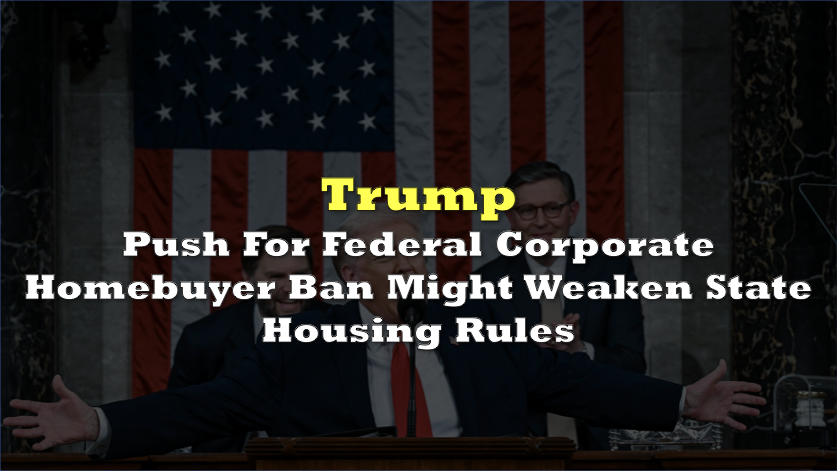

President Donald Trump’s demand that Congress ban Wall Street from buying up single-family homes would, based on the draft legislation, not amount to a blanket prohibition on corporate ownership but rather a federal framework centered on ownership thresholds, carveouts, and possible limits on state enforcement.
In his State of the Union remarks, Trump framed the policy as a defense of homeownership, saying large investment firms were outbidding families with cash offers and converting homes into rentals. He cited Rachel Wiggins of Houston, who he said placed bids on 20 homes and lost all 20 to major investors.
“She was devastated. Stories like this are why last month I signed executive order to ban large Wall Street investment firms from buying up in the thousands, single-family homes. And now I’m asking Congress to make that ban permanent because homes for people — really, that’s what we want. We want homes for people, not for corporations,” Trump said in the speech.
In state of the union speech, Trump called for Congress to ban Wall St from buying up single family homes.
— Luke Goldstein (@lukewgoldstein) February 25, 2026
The GOP bill now being sent around is actually a federal preemption blocking states from doing exactly that.
We got a draft of the bill: pic.twitter.com/whnix7Njes
Legislative drafts
The draft legislative language is materially narrower than that rhetoric. Sen. Bernie Moreno’s proposal would reportedly prohibit institutional investors from owning more than 100 single-family homes, which is not a total ban on corporate purchases and instead functions as a cap.
The biggest policy implication is federal preemption. One draft would bar any state or locality from imposing its own restrictions on institutional investors buying single-family homes. If enacted in that form, the bill would not just regulate corporate landlords at the federal level, but it would also strip states and cities of the ability to enact tougher restrictions than Washington.
A second draft reportedly softened that provision. Instead of blocking all state and local action, it would preempt only “less restrictive” rules, meaning stronger local regulations could theoretically survive.
At least 38 bills are moving through 18 state legislatures to limit institutional investors and private equity in housing. Those state efforts range from outright bans on large investment firms owning single-family homes to cutting off government support for those investments. The federal draft’s 100-home cap appears less restrictive than many of those state proposals, so a broad preemption clause could replace tougher state rules with a weaker national standard.
Exemptions
The practical impact also depends on the bill’s exemptions. Both draft versions reportedly exempt build-to-rent homes, which are single-family developments specifically designed as rentals. That carveout is important because build-to-rent is one of the fastest-growing segments of the housing market. Excluding it would leave a major lane open for large real estate firms to keep expanding single-family rental exposure even while a nominal “ban” is in place.
A second exemption covers investment firms offering a “homeownership program,” the lease-to-own style arrangements in which renters lease a home for a set period before purchasing it. Critics argue these models have often failed to convert renters into owners and can include burdensome terms, including repair obligations shifted to tenants.
Invitation Homes, described as the nation’s largest corporate landlord, owns 86,000 housing properties nationwide and already offers a homeownership program of this kind. Since the reported cap is 100 single-family homes, firms using exempted structures or qualifying programs could preserve significant exposure that the headline politics suggest would be eliminated.
Trump’s executive order was the administration’s first move to block large Wall Street investment firms from buying single-family homes “in the thousands,” but it appears narrower than the headline suggests because it already included carveouts, including for build-to-rent developments. In practice, the order set the policy direction and framed the issue politically, while the real market impact would depend on how federal agencies implement it and whether Congress codifies it into law.
Information for this briefing was found via The Lever and the sources and the companies mentioned. The author has no securities or affiliations related to this organization. Not a recommendation to buy or sell. Always do additional research and consult a professional before purchasing a security. The author holds no licenses.