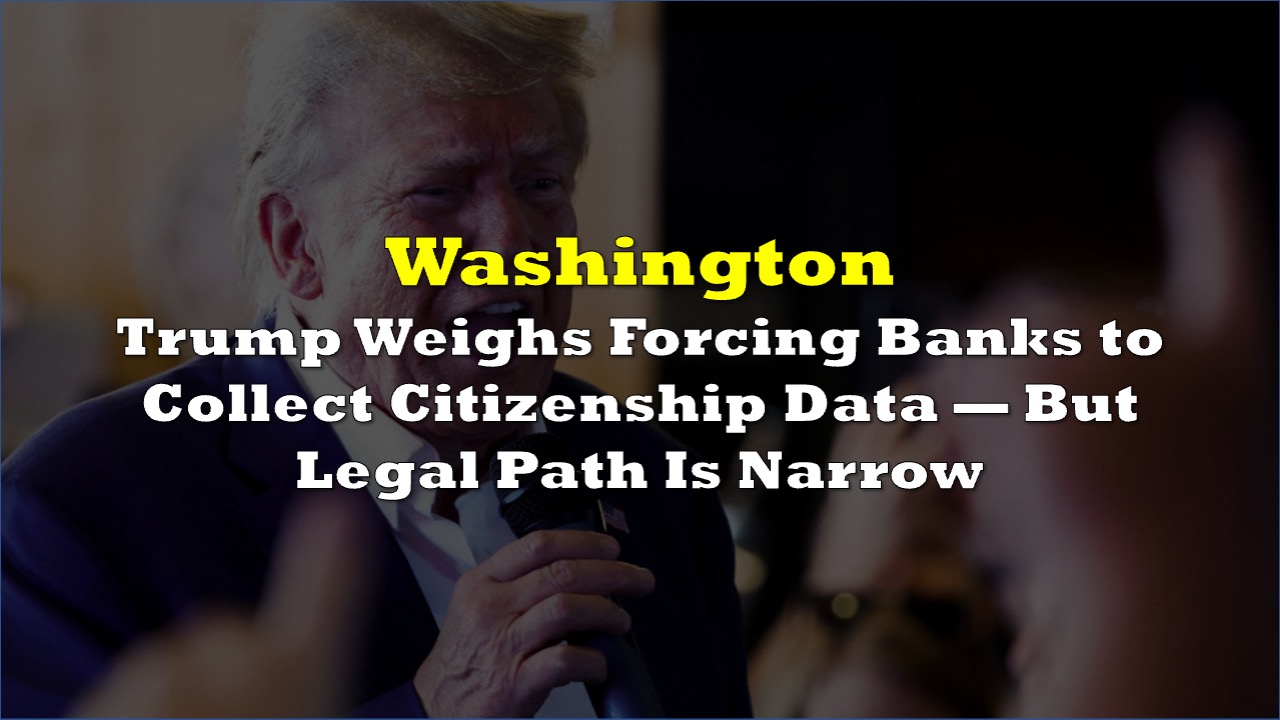

The Trump administration is considering an executive order that would require banks to collect citizenship information from all customers, a move that legal experts say faces serious constitutional obstacles fresh off a Supreme Court rebuke of the president’s executive authority.
The Wall Street Journal first reported the potential action on Tuesday, February 24, citing people familiar with the matter. The White House called coverage of unannounced policymaking “baseless speculation.”
Under the proposal, banks would solicit documents such as passports from both new and existing customers. The administration is also weighing whether to involve the Treasury Department’s Financial Crimes Enforcement Network in collecting the data.
It remains unclear whether the order would mandate data collection alone or go further, directing banks to close accounts for customers who cannot provide documentation.
A financial industry source told CNN the plan is “a bad idea” and “very alarming,” adding that “verifying every bank customer’s citizenship status would be unworkable.” Roughly half the US population does not hold a valid passport.
The proposal arrives days after the Supreme Court’s 6-3 ruling that Trump exceeded his authority when he imposed sweeping tariffs under the International Emergency Economic Powers Act.
In Learning Resources, Inc. v. Trump, decided on February 20, Chief Justice John Roberts wrote that the president “must identify clear congressional authorization” before exercising broad economic powers — and found none existed under IEEPA.
Read: More Trump tariffs coming after Supreme Court decision
The court’s majority applied the “major questions doctrine” — the principle that consequential policy decisions require explicit congressional backing, not an implied executive grant.
That same standard now looms over a potential banking mandate. Under existing “know your customer” rules, financial institutions already collect identifying information to combat money laundering, but citizenship verification is not among them.
Chi Chi Wu, an attorney at the National Consumer Law Center, told Axios that any regulatory change would require the administration to go through the Administrative Procedure Act — a process that takes one to two years and invites legal challenges. Wu also cited the Right to Financial Privacy Act, which bars the government from requesting financial records without legal process, such as a subpoena.
The banking proposal is the latest move by the administration to restrict immigrant access to financial services. Earlier this month, the Small Business Administration blocked all non-US citizens and nationals from its primary 7(a) loan program.
Xi Huang, a professor at the University of Central Florida who studies immigration policymaking, told Axios that cutting immigrants off from the banking system could limit banks’ ability to invest locally — a ripple effect that would extend well beyond the immigrant community itself.
Information for this story was found via the sources and companies mentioned. The author has no securities or affiliations related to the organizations discussed. Not a recommendation to buy or sell. Always do additional research and consult a professional before purchasing a security. The author holds no licenses.