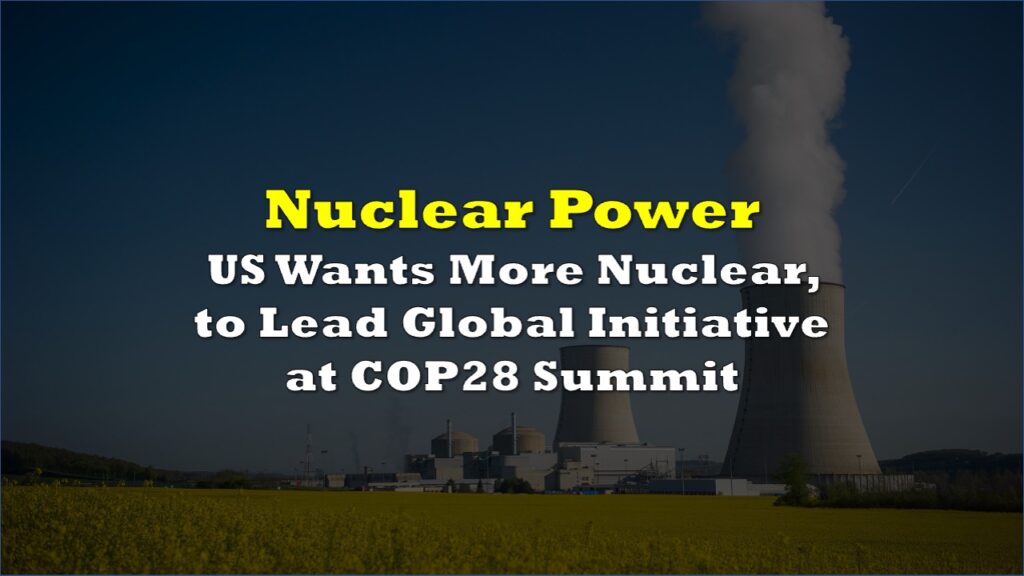

The U.S. Department of Energy is offering $17.5 billion in conditional loans to help build 10 new large-scale nuclear reactors, with construction targeted to begin by 2030 with power to begin flowing in the mid-2030s.
The move is designed to shave up to three years off the development timeline and drive down costs by rebuilding a domestic nuclear supply chain that has largely gone dormant.
Rather than acting as construction loans, the funding will be used to purchase long-lead components such as reactor vessels and steam generators, parts that can take years to procure and have historically been a bottleneck for large nuclear projects.
 Sponsored · Cambria Gold Mines
The DOE’s Office of Energy Dominance Financing will back up to five loans, each supporting two 1.1-gigawatt Westinghouse AP1000 reactors at a single site, for a combined output capable of powering nearly 10 million homes.
Surging electricity demand, fueled by the rapid expansion of AI data centers, is a central driver of the program’s urgency. Government estimates put data center electricity consumption at roughly 4% to 5% of the national total in 2024, a figure that could approach triple that level before the decade is out.
Energy Secretary Chris Wright pointed to strong interest from data center hyperscalers, the tech giants behind global cloud infrastructure, as a key factor underpinning the program’s commercial case.
Seven utility and energy company partners have each signed letters of intent with Westinghouse, with project sites already identified, though the DOE declined to name them or their locations until formal selections are made. Five projects will ultimately be chosen.
Ownership of each plant will be shared between Westinghouse and its utility partner, with both sides required to commit $500 million in equity upfront before accessing federal funds, totalling $1 billion per project in private capital. Funding meanwhile is expected to be limited to $3.5 billion per project.
The AP1000 design is the only licensed large-scale advanced commercial reactor operating in the U.S. today, but its track record is complicated. At Georgia Power’s Plant Vogtle, the only ground-up reactor construction completed in the U.S. in recent decades, the project finished years late and billions over budget. Wright attributed those overruns to poor planning, supply chain gaps, and pandemic disruptions, and argued that building simultaneously across multiple sites will generate the expertise and efficiencies that Vogtle lacked.
Brookfield Asset Management CEO Connor Teskey, whose firm co-owns Westinghouse alongside Cameco, said the loans “serve as a catalyst for nuclear, providing the certainty needed to enhance the domestic nuclear supply chain and accelerate construction of nuclear projects that will deliver reliable baseload power around the country for decades to come.”
The program aligns with President Trump’s goal of quadrupling U.S. nuclear capacity to 400 gigawatts by 2050. Critics have argued that new nuclear remains too expensive and slow relative to renewables and natural gas, but the administration is betting that volume construction can change that calculus.
Information for this story was found via the sources and companies mentioned. The author has no securities or affiliations related to the organizations discussed. Not a recommendation to buy or sell. Always do additional research and consult a professional before purchasing a security. The author holds no licenses.