

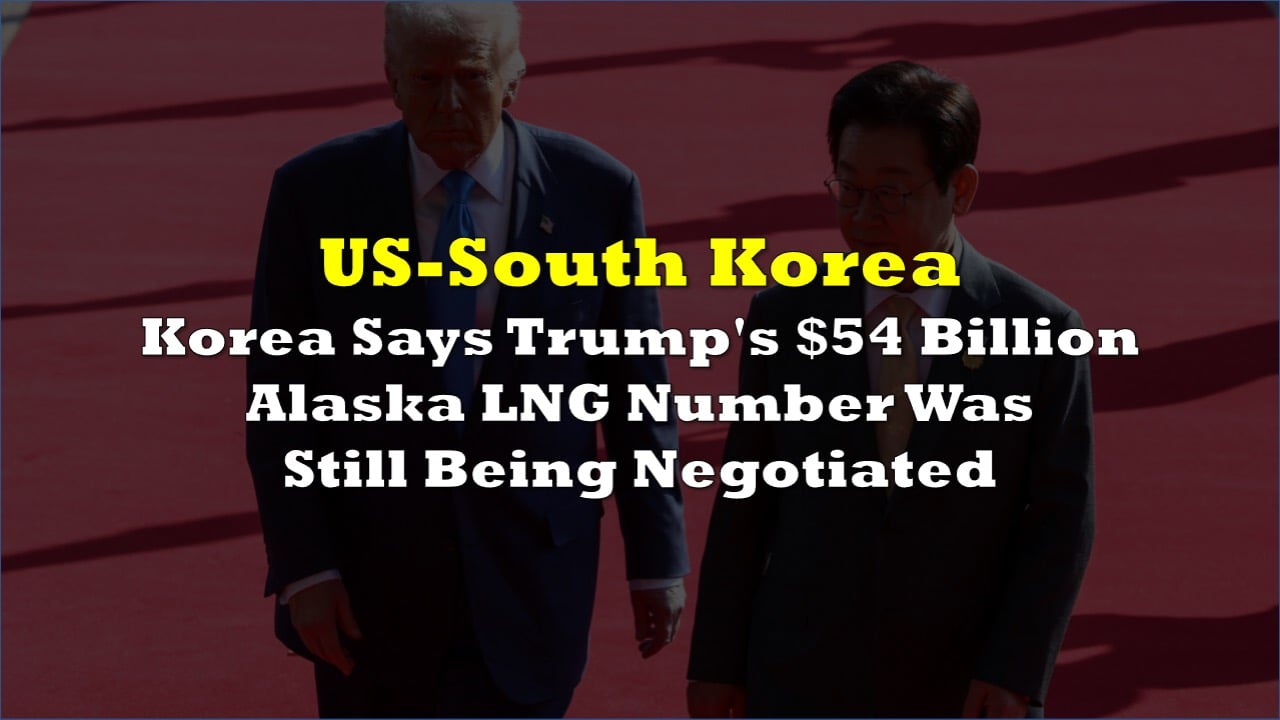

Private talks between Washington and Seoul had floated figures as high as $67 billion for South Korea’s Alaska LNG commitment, Industry Minister Kim Jung-kwan now says. That figure is well above the $54 billion US President Donald Trump announced at the White House this week as part of a broader $200 billion Korean package for US energy projects, and above Commerce Secretary Howard Lutnick’s earlier “exceed $50 billion” claim. Kim called the swing itself telling, saying “the US side itself does not yet have a firmly established project.”
Glenfarne, the project’s developer, has only about 13 million tons of its planned annual output under sales agreements, most of them nonbinding. Securing financing requires at least 16 million tons in firm, binding contracts, a shortfall of roughly 3 million tons the company has yet to close.
Korean law also caps the government’s own annual US investment at $20 billion against a $200 billion overall ceiling, with funding arriving in stages tied to project milestones, and Seoul secured a provision shielding it from US tariff retaliation if it walks away over viability concerns.
 Sponsored · Cambria Gold Mines
The two governments staged Wednesday’s announcements differently. Trump unveiled the figure at the White House with more than a dozen aides and corporate executives standing alongside him, while Kim delivered Seoul’s version alone, at a subdued televised briefing, hours after personally objecting to how Lutnick described the deal.
Kim said that Washington wants the political upside for Alaska while “Korea’s interest is in recovering the principal and interest on its investors’ money.”
Alaska LNG is one piece of a much larger package, and the only piece that’s still in dispute. Seoul and Washington agreed Korea would invest in eight nuclear reactors, six Westinghouse AP1000 units and two of Korea’s own APR1400 design, using up to $120 billion in Korean funds, while Korean firms separately pursue a 5% to 10% ownership stake in Westinghouse.
Korea has also finalized a $22.3 billion stake in an Encinal, Texas, gas-fired power plant project, with developers forecasting returns of 15% or better, as much as $45 billion over two decades.
ExxonMobil, BP and ConocoPhillips worked on an earlier version of the project through the mid-2010s before all three pulled out in 2016, pointing to the economics having turned against it. Financing deals have also fallen through with Canada in 1977, Japan in 1988, and China’s Sinopec in 2017, over nearly 50 years of on-and-off attempts to build the pipeline.
Notably, Trump has cast the investment as a win for Republican incumbent Dan Sullivan, who faces Democrat Mary Peltola in November. He used the same event to attack a third candidate on the ballot, a retired Petersburg schoolteacher who shares Sullivan’s exact name, calling him “a disgraceful fraud.” That candidate, a registered Republican from Petersburg, says he entered the race on his own, with no evidence tying his campaign to Democratic operatives.
State Senator Scott Kawasaki remains skeptical that any of this will become real money before any party signs a contract, comparing Trump’s pledge to past Alaska promises that never fully materialized.


One Response
Deal with real people in Canada…