

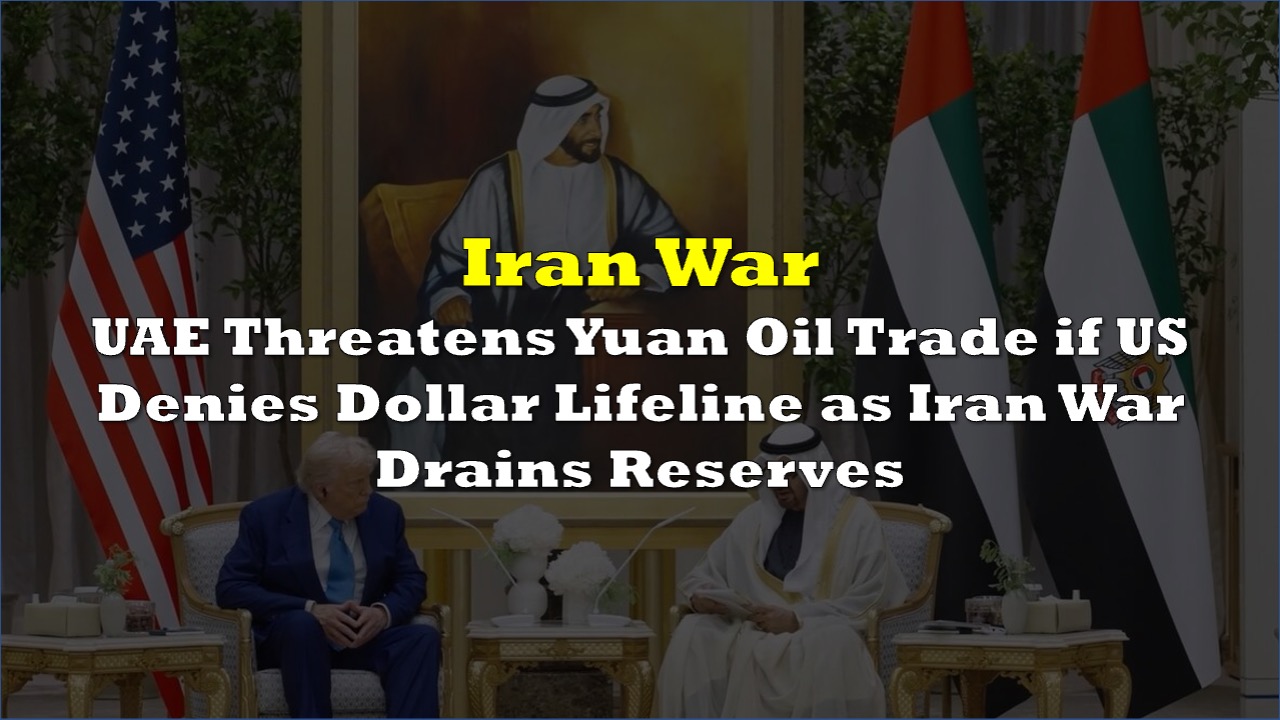

The United Arab Emirates has opened talks with Washington about a dollar liquidity backstop — and warned that without one, it may shift oil and gas transactions to Chinese yuan, according to the Wall Street Journal.
Central Bank Governor Khaled Mohamed Balama brought the proposal to Federal Reserve officials and Treasury Secretary Scott Bessent in Washington last week, the Journal reported. Abu Dhabi’s position, relayed through multiple officials: the war has strained its finances, dollar reserves could come under pressure, and if Washington does not provide a liquidity facility, the UAE may have little choice but to settle oil and gas trades in yuan or other non-dollar currencies. Emirati officials also told their US counterparts that Trump’s decision to attack Iran was what drew the country into the conflict to begin with. No formal application for a swap line has been submitted.
The mechanism being discussed — a bilateral currency swap with the Federal Reserve — would allow the UAE Central Bank to draw down dollars against dirhams at the prevailing exchange rate, effectively insuring against a hard-currency crunch without requiring emergency asset sales.
 Sponsored · Selkirk Copper Mines
The Fed currently holds standing arrangements of this kind with five central banks: the European Central Bank, the Bank of Canada, the Bank of England, the Bank of Japan, and the Swiss National Bank. Extending one to the UAE would mark a meaningful expansion of the Fed’s wartime financial commitments.
What makes the yuan threat credible is that the UAE does not need to build new infrastructure to act on it. The country is a founding member of mBridge, a multi-central bank digital currency platform linking China, the UAE, Hong Kong, and Thailand that had settled more than $55 billion in transactions by late 2025 — operating entirely outside the SWIFT network.
The UAE has already completed its first yuan-denominated LNG trade with China, and annual bilateral non-oil commerce between the two countries now exceeds $50 billion. Pivoting a share of oil settlement to yuan would be a policy choice, not an engineering problem.
The broader stakes are the petrodollar system itself — the arrangement struck in 1974 under which Gulf states committed to dollar-denominated oil pricing and channeled surplus revenues into US Treasuries, in return for American security guarantees.
That agreement created a self-reinforcing loop of global dollar demand that has underwritten US deficit financing ever since. The system has been fraying at the edges: Saudi Arabia quietly let its exclusive dollar-pricing commitment lapse in June 2024 and has since developed yuan settlement infrastructure, including a bilateral currency swap with China worth $7 billion and full participation in mBridge. The UAE’s ultimatum suggests the war is compressing a slow structural shift into something faster.
The UAE’s immediate economic pressure is real. The country has absorbed more than 2,800 missiles and drones since US-Israeli strikes on Iran began on February 28, sustained damage to energy infrastructure, and watched oil revenues evaporate as the Strait of Hormuz closure severed its primary dollar earnings channel — including throughput at Jebel Ali, one of the world’s largest cargo ports.
The war has drained roughly $50 billion in Gulf oil revenues since February 28, with more than 500 million barrels knocked out of global supply at an average price of around $100 a barrel, according to Kpler senior crude analyst Johannes Rauball in a Reuters report.
Information for this story was found via the sources and companies mentioned. The author has no securities or affiliations related to the organizations discussed. Not a recommendation to buy or sell. Always do additional research and consult a professional before purchasing a security. The author holds no licenses.




One Response
LOL shallow reactionary sophomoric translations suck.
Psalms 58: 1-8, 10 does not compare to Moshe struggling with his own Yatzir Ha’Ra together with the survivors of the Wilderness generations who both endured death and exile from the oath sworn lands of Canaan. The mitzva of Yovel and the pursuit of justice go hand in glove. Only in conquered Canaan where a free Independent Israelite nation rules the land can there exist “justice”. Even in the land of Canaan, whenever foreign kingdoms conquer the land and rule it, neither the Yovel כלל or the Justice פרט apply.
Goyim never accepted the Torah vision of justice at Sinai. Hence despite their “Courts of Law”, just as the Court of Par’o validated beating Israelite slaves for their failure to meet their daily quota of brick production so to all the Goyim courts throughout history ever once forced either the Church or Mosque to stand before the Bar and address their violent war crimes.
Psalm 59: 1-4, 9, 17 communicates emotional themes during times of peril. Numbers 20 re-introduces the Central “Curse” theme of the Torah – g’lut. G’lut as the negative Torah key theme opens with the expulsion of Adam from the garden, the exile of Noach in the Ark, the scattering of the people who built the Tower of Bavel, the destruction of Sodom, the exile of the sons of Yaacov to Egypt and the ensuing slavery that followed thereafter. Numbers 20, reintroduces this, the Central negative Torah theme of g’lut; which comes from the Evil Inclination known as ערב רב who came out of Egypt and reject – to this day – the revelation of the Torah at Sinai. The ערב רב by Torah definition: אין להם יראת אלהים. These assimilated and intermarried Jews – no different from Goyim – who likewises reject and do not accept the revelation of the Torah at Sinai לשמה – the first and Greatest Sinai commandment which defines the whole of the revelation of the Torah. ערב רב and Goyim have no brit inheritance not to the Avot as the fathers of the chosen Cohen people nor to the land inheritance given to the chosen Cohen people – the brit descendants of the Avot.
_______________________________________
_______________________________________
Your foreign book of James fails. Written some 1500 years after the revelation of the Torah at Sinai, it shares no connection to the Torah because Goyim never accepted the Torah at Sinai revelation. Plus, the book of James addresses Goyim concepts of spirituality — not Jewish visions of Sanhedrin courtroom common law justice. Your apostle Paul fails to distinguish Torah common law judicial justice from Greek & Roman statute law decrees. T’NaCH Prophets, follow and compare to Moshe as a Torah prophet. Aaron and his House anointed Moshiach, whereas Moshe through Torah prophetic mussar serve as the model for later prophets who functioned as the chief enforcers of Sanhedrin courtroom judicial rulings of justice. The foreign idea that prophets predict the future, and therein “fulfill Torah commandments”, confuses witchcraft with prophesy. Torah prophets command mussar to all living generations of the chosen Cohen people. Bil’aam predicted the future as the definition of his foreign prophesy.
Hence the NT jargon of “fulfilling the words of the prophets” as off as Muhammad’s declaration that prophets sent to all Goyim and spoke in the tongue of these Goyim – who reject the revelation of the Torah at Sinai. The Koran, for example, declares that the Jews changed the Torah and replaced Yitzak for Yishmael at the Akadah. However, the Koran fails to show this theme where HaShem choses his Cohen people, rather than first born birth! The concept recorded twice in the opening kre’a shma blessing תמיד מעשה בראשית, understood that wisdom commandments “create” the chosen Cohen people rather than race. The “human race” shares a 98.7% genome match with Apes. Starting with Cain, through the rejection of Esav and even the first born of Israel! The still later Koran and the NT, both fail to distinguish: that korbanot exist as Torah time-oriented commandments which require k’vanna – based upon the rejection of Cain’s positive commandment and acceptance of Hevel’s wisdom commandment!
This fundamental Shabbat/Chol distinction both alien spiritualities universally fail to discern the distinction between Primary wisdom Torah commandments from secondary positive and negative Torah commandments – which serve as precedents to derives the k’vanna of wisdom commandments. Its the latter wisdom commandments which obey the Creation story whose משל metaphor of creation in 6 days – introduces the subject of wisdom time-oriented Primary Torah commandments. The Torah commands not to do מלאכה – create מלאכים – on shabbat. The Torah דיוק\inference, that the 6 days of Chol/shabbat dedicate wisdom time-oriented Primary commandments and on the last day of the week (also called shabbat, like all Torah commandments wisdom vs positive & negative secondary precedents – equally called “commandments”).