

Although the US has been adamantly reopening its economy and lifting restrictions across many states, with the US president even threatening to cut funding to schools that do not reopen for the upcoming school year, the country’s coronavirus cases continue to rise at record levels.
According to data collected by John Hopkins University, Wednesday saw a total of 60,021 new coronavirus cases within a span of 24 hours. Almost half of all new cases in recent days have been originating from a select few states, including Texas, Arizona, Florida, and California, with the potential for an even further daily increase following the July Fourth long weekend.
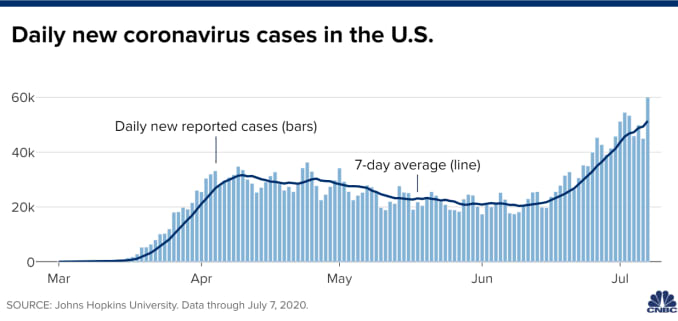
However, the actual number of new infections are most likely going underreported. According to the Centers for Disease Control and Prevention’s Director Robert Redfield, there are a lot of Americans that may have the virus, but are asymptomatic and refrain from getting tested. As a result, the US is more likely only able to diagnose 1 out of every 10 cases, despite the US president boasting about a significant increase in testing.
 Sponsored · Selkirk Copper Mines
The US has in fact significantly increased coronavirus testing from an average of 174,000 daily tests in April, to over 650,000 daily tests as of July. Nevertheless, according to data collected by the Covid Tracking Project, the percentage of positive tests are also on the rise simultaneous to the increase in testing, thus suggesting that the virus has been spreading quicker than previously assumed.
Despite cases soaring across the US, the death rate has remained relatively low. According to Dr. Fauci, the reduction in coronavirus-related deaths can be attributed to an increase in the quality of hospital care for patients, as well as the emerging success of various treatment strategies. In addition, the highest infection rates have thus far been concentrated among the younger age groups, which tend to be more resilient in terms of overcoming the infection. However, the younger age groups also increase the risk of passing the virus onto the elderly and the most vulnerable, which would in turn increase the death rate once again.
Information for this briefing was found via CNBC and John Hopkins University. The author has no securities or affiliations related to this organization. Not a recommendation to buy or sell. Always do additional research and consult a professional before purchasing a security. The author holds no licenses.