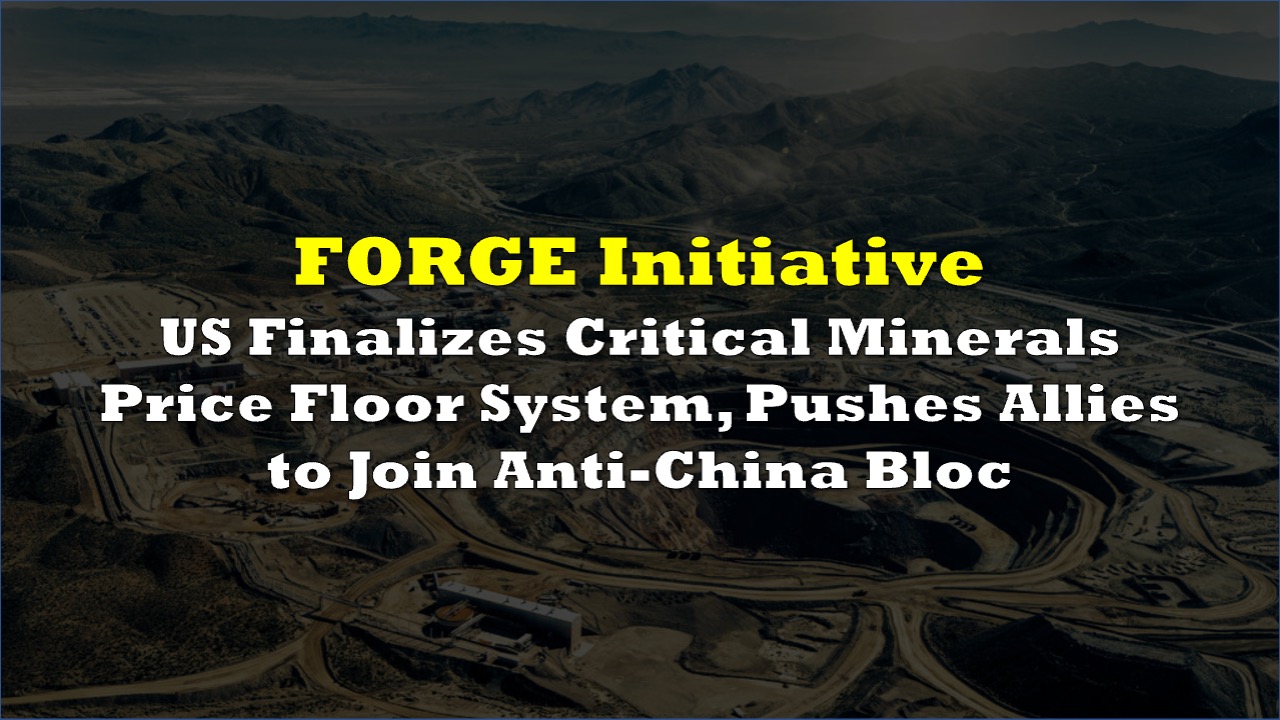

The Trump administration has completed a price floor framework for critical minerals and is actively pitching it to allied governments, as Washington accelerates efforts to reduce Western dependence on China’s grip over resources essential to modern defense, technology, and energy infrastructure.
Under Secretary of State for Economic Affairs Jacob Helberg confirmed on February 18 that multiple US agencies developed the system and have opened discussions with partners worldwide, Bloomberg reported. The disclosure arrives two weeks after the administration convened a landmark gathering at the State Department that drew officials from more than 50 nations.
The US has developed a critical minerals price floor system that it’s pitching to allies as the Trump administration and more than 50 countries look to reduce dependence on China https://t.co/xffnDf3Zp0
— Bloomberg (@business) February 17, 2026
Secretary of State Marco Rubio hosted the February 4 Critical Minerals Ministerial, where Vice President JD Vance introduced the Forum on Resource Geostrategic Engagement (FORGE) — a proposed preferential trade zone anchored by coordinated price floors. “We will establish reference prices for critical minerals at each stage of production,” Vance said. “For members of the preferential zone, these reference prices will operate as a floor maintained through adjustable tariffs to uphold pricing integrity,” CNBC reported.
The EU, Japan, and Mexico each reached new agreements with Washington that incorporate the price floor mechanisms, broadening the coalition’s early footprint. FORGE follows an earlier plurilateral initiative called Pax Silica, which focuses specifically on AI-related supply chains, the Council on Foreign Relations noted. Across both efforts, the US government has announced more than $30 billion in direct funding commitments tied to critical minerals over the past six months.
The scale of Western vulnerability helps explain the urgency. The US is fully import-dependent for 12 critical minerals and relies on foreign sources for more than half its consumption of 29 others, the Center for Strategic and International Studies found. The CSIS analysis also notes that Trump signed an executive order on January 15 directing the Commerce Department and the US Trade Representative to pursue bilateral agreements on processed minerals and explore price support mechanisms as a matter of national security.
Related: US Grew More Reliant on Mineral Imports in 2025, Reversing Two-Year Decline
China controls refining capacity for 19 of 20 minerals essential to clean energy and advanced technology manufacturing — dominance that took decades of strategic investment to build. Washington accuses Beijing of suppressing global mineral prices to undercut competitors before they gain scale, an allegation Vance addressed at the ministerial without naming China directly.
To provide immediate market stability, Trump launched Project Vault on February 3 — a $12 billion stockpile reserve backed by $10 billion from the US Export-Import Bank and $2 billion in private capital — designed to shield domestic manufacturers from cheaper Chinese imports.
But the initiative’s biggest vulnerability may not be China — it may be Washington itself. Coordinated price floors across 50-plus countries and dozens of minerals face untested WTO exposure and enormous implementation complexity.
More corrosively, the Peterson Institute for International Economics argues that allies must now factor US geopolitical risk into their supply chain math alongside Chinese risk — a calculation that Trump’s tariff policies and Greenland posturing have made sharper.
Information for this story was found via Bloomberg, CNBC, Council on Foreign Relations, Center for Strategic and International Studies, Climate Home News, Al Jazeera, Peterson Institute for International Economics, and the sources and companies mentioned. The author has no securities or affiliations related to the organizations discussed. Not a recommendation to buy or sell. Always do additional research and consult a professional before purchasing a security. The author holds no licenses.