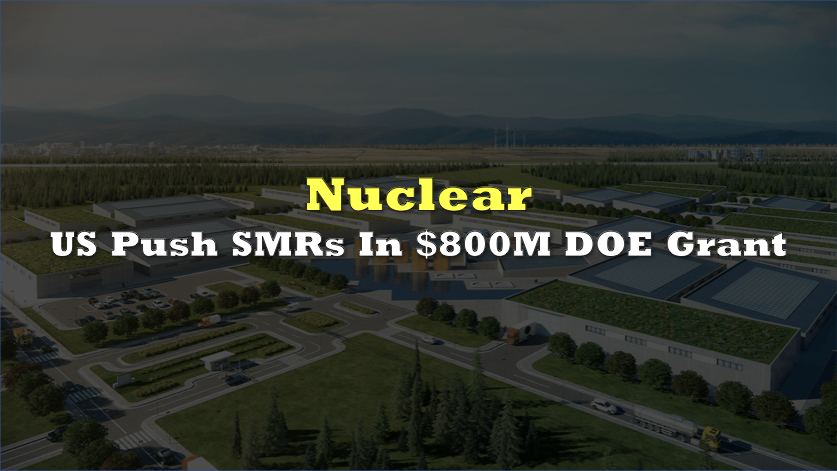

The US is advancing more nuclear efforts after the Energy Department selected Tennessee Valley Authority and Holtec Government Services for early deployments of advanced light-water SMRs, with project teams eligible for up to $800.0 million in federal cost-shared funding tied to initial projects in Tennessee and Michigan and positioned for follow-on builds and supply-chain expansion.
The award structure is symmetrical with $400.0 million for each entity, framed as support for the first domestic Gen III+ SMR plants, with DOE also pointing to a wider program pipeline launched via a $900.0 million March 2025 solicitation and a further $100.0 million still to be awarded later this year.
TVA’s funded scope is anchored on deploying a GE Vernova Hitachi BWRX-300 at the Clinch River Nuclear site in Tennessee, while also accelerating additional units with Indiana Michigan Power and Elementl, which implies a build plan that is not limited to a single first-of-a-kind unit.
On execution, TVA’s plan is paired with named domestic nuclear supply-chain partners Scot Forge, North American Forgemasters, BWX Technologies, and Aecon Group (TSX: ARE), plus additional supporting partners including Duke Energy, Oak Ridge Associated Universities, and Electric Power Research Institute.
Holtec’s funded scope is more explicit on unit count: it plans to deploy two SMR-300 reactors at the Palisades Nuclear Generating Station site in Covert, Michigan, with DOE describing the build as a demonstration of viability intended to enable additional orders “both domestically and abroad.”
Holtec’s go-to-market model is positioned as vertically integrated: it intends to act as technology vendor, supply chain vendor, and plant constructor in partnership with Hyundai Engineering & Construction, then as operator and electricity merchant selling power to nearby utilities and end-users.
DOE is not subtle about the demand thesis it is using to justify speed. Secretary Chris Wright tied SMR deployment to baseload reliability for load growth, including manufacturing and compute, saying advanced light-water SMRs provide “reliable, round-the-clock power” to support “data centers and AI growth” and a stronger grid.
The department says the selections “will help deliver new nuclear generation in the early 2030s,” and it explicitly links award intent to strengthening domestic supply chains while facilitating additional follow-on projects.
Information for this story was found via the sources and companies mentioned. The author has no securities or affiliations related to the organizations discussed. Not a recommendation to buy or sell. Always do additional research and consult a professional before purchasing a security. The author holds no licenses.