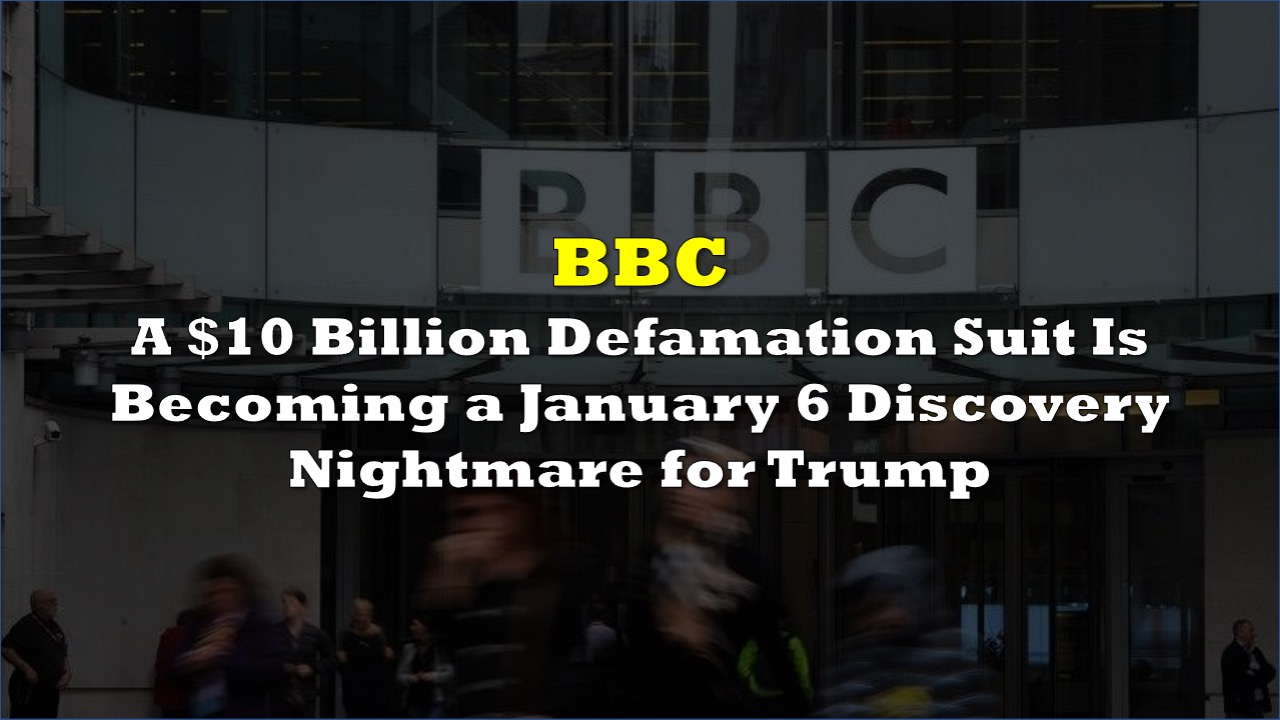

Donald Trump sued the BBC for $10 billion over a documentary that spliced his January 6, 2021 speech to imply he incited the Capitol riot. The broadcaster is now using the lawsuit’s own discovery process to demand the records that could answer exactly that question — and it has turned the case into one of the most legally perilous proceedings Trump has faced since leaving office the first time.
The lawsuit stems from a BBC Panorama documentary titled Trump: A Second Chance?, broadcast in the United Kingdom a week before the 2024 presidential election. The program edited together two separate clips from Trump’s January 6 speech — one where he told supporters to march on the Capitol, and another from nearly an hour later where he said “fight like hell” — presenting them as a continuous sequence.
BBC Chair Samir Shah sent a personal letter of apology to the White House, and the corporation published a formal correction acknowledging the edit had “unintentionally created the impression” that Trump had made a direct call for violent action. Director-General Tim Davie and head of news Deborah Turness both resigned in the wake of the controversy. The BBC declined to offer financial compensation and disputed any basis for a defamation claim.
 Sponsored · Silver47 Exploration Inc.
Trump filed suit in the Southern District of Florida in December 2025, seeking $5 billion on a defamation count and another $5 billion for an alleged violation of Florida’s Deceptive and Unfair Trade Practices Act.
Rather than settle, the BBC went on offense. It issued 47 subpoenas to members of Trump’s family and cabinet, the Department of Justice, and other federal agencies — seeking information about Trump’s intent before and during the speech. Recipients include Donald Trump Jr., Ivanka Trump, Jared Kushner, Steve Bannon, Stephen Miller, and Michael Flynn.
In discovery filings, the BBC has separately requested Trump’s telephone logs, calendars, schedules, and daily diaries covering November 3, 2020 through January 20, 2021, along with materials Trump’s team previously turned over to government investigators.
The BBC has framed its defense around the argument that what the edit implied was not materially far from what actually occurred — meaning the claim was not false in any meaningful legal sense. Trump’s lawyers called the requests “drastically far afield from the issues in this action” and accused the company of converting a defamation dispute into a trial on the January 6 riot.
Trump’s attorneys missed the June 5 deadline to respond to the BBC’s motion to dismiss. US District Judge Roy Altman — a Trump appointee — ordered them to explain why he should not sanction them for their “apparent disregard of court deadlines” and whether the motion should be treated as unopposed.
Attorneys attributed the lapse to sealed exhibit procedures and the volume of deposition transcripts under review.
The broadcaster also subpoenaed the Donald J. Trump Revocable Trust to assess the documentary’s economic impact. Trump’s legal team refused — even as the original complaint alleged the BBC had injured the value of his brand, properties, and businesses.
The BBC has moved to dismiss on two grounds: the documentary never aired in the United States, undermining the Florida jurisdictional basis; and Trump cannot meet the “actual malice” standard required for public-figure defamation claims. It has also argued that his re-election demonstrated no measurable harm to his reputation.
A hearing on the discovery disputes is set for July 21. The case goes to trial in February 2027.