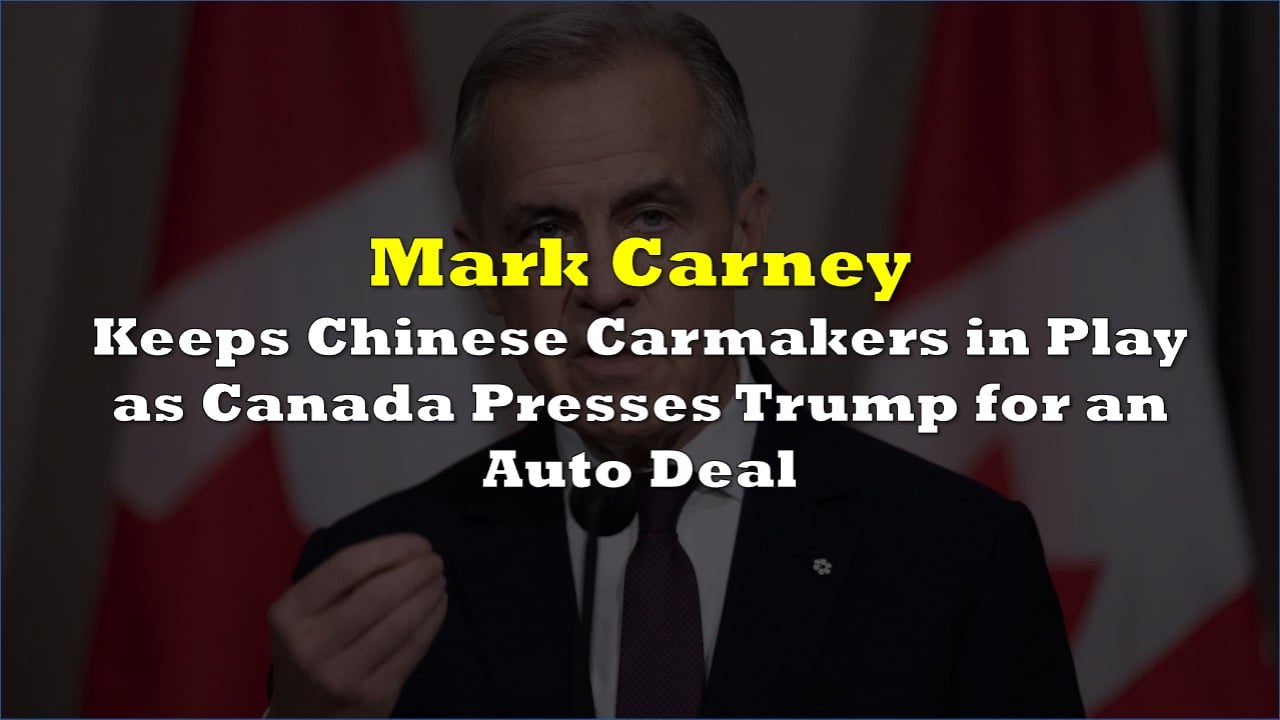

Prime Minister Mark Carney said Canada could seek investment from Chinese carmakers if its trade talks with President Donald Trump fail to protect the auto industry, telling reporters in Cambodia on Monday.
A deal with Washington remains his priority, Carney said. He added that the outcome will determine whether Canada courts European, Chinese or Japanese automakers, and he said Canada will move forward either way. Asked whether Chinese investment gives him leverage over the US, he said it does not, though he described the approach as “action, reaction” on behalf of Canadian auto workers.
Any Chinese plant would have to meet conditions, Carney said. He wants substantial manufacturing in Canada rather than assembly of imported parts, along with proper labor standards and domestic supply chains. Canada has already rejected the assembly model for the shuttered plant that Stellantis (NYSE: STLA) left in Brampton, Ontario.
Trump trade adviser Peter Navarro answered the same day in a post on X. He questioned whether Carney was seriously trying to use China as a counterweight to the US, called the idea “offensive in the extreme,” and said Canada should worry more about China overwhelming it.
Ontario Premier Doug Ford, whose province anchors Canada’s auto industry, used social media the same day to criticize the January deal that let Chinese EVs into the country. He said Ottawa should protect Canadian auto workers instead of importing more subsidized Chinese cars.
 Sponsored · Cambria Gold Mines
On Saturday in Manila, Carney said any agreement with the US has to keep a workable auto sector alive in Canada. He described long conversations with Trump and senior American officials, saying the sides had made headway but remained apart on some points.
Carney met Chinese President Xi Jinping on Tuesday in Shenzhen, on the eve of the APEC leaders’ summit, which Xi is hosting in the city. It was the second in-person meeting between the two this year, after Carney’s January trip to Beijing.
The two countries also announced new trade measures. Beijing extended tariff relief on certain Canadian goods, covering peas, canola meal, lobster and crab, through at least the end of 2028. Ottawa, for its part, will keep waiving duties through the end of 2028 on 32 additional Chinese steel and aluminum items that Canadian producers cannot supply in enough volume. The prime minister’s office puts the value of Canadian exports covered at roughly C$400 million, with frozen pork and seafood among them.
Read: China Cuts Duties on C$400 Million in Canadian Pork and Seafood in Swap for Steel Relief
Carney has said what is on the table with China comes with “clear guardrails,” and that the US talks will help decide how Canada handles Chinese investment.
The January agreement cut Canada’s tariff on Chinese electric vehicles from 100% to 6.1% for up to 49,000 vehicles a year. About 16,211 Chinese EVs have entered Canada since March, according to the prime minister’s office, and roughly half sold for $35,000 or less. BYD, China’s biggest EV maker, has started selling vehicles to Canadian buyers.
Canada’s shipments to China are up roughly 40% since January, led by oil, canola and peas. Security analysts and human rights groups have cautioned that a warmer relationship with Beijing could put Canadian security and values at risk.