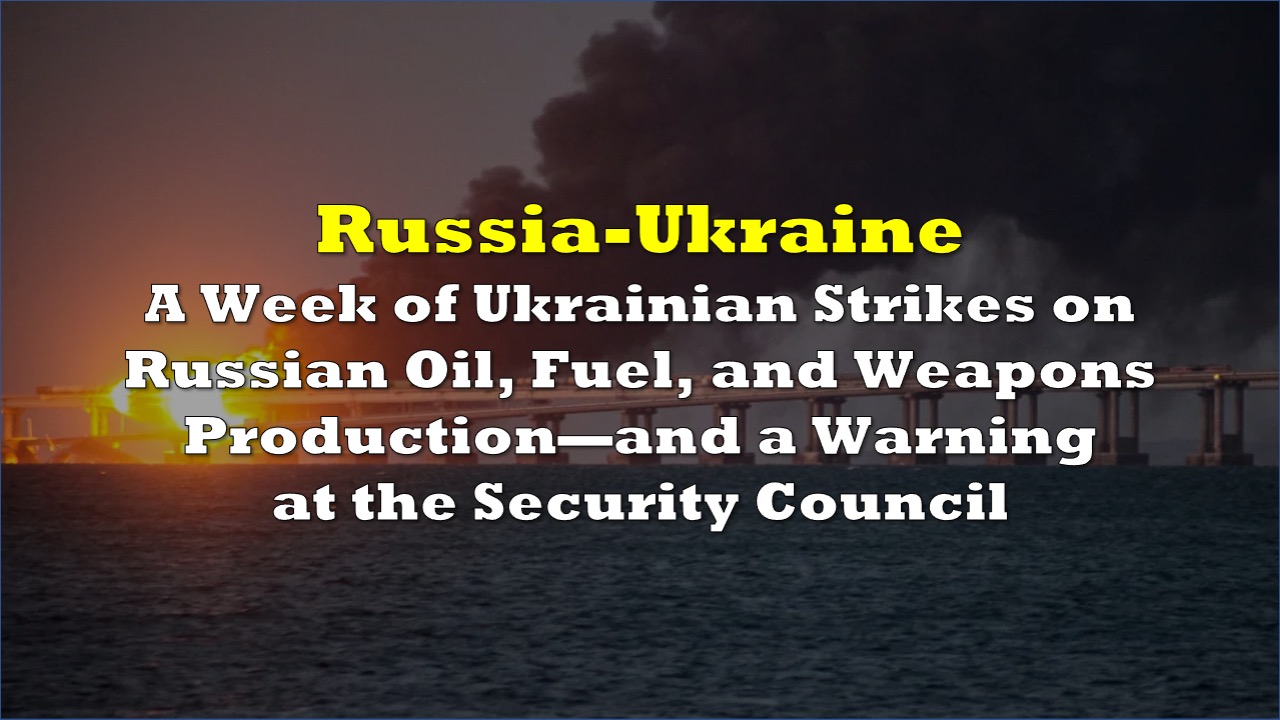

In less than a week, Ukraine struck Moscow’s main oil refinery twice, set fuel depots on both sides of the Kerch Strait ablaze, suspended civilian fuel sales across occupied Crimea, and destroyed a semiconductor plant supplying components for three of Russia’s most critical weapons systems.
Ukraine’s General Staff has described the operations as deliberate targeting of Russia’s defense industrial base and energy supply chain.
Moscow, June 17-18 — the opening act
Ukraine launched its largest single-night drone operation of the war on June 17-18, sending a massive wave of unmanned aircraft across more than a dozen Russian regions and striking the Gazprom Neft refinery at Kapotnya — nine miles from the Kremlin — for the second time in 48 hours.
 Sponsored · Selkirk Copper Mines
The refinery supplies roughly 40% of Moscow’s petrol and half of its diesel. Residents across southeastern Moscow woke to oil droplets on their cars and windowsills. Four airports halted flights.
The War Came to Moscow: Black Rain, 555 Drones, and Zelensky’s Message to Putin
Kerch, June 20-21 — the fuel lifeline
Two days later, Ukrainian drones struck fuel and logistics infrastructure on both sides of the Kerch Strait simultaneously. The primary targets were the AEGAZ Terminal oil storage complex in Kerch and the Port Kavkaz fuel depot in Russia’s Krasnodar region — the two maritime fuel nodes sustaining Crimean supply since Ukraine’s drone campaign began eating through overland routes.
Zelenskyy confirmed strikes against “maritime oil transportation infrastructure in Krasnodar and an oil depot in occupied Kerch,” calling them “a fair response to Russia’s brutal strikes against our people.”
 Sponsored · Cambria Gold Mines
The ferry Panagia was also struck; all ferry operations between the two ports were suspended. Russian authorities in occupied Crimea responded by halting all civilian fuel sales — only government agencies and emergency services could buy fuel. NASA satellite data confirmed thermal anomalies at both locations.
The Kerch strikes were the peak of a sustained campaign across the peninsula: on June 19, Ukrainian drones hit the Hlibivka underground gas storage facility; on June 20, the Unmanned Systems Forces struck four gas compressor stations, the Henichesk Strait bridge, and thirteen additional military installations. Ukraine also struck a railway bridge on the Kerch-Dzhankoi line on June 18 — a key route for Russian military equipment and fuel moving to the southern front.
Voronezh, June 22 — the weapons supply chain
Ukraine’s Air Force struck the Voronezh Semiconductor Devices Plant on Monday morning using high-precision air-launched cruise missiles. The facility — known as VZPP-S or “Sborka” — is a sanctioned enterprise that supplied transistor assemblies for the guidance systems of Kh-101 cruise missiles, semiconductor arrays for the onboard computer inside the Iskander-K system’s 9M727 missiles, and diodes and transistor modules for the Pantsir-S1 air defense system.
The components it produced are exactly the class of precision electronics that Western sanctions have already made difficult for Russia to source domestically.
Ukraine’s General Staff said the strike would “significantly degrade Russia’s ability to produce new missiles.” Voronezh Oblast Governor Alexander Gusev confirmed the attack at 11:40 AM local time — mid-workday Monday.
He later acknowledged that “there are casualties, including some in critical condition,” with the full toll still being determined. A state of emergency was declared in the surrounding district. Some Russian military channels suggested British-supplied Storm Shadow missiles were used; Ukraine did not confirm the weapon type.
Ukraine’s Defense Minister Mykhailo Fedorov said on June 17 that the drone campaign was turning Crimea “into an island.”
Military cargo traffic on the main overland routes into the peninsula has fallen 71%. Fuel prices in occupied Crimea have nearly doubled relative to Moscow rates. Ukrainian forces struck Russian refineries 38 times between January and May 2026 — 16 times in May alone, the highest monthly figure since the full-scale invasion began.
Russian refinery utilization has fallen 14% since the start of the year and sits approximately 20% below pre-war levels.
On June 21-22, Ukraine also struck a space communications center in Moscow Oblast and an oil refinery in the Siberian city of Tyumen — more than 2,000 kilometers from the Ukrainian border.
The warning
Ukraine’s UN Ambassador Andrii Melnyk told the Security Council on Monday that Kyiv’s patience with the peace process was “not endless” and that Ukraine might “recalibrate and modify” its ceasefire offer if the council continued to wait.
Trilateral US-Ukraine-Russia talks have been ongoing in Geneva since February, though the gap between the parties on territory, ceasefire monitoring, and security guarantees has remained wide. Zelenskyy told G7 leaders last week that June and July could be decisive for Ukraine.