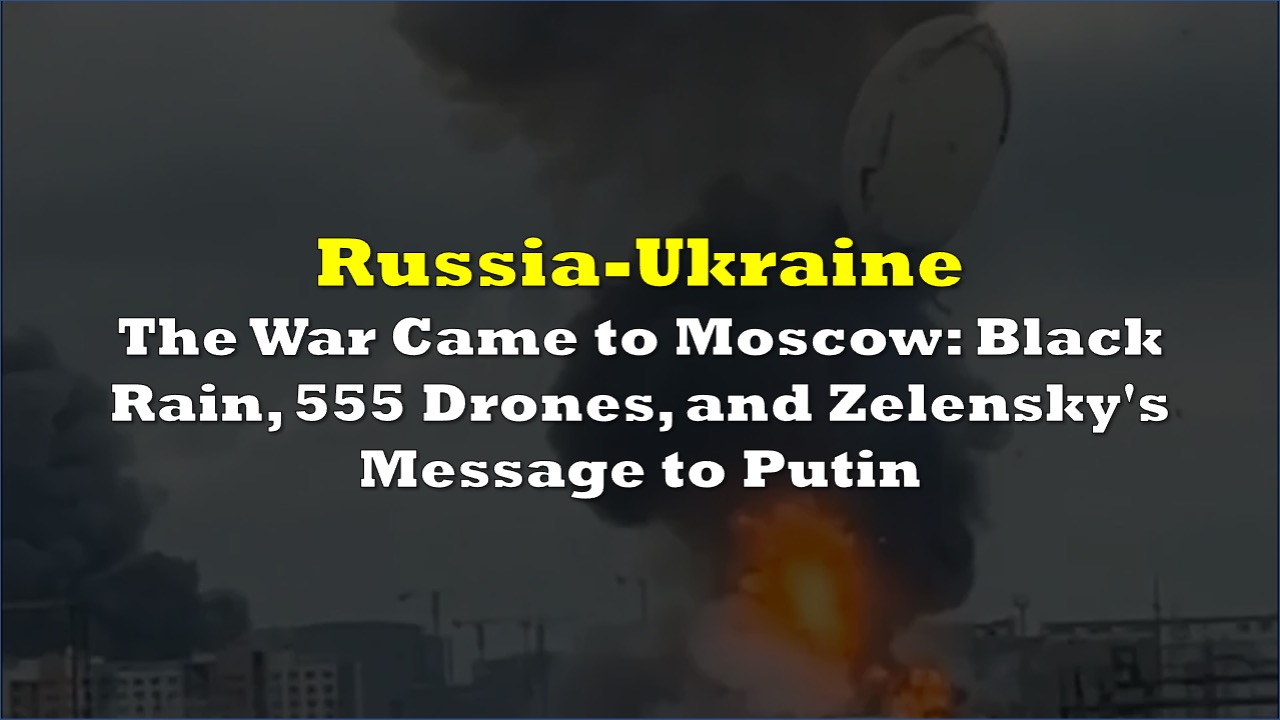

In the early hours of June 18, residents across southeastern Moscow stepped outside to find their cars, windowsills, and clothing spotted with dark, oily residue. Smoke from Gazprom Neft‘s Kapotnya oil refinery — struck by Ukrainian drones for the second time in 48 hours — had drifted across the Russian capital in what locals called “black rain.” The refinery, located nine miles from the Kremlin, supplies roughly 40% of Moscow’s petrol and half of its diesel fuel.
Russia’s Defence Ministry claimed its air defenses intercepted 555 Ukrainian drones across more than a dozen regions overnight, with nearly 200 shot down as they approached the capital — Ukraine’s largest drone operation of the war.
Four Moscow airports halted flights, generating more than 500 delays and cancellations. Drone debris struck residential buildings, a fitness centre, and a shopping centre in the Moscow region. Seventeen people were reported injured. Ukraine’s strikes that night reached beyond Moscow — Zelensky confirmed targets were also struck in the Rostov region and in Russian-occupied Ukrainian territories.
Burning 40% of Moscow’s fuel supply
Ukrainian military officials described the Kapotnya facility as directly “involved in supporting the Russian military” — a critical node in the supply chain that keeps Russia’s war machine mobile. Ukraine’s drone campaign has systematically targeted Russian refinery capacity throughout 2025 and 2026, degrading Moscow’s ability to maintain fuel output for both military and civilian use.
 Sponsored · Selkirk Copper Mines
Read: Ukraine hits Moscow refinery and tests Russia’s air defenses
The US-Iran memorandum of understanding, signed June 15, has begun easing Hormuz shipping traffic and with it global oil prices. Russian crude now competes in a market where Iranian supply is gradually returning.
Meanwhile, Trans Mountain hit full capacity this month for the first time since its 2024 expansion — driven in part by Asian buyers diversifying away from the Hormuz route. If the strikes hold, Russia loses refinery output at the worst possible time for its finances. Damage assessments for the Kapotnya facility had not been independently verified at the time of publication.
The thing about the timing
The Moscow strike came hours after Zelensky held what he described as “an important coordination call” with President Trump and French President Emmanuel Macron on the sidelines of the G7 in France. He told the G7 he had secured pledges of further support from world leaders. The refinery attack followed.
In his post confirming the strikes, Zelensky notably called them “long-range sanctions,” implying the destruction of Russian energy infrastructure was a financial penalty, not a military response. “It is time the war ended,” he wrote, “and Russia must take the necessary steps in diplomacy.”
On June 4, Zelensky published an open letter to Putin, proposing direct bilateral peace talks and offering a face-to-face meeting in a neutral country, while noting that Ukraine’s long-range drones had just struck the opening of Putin’s St. Petersburg Economic Forum. “As you well know,” he wrote, “this distance is not the limit of our capabilities.” Putin did not respond publicly.
The cathedral and the refinery
On June 15, a Russian missile and drone barrage struck the Kyiv-Pechersk Lavra — the Monastery of the Caves — a UNESCO World Heritage Site more than a thousand years old. The Dormition Cathedral’s roof caught fire. Monks and church workers carried icons and liturgical relics to safety as the building burned, racing against the flames before firefighters arrived to contain them.
Five first responders died in Kharkiv when a second Russian missile hit rescue workers as they fought the fire caused by the first. The same barrage burned down the costume archive at the Dovzhenko Film Studios, destroying roughly 100,000 garments the studios described as irreplaceable.
Russia claimed to have targeted drone manufacturing facilities. The Kyiv-Pechersk Lavra has no military function. Metropolitan Epiphanius, head of the Orthodox Church of Ukraine, described the attack as “a crime against humanity, against history, against Christianity.”
On the streets of Moscow, the morning after the refinery strike, residents watched black smoke rise over the city. “The war is here,” one woman said in a widely shared video clip, filmed outside her apartment as the smoke darkened the sky above her.
Zelensky has said it is time to end this war. He has also said that “if Ukraine burns, Moscow will burn, too.”
Information for this story was found via the sources and companies mentioned. The author has no securities or affiliations related to the organizations discussed. Not a recommendation to buy or sell. Always do additional research and consult a professional before purchasing a security. The author holds no licenses.