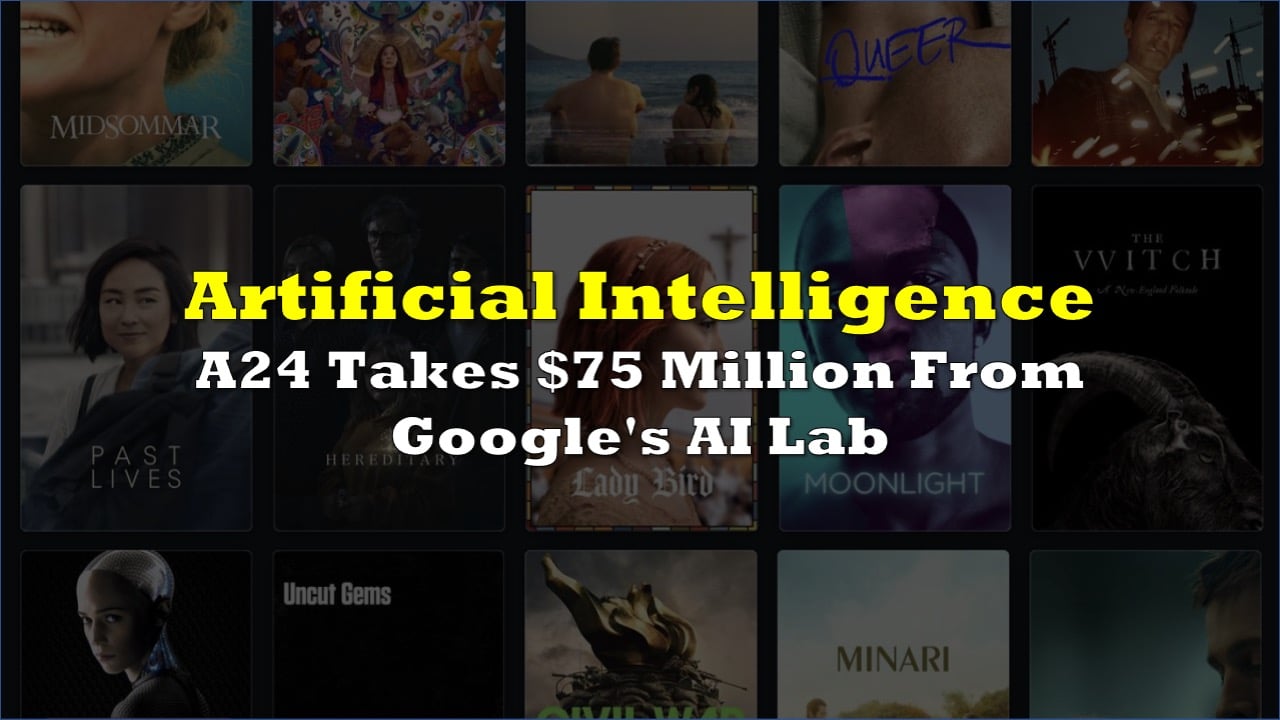

A24 built its brand on being the studio that said no to everything Hollywood said yes to — risk-taking directors, unconventional marketing, films that made audiences uncomfortable in ways they came back to praise. That identity stuck so thoroughly that fans pay monthly for early access to every release, a subscription called AAA24 that amounts to a standing bet that whatever A24 makes next will be worth seeing.
On Monday, the studio tested that bet.
Google DeepMind announced a roughly $75 million investment in A24 — the first time Google has taken a financial stake in a Hollywood film studio — tied to a multi-year AI research partnership to develop new tools for movie production and distribution. The deal gives A24 access to DeepMind’s research and infrastructure. It does not give Google access to A24’s content library or data, and the studio retains full creative control.
 Sponsored · Selkirk Copper Mines
That distinction did not survive contact with the r/A24 subreddit, which entered what multiple outlets described as full meltdown mode within hours. Members began posting screenshots of cancelled AAA24 subscriptions.
Kane Parsons, the director of Backrooms — the film that set A24’s largest opening weekend record and made Parsons the youngest director ever to top the US box office — told The Australian earlier this month that if he could snap his fingers and eliminate generative AI forever, he probably would. “Creatively, I get no enjoyment from using those tools,” he said. He called the technology “cultural and economic rot.”
Scott Belsky, the A24 partner who leads the studio’s 20-person technology division, A24 Labs, moved quickly to draw limits around the partnership. The tools, he told the Wall Street Journal, “won’t look anything like the prompted generation type of AI that people feel uncomfortable with.”
The primary near-term application is AI-generated storyboards — not scripts, not performances, not finished scenes. Belsky argued that most AI companies pitch filmmakers on speed and cost reduction; A24’s approach, he said, puts creative risk-taking first.
The deal’s terms are specific about what Google doesn’t get: no access to A24’s content library, no A24 footage as training data for AI models. That last point distinguishes this from Lionsgate‘s deal with Runway AI, which gave the AI company access to its film library to train a generative model, and from Netflix‘s $600 million acquisition of InterPositive, which brought AI tools directly into its production workflow.
What Google does get is access to A24’s production process. As IndieWire put it, Google can’t take Moonlight, but it can take a seat in the room where the next one gets made.