A proposed 3,300-kilometre oil pipeline connecting Alberta’s production hub at Hardisty to refineries in Sarnia, Ont., was announced Monday by premiers Doug Ford and Danielle Smith, carrying no confirmed price tag, no set timeline, and a significant gap in support from the province it would need to cross.
Manitoba is sitting out. Premier Wab Kinew has said his government will only pursue large-scale infrastructure when Indigenous communities are partners from the outset, not brought in for consultation after plans are already formed. Because the proposed route travels through Manitoba on its way from Alberta’s oil-producing heartland to Ontario’s refining capacity, the province’s absence is less a political footnote than a practical barrier Ford and Smith have not yet resolved.
Ford described himself as optimistic about bringing Manitoba on board, offering praise for Kinew and expressing confidence that an agreement could be reached. He went further, floating the idea of a pipeline extension to the Port of Churchill.
 Sponsored · Selkirk Copper Mines
Ontario, Ford added, was prepared to own and finance the corridor if private investment proved insufficient.
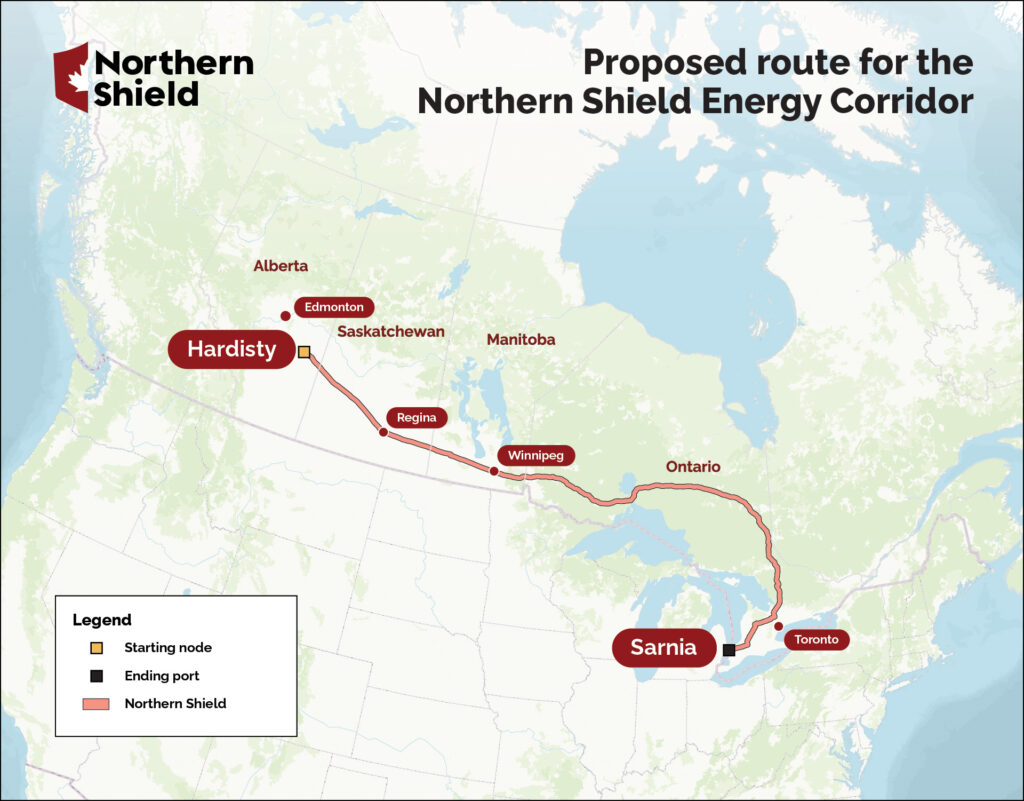
At its core, the project is designed to carry roughly 500,000 barrels daily, dedicated to domestic supply, with capacity potentially expandable to 800,000 barrels per day.
Looking further ahead, the corridor would carry natural gas and other energy products, with the eventual goal of opening an export route to European markets. The proposal builds on a memorandum of understanding signed last year among Ontario, Alberta and Saskatchewan to study an east-west pipeline built with domestically produced steel, tied to a planned James Bay deep-sea port.
A feasibility study involving multiple consulting groups is already in progress, and Ontario has begun consultations with Indigenous communities, though costs and a construction timeline remain undefined. Ford and Smith made the announcement in Calgary, where the two leaders had spent their morning flipping pancakes at Smith’s annual premier’s breakfast during the Calgary Stampede.
The Northern Shield announcement follows by one week Smith’s formal proposal for a separate pipeline to British Columbia’s southwest coast, developed alongside federally-owned Trans Mountain Corp. and Pembina Pipeline Corp. Together, the two projects reflect a broader Alberta push to diversify oil export routes in multiple directions at once.
Saskatchewan Premier Scott Moe expressed support for the east-west plan, saying it would reinforce Canadian energy security and support well-paying jobs across the country.
Information for this story was found via the sources and companies mentioned. The author has no securities or affiliations related to the organizations discussed. Not a recommendation to buy or sell. Always do additional research and consult a professional before purchasing a security. The author holds no licenses.