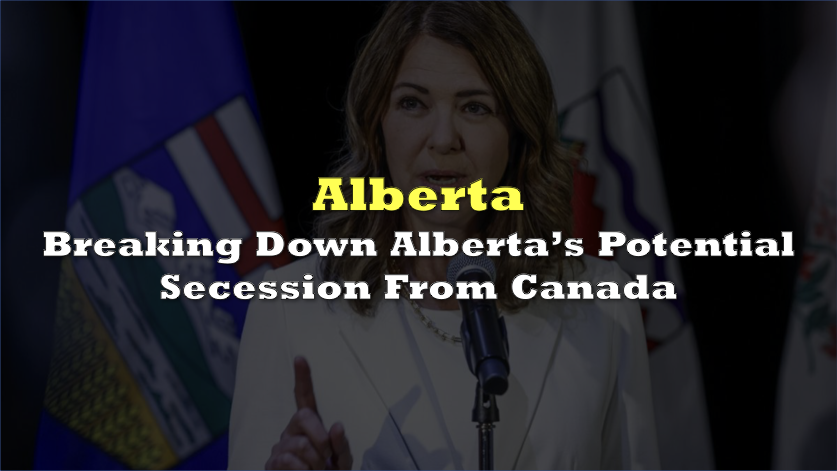

Alberta’s separation debate has reached voters before the province has answered the basic implementation questions that would determine whether independence is even bankable.
The Oct. 19 vote being advanced by Premier Danielle Smith’s government does not ask Albertans to create a new country. It asks whether Alberta should remain a Canadian province or begin the legal process required under the Constitution to hold a future binding referendum on separation.
That distinction is the point: the ballot would create political pressure, not sovereignty.
 Sponsored · Altamira Gold Corp.
But the gap between those two outcomes is where the real story sits.
Dual citizenship
The most viral version of Alberta separation is also one of the least settled: whether Albertans would keep Canadian passports or be forced to choose between Canada and a new Alberta.
Current Canadian rules do not support a simple “choose one” claim. Immigration, Refugees and Citizenship Canada says Canadians may take foreign citizenship while keeping Canadian citizenship. Canada’s travel guidance also says Canada allows multiple citizenships, though other countries may not.
Renouncing Canadian citizenship is not automatic either. The Citizenship Act sets out an application process for renunciation, including that the applicant is or will become a citizen of another country.
 Sponsored · Selkirk Copper Mines
But that does not mean two passports would automatically land in every mailbox. Alberta is not a country today. A future Alberta state would have to legislate its own citizenship rules, create passport infrastructure, secure international recognition, and negotiate transition terms with Ottawa. Canada could also legislate specific rules as part of a separation settlement.
The most accurate answer is therefore unsatisfying but important: Canadian law does not now force Albertans to give up Canadian citizenship simply because Alberta debates independence, but dual citizenship after separation would depend on laws and negotiations that do not yet exist.
The legal gatekeeper is not Edmonton
The second disclosure gap is constitutional control. Alberta can hold a political vote, but it cannot unilaterally convert that vote into independence.
The Supreme Court of Canada’s Quebec secession reference found that unilateral provincial secession has no legal basis under Canadian or international law. A clear democratic vote would create an obligation to negotiate, not a right to walk out.
The Clarity Act adds a federal filter. The House of Commons must determine whether a referendum question is clear and whether a clear majority has expressed a will to secede. If the question or majority is not clear, Ottawa is barred from entering negotiations on the terms under which a province could leave Canada.
That gives Parliament a decisive role in judging the mandate. It also means Alberta voters could approve the start of a process that is later challenged, narrowed, or refused by federal institutions.
In business terms, the province would be asking voters to authorize a transaction before the counterparty has agreed the offer is valid.
Prime Minister Smith
Some online discussions have speculated about Smith’s political incentives. But in a May 21 address, Smith said she supports Alberta remaining in Canada, while also defending the province’s plan to give Albertans a say on the path forward.
Prime Minister Mark Carney has attacked that strategy as dangerous. Reuters reported that Carney warned the vote could become a “dangerous bluff,” drawing a Brexit comparison and arguing that referendum campaigns can mislead voters about downstream costs.
Treaty rights
The least optional file may be Indigenous law.
Recent Alberta litigation has already shown that separation cannot be treated as a province-only question. OKT Law said an Alberta court quashed a bid for an independence referendum in favour of First Nations Treaty rights. JURIST reported that an Alberta judge quashed a separation petition for violating First Nations’ right to consultation.
The issue is not simply whether First Nations oppose or support separation. It is whether a provincial process that could alter constitutional relationships, border realities, Crown obligations, and Treaty implementation can move ahead without consultation.
That creates a timing problem for separatists. Legal challenges can slow the process before a referendum campaign becomes a negotiating mandate.
For Alberta, Treaty rights are not a moral footnote to a constitutional story. They are part of the legal architecture that determines whether the story can proceed.
Fiscal leverage
Alberta’s oil wealth gives the province bargaining power, but its finances also show why separation would be a high-risk transaction.
Reuters reported in February that Alberta projected a $9.4 billion deficit for 2026-27, driven largely by lower oil prices. The province expected non-renewable resource revenue to fall to 18% of total revenue from 21% a year earlier, with deficits also projected for the following two years.
That matters because independence would require Alberta to duplicate or replace federal functions while negotiating a share of federal debt, assets, pensions, tax administration, border services, defence arrangements, regulatory agencies, and trade infrastructure.
A landlocked Alberta would also have to keep moving energy through territory that would remain Canadian. The argument for separation often begins with escaping Ottawa. The mechanics of separation would force Alberta to negotiate with Ottawa on almost every material file.
Information for this story was found via the sources and companies mentioned. The author has no securities or affiliations related to the organizations discussed. Not a recommendation to buy or sell. Always do additional research and consult a professional before purchasing a security. The author holds no licenses.