
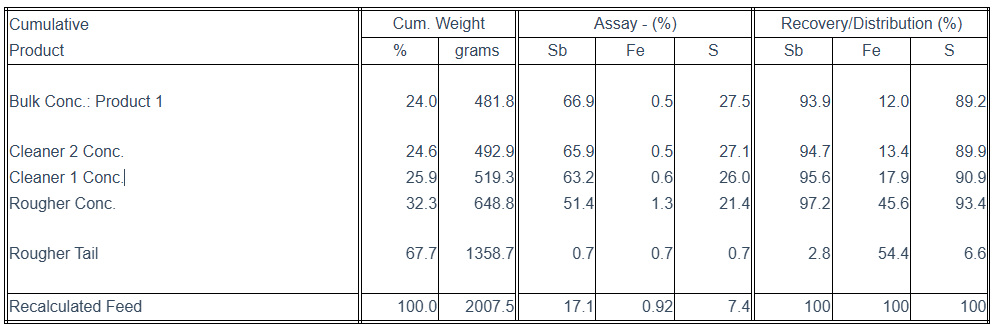
Blue Jay Gold (TSXV: JAY) has produced a 66.9% antimony concentrate at 93.9% recovery in the first modern metallurgical testwork on the Becker-Cochran occurrence at its Steller Gold Project in southern Yukon.
The bench-scale flotation program was run at ALS Metallurgy on more than 400 kilograms of stibnite-bearing material collected by company personnel from a single surface trench. The test composite graded 17.1% antimony at head.
The testwork saw a conventional flowsheet used. Material was ground to roughly 140 microns, then run through rougher flotation, regrinding and two cleaner stages, with lead nitrate as the activator and SIPX as the collector. Less than 3% of the contained antimony was lost to tailings.
That grade clears the 60% level generally associated with premium concentrate and approaches the 71.7% ceiling for pure stibnite.
It also improves on work done at the site six decades ago. Testing in 1965 on an 8-ton bulk sample returned 92.8% recovery and concentrates above 62% antimony, before underground development halted when antimony prices fell.
Roughly 50 kilograms of the new concentrate has been split among three North American processing groups, each using a different downstream route, to be refined into finished antimony products. First results are expected in the coming weeks.
“The concentrate is now with three North American processing groups who will convert it into a range of finished antimony products, and we expect the first of those within weeks. That means this material will have gone from rock in the ground to finished metal inside a single exploration season. Linking the mine site to metal production is where value is created in critical minerals, and we saw no reason to wait years to find out whether this material can make that trip,” CEO Geordie Mark said.
RELATED: Blue Jay Gold Extends High-Grade Zone at Depth at Skukum Creek With 6.15 g/t Gold Over 14 Metre Hit
Assays meanwhile are pending from a 10-hole drill program testing the down-dip extension of the mineralized shear zone below the historical workings. If continuity is confirmed, the company plans variability and locked cycle testing on drill core composites, with flotation optimization work set to begin shortly.
Becker-Cochran sits within an antimony anomaly about 8 kilometres wide and forms no part of the current mineral resource estimate.
Blue Jay Gold last traded at $0.82 on the TSX Venture.
The scientific and technical information contained in this article has been summarized from Blue Jay Gold Corp’s news release dated September 21, 2026. The original news release was reviewed and approved by Freeman Smith, P.Geo., VP Exploration of Blue Jay Gold Corp., and a Qualified Person as defined by National Instrument 43-101. Drill intercepts represent core lengths unless explicitly stated as true width. For complete details regarding QA/QC protocols, sampling procedures, and analytical methodology, please refer to the full press release available on the company’s profile at SEDAR+.
Further detail regarding the Becker-Cochran occurrence, including its discovery, historical exploration, development and sampling, and regarding the Steller Gold Project and its current Mineral Resource Estimate, is set out in the technical report entitled “Technical Report and Updated Mineral Resource Estimate of the Steller Gold Project, Whitehorse Mining District, Yukon Territory, Canada,” prepared for the Company by P&E Mining Consultants Inc. with an effective date of October 31, 2025, available under the Company’s profile on SEDAR+ at www.sedarplus.ca. The historical metallurgical results quoted above are drawn from reports prepared for or on behalf of Yukon Antimony Corporation Ltd. between 1964 and 1966, including the concentration report of the Mineral Processing Division, Department of Mines and Technical Surveys, dated July 6, 1965. https://data.geology.gov.yk.ca/assessment-report/202 https://data.geology.gov.yk.ca/mineral-occurrence/12812 https://data.geology.gov.yk.ca/assessment-report/3639