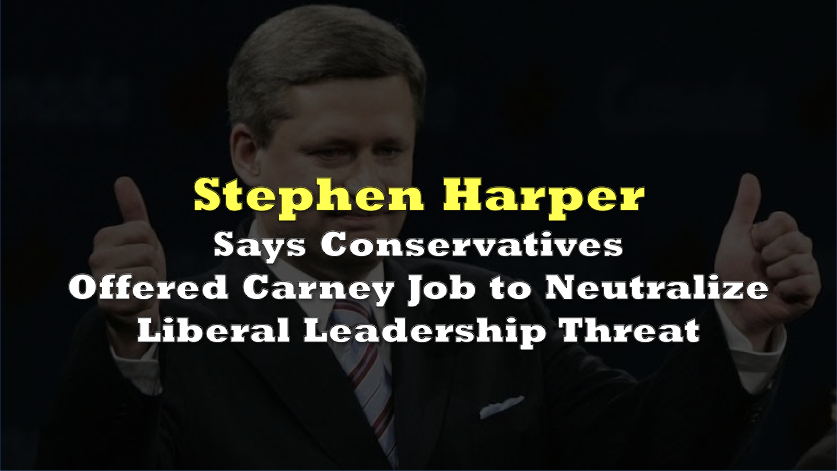

Former Prime Minister Stephen Harper says his government approached Prime Minister Mark Carney about joining the Conservatives in 2012 with a strategy that offered political benefits even if the central banker refused. A successful pitch could bring Carney into cabinet but an unsuccessful one, according to Harper’s new memoir, could compel him to publicly reject a potential bid to lead the Liberals.
The account, published in Here for Canada: Memoirs of the 22nd Prime Minister, adds a political rationale to a recruitment attempt Carney had already disclosed. The Canadian Press reported the details Tuesday, based on Harper’s description of discussions with his then-chief of staff, Nigel Wright.
Harper writes that finance minister Jim Flaherty had grown concerned about Carney’s possible political ambitions following the Conservatives’ 2011 election victory. Harper shared those concerns with Wright, who proposed approaching the Bank of Canada governor about joining the government.
 Sponsored · Cambria Gold Mines
“This was a serious concern for us,” Harper writes of the leadership speculation.
The proposal gave the Conservatives two possible advantages, according to Harper’s account. Accepting would put Carney on their side of the aisle. Declining while affirming the political neutrality expected of a sitting central bank governor would take him out of contention for the Liberal leadership at that time.
The concern was not invented after the fact. On September 27, 2012, The Canadian Press reported that the Bank of Canada was publicly pushing back against speculation about Carney becoming Liberal leader. The bank pointed to Carney’s earlier statements that he was focused on his central banking responsibilities.
Carney did not enter federal partisan politics in 2012. He subsequently became governor of the Bank of England, and remained outside elected politics for more than a decade.
The memoir also sharpens an unresolved disagreement over exactly what Harper proposed. During a February 2025 CBC interview, Carney said Harper asked him to become finance minister. Harper now says that job was occupied by Flaherty and that he told Carney he would be a leading candidate if it later became available.
Carney said in 2025 that moving directly from the Bank of Canada into elected politics would have been inappropriate. Harper says Carney ultimately chose to remain nonpartisan.
The political divergence resurfaced during the 2025 Liberal leadership contest. Harper publicly criticized Carney’s economic record and endorsed Conservative Leader Pierre Poilievre. Carney won the Liberal leadership on March 9 and was sworn in as prime minister five days later.
Their relationship has since taken another turn. At Carney’s Canada Investment Summit in September 2026, Harper praised the initiative, while Carney acknowledged taking advice from his predecessor.