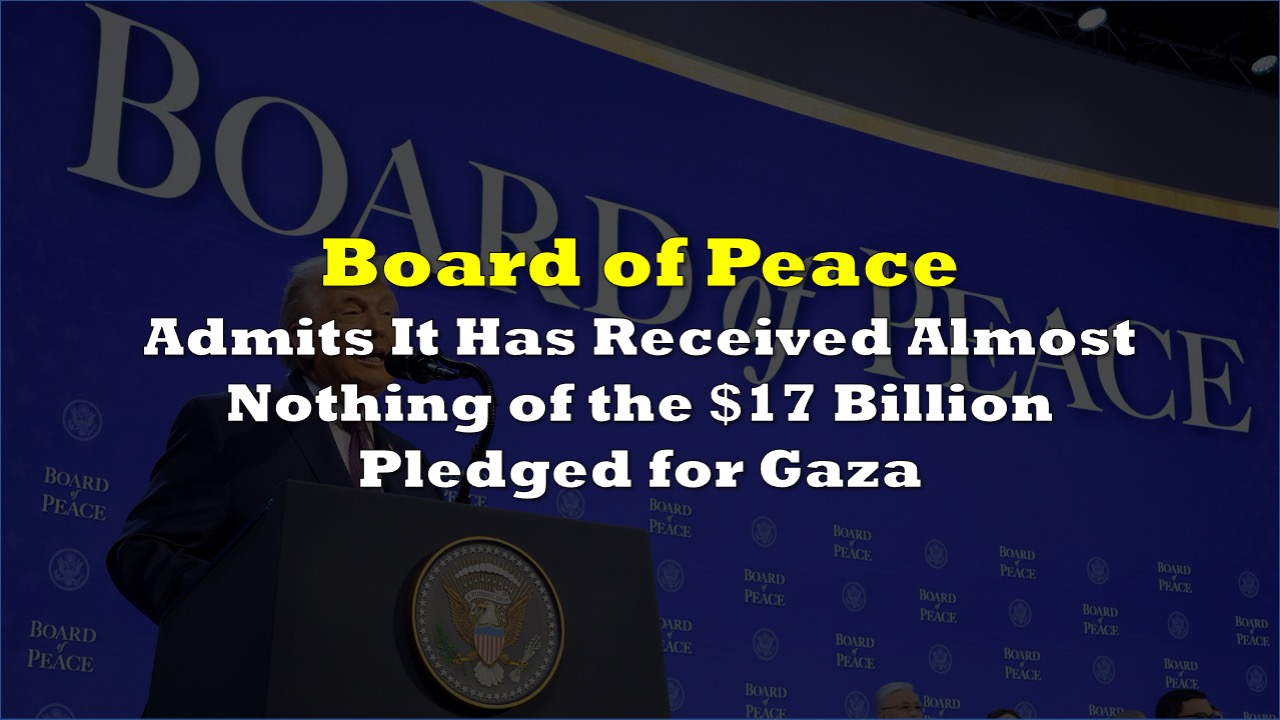

Trump’s Board of Peace — the US-led body tasked with governing and rebuilding Gaza — has received almost none of the $17 billion pledged at its inaugural Washington conference in February, according to a report the board itself submitted to the UN Security Council on May 15.
“Funds committed but not yet disbursed represent the difference between a framework that exists on paper and one that delivers on the ground for the people of Gaza,” the report stated, urging donor countries to accelerate disbursement. As recently as April, the board had insisted it was an “execution-focused organisation that calls capital as needed” and denied facing funding constraints. The May 15 report contradicts that directly.
The board was chartered by Trump at the World Economic Forum in Davos on January 22, with the president serving as chairman and 28 member states including Saudi Arabia, the UAE, Qatar, Kuwait, Egypt, Turkey, Indonesia, and Israel.
 Sponsored · Altamira Gold Corp.
At its first formal meeting in Washington on February 19 — attended by former British Prime Minister Tony Blair as an executive board member — eight founding donor nations signed a Declaration pledging financial support, with Trump separately announcing a $10 billion US contribution.
Read: Board of Peace: Trump Pledges $10B To A Board He Chairs And His Son-in-Law Runs
US Ambassador Michael Waltz, the former National Security Advisor, signed the report transmitting the May 15 findings to the Security Council.
Negotiations are reportedly underway between the Trump administration and JPMorgan Chase to establish a private account for the board — but Trump’s ongoing personal lawsuit against JPMorgan and CEO Jamie Dimon, seeking $5 billion in damages, has raised concerns about whether any settlement discussions could affect those arrangements. Saudi Arabia and Kuwait have indicated their contributions will be disbursed over several years rather than upfront.
 Sponsored · Selkirk Copper Mines
The board’s report identifies Hamas refusing verified decommissioning as “the critical variable — the single factor that unlocks every other element of the plan.” Experts tracking international aid to Palestinians point to deeper structural problems as well. The board’s architecture sidelines Palestinian political representation entirely — donors are being asked to fund reconstruction of a territory whose political future remains unresolved, under a governance structure with no Palestinian voice.
The board’s charter also includes a provision allowing member states to secure a permanent seat in exchange for a $1 billion contribution, a structure that critics have described as pay-for-influence. Moath al-Amoudi, an expert in international aid to Palestinians, told Al Jazeera the publicized pledges amount to a “talk show” and that “donors are terrified of engaging with a board that carries no political vision and treats Gaza merely as an American security protectorate.”
Approximately 85% of Gaza’s buildings and infrastructure have been damaged or destroyed, with 70 million tonnes of rubble requiring clearance, according to the board’s own report. The UN and World Bank put total recovery and reconstruction needs at $71.4 billion over the next decade — the $17 billion pledged, even if fully disbursed, would cover less than a quarter of that.
The Security Council endorsement — adopted 13-0 with China and Russia abstaining — is set to expire in less than two years, and Carnegie analysts warn the board risks devolving into a private enterprise or dissolving entirely if it cannot demonstrate delivery before then.
Faced with a funding gap it cannot close through pledges alone, the US last week asked Israel to redirect $5 billion in Palestinian tax revenues, which it withheld from the Palestinian Authority since the war, directly to the Board of Peace.
Information for this story was found via the sources and companies mentioned. The author has no securities or affiliations related to the organizations discussed. Not a recommendation to buy or sell. Always do additional research and consult a professional before purchasing a security. The author holds no licenses.