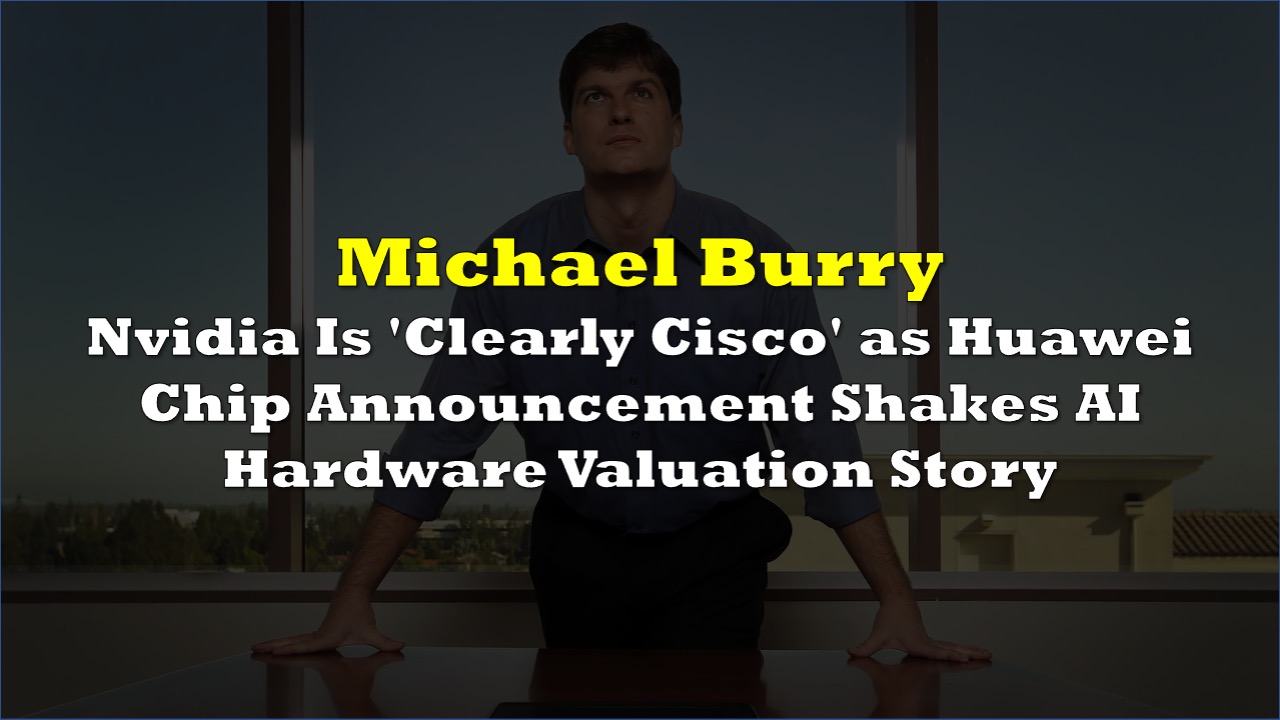

Michael Burry responded to renewed scrutiny of his AI bear case Tuesday with a pointed clarification: “I stand by my analysis. I am not claiming Nvidia is Enron. It is clearly Cisco.”
The comment comes after Nvidia (Nasdaq: NVDA) distributed a seven-page memo to Wall Street analysts rebutting what it described as inaccurate portrayals of its accounting practices — pushing back on Burry’s arguments about stock-based compensation and GPU depreciation schedules discussed in his May 2026 Substack post, “The Heretic’s Guide to AI’s Stars Part III: Tracepalooza and the Bezzle.”
The Cisco (Nasdaq: CSCO) analogy is specific. During the dot-com boom, Cisco dominated networking hardware underpinning the internet buildout. When enterprise spending on fiber infrastructure plateaued, its stock lost more than 80% of its value — a level it did not recover to for over 20 years.
 Sponsored · Altamira Gold Corp.
Burry argues Nvidia occupies the same position: a genuine technology leader priced on assumptions about the duration of demand that may not hold. He estimates the AI industry could understate GPU depreciation by $176 billion between 2026 and 2028, as companies stretch the assumed useful life of aging chips to inflate margins on paper.
Huawei‘s announcement on Monday of its Tau (τ) Scaling Law and LogicFolding architecture — a framework targeting transistor density equivalent to a 1.4-nanometer process by 2031, without the Western lithography equipment US sanctions bar it from buying — adds a supply-side challenge to Burry’s demand-side one.
Read: Huawei Wants To Change The Chip Game With 1.4nm Density Target
The dominant narrative underpinning Nvidia, TSMC, and the broader AI hardware supply chain holds that advanced chips will remain scarce and controlled by a small number of Western firms. Nvidia CEO Jensen Huang this month acknowledged the company had largely conceded China’s AI chip market to Huawei’s Ascend processors, according to Reuters.
Burry also published a new post on Sunday on Cassandra Unchained, teasing additional material cut from Part III — covering what he called “current misinformation on demand, the highly leveraged financing of the buildout, and both the mechanism and timing for the AI narrative to come to Jesus.”
The post additionally addresses China’s crackdown on cross-border stock trading in Hong Kong, an action announced last week that may affect up to $32 billion in assets, according to Citic Securities.
Burry has made bearish tech calls before that did not play out on his expected timeline, and Huawei’s 1.4nm-equivalent target still arrives three years after TSMC’s planned actual 1.4nm production. But if AI infrastructure spending is built on a demand story that overstates returns, and the hardware scarcity justifying today’s pricing begins to erode through alternative supply chains, the valuation math supporting the sector becomes harder to defend on both ends simultaneously.
Information for this story was found via the sources and companies mentioned. The author has no securities or affiliations related to the organizations discussed. Not a recommendation to buy or sell. Always do additional research and consult a professional before purchasing a security. The author holds no licenses.