

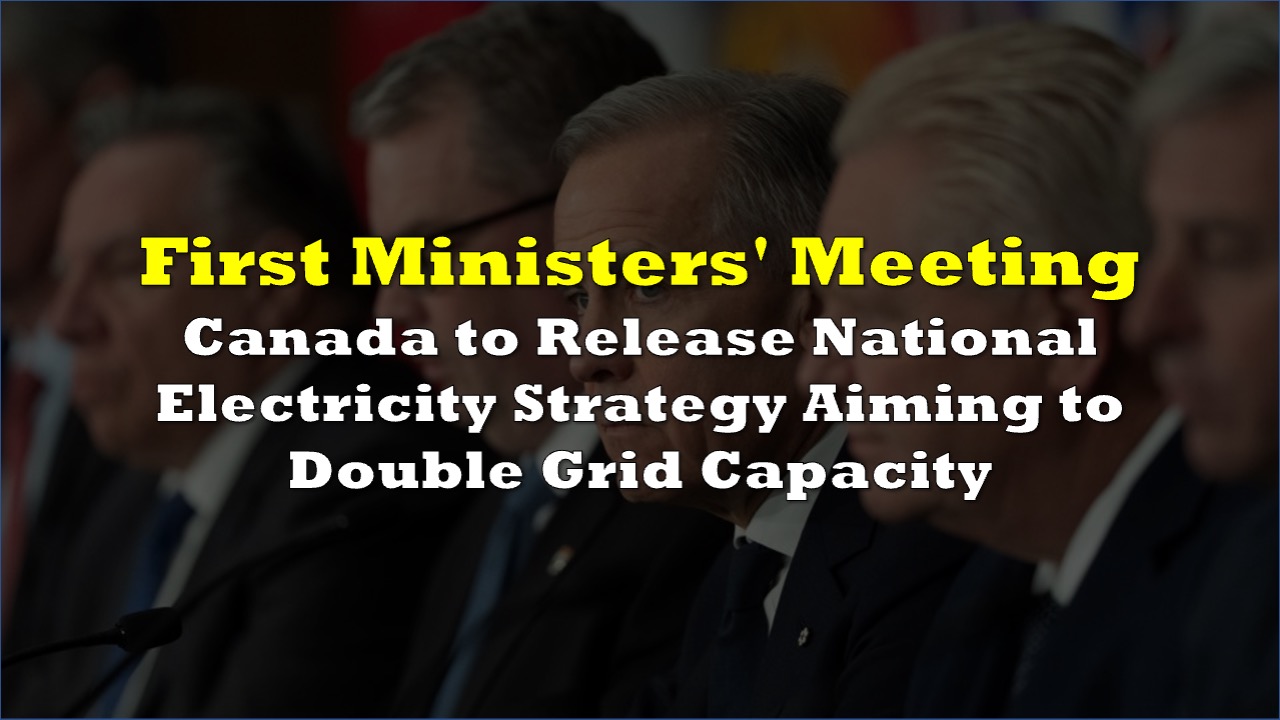

Prime Minister Mark Carney announced on Thursday that the federal government will release a draft national electricity strategy in the coming weeks, with an overarching goal of doubling the size of Canada’s electricity grid to meet surging demand from electrification and economic growth.
Carney made the announcement following a First Ministers’ Meeting with provincial and territorial leaders in Ottawa, stating the strategy would “complement provincial and territorial leadership” while supporting nationwide grid expansion efforts.
CARNEY: "In the coming weeks, the federal government will release a draft of our national electricity strategy … our objective is to more than double the size of Canada's electricity grid." pic.twitter.com/mwl1KuECkO
— Scott Robertson (@sarobertsonca) January 29, 2026
The meeting focused on strengthening Canada’s economy ahead of the upcoming review of the Canada-United States-Mexico Agreement, with discussions centering on areas within federal and provincial control, including infrastructure megaprojects, international trade partnerships and domestic investment.
Canada’s electricity needs are projected to double or triple before 2050 due to increasing electrification of industry, transportation, and heating systems, alongside growing power demands from data centers and emerging technologies. Canadian provinces currently maintain significantly more electrical interconnections with the United States than with each other, with over 30 cross-border transmission lines compared to limited interprovincial capacity.
Manitoba Premier Wab Kinew told reporters after the meeting that internal trade and the construction of megaprojects were significant topics of discussion. Prince Edward Island Premier Bloyce Thompson, chair of the Council of the Federation, said a major part of the discussions focused on growing the economy and creating jobs.
During his election campaign in April 2025, Carney pledged to work with provinces and territories to build an east-west electricity grid, describing it as a historic nation-building project to secure Canada’s energy sovereignty and reduce dependence on the United States.
The prime minister’s November 2025 budget included measures supporting grid expansion, including a 15% Clean Electricity Investment Tax Credit for new generation, storage, and interprovincial transmission projects. The budget also expanded the Canada Infrastructure Bank’s statutory capital from $35 billion to $45 billion with a broader mandate for nation-building projects.
Several major transmission projects are already underway, including the Wasoqonatl Reliability Intertie between Nova Scotia and New Brunswick, supported by $217 million in Infrastructure Bank equity and slated for construction later this decade. British Columbia and Alberta have a legislated plan to restore nearly one gigawatt of transfer capacity on their 500-kilovolt interconnection by 2026.
More than 100 climate, community, and Indigenous groups called on Carney in August to prioritize building an east-west electricity grid with renewable energy while upholding workers’ and Indigenous rights, citing significant job creation, health, affordability, and national security benefits.
According to the joint statement released on Thursday, Carney updated premiers on Ottawa’s plans for the CUSMA review and committed to monthly meetings once formal trade talks begin. The leaders agreed to create a Team Canada trade-and-investment hub with federal, provincial, and territorial representatives to support trade missions and business delegations.
Information for this story was found via the sources and companies mentioned. The author has no securities or affiliations related to the organizations discussed. Not a recommendation to buy or sell. Always do additional research and consult a professional before purchasing a security. The author holds no licenses.





One Response
We are at a crucial point wherein, settling into “same old same old, as being promoted by actions of the PC party, would bring us to our knees, begging Trump not to continue using Canada’s a cheap source of USA Economic strength. His fear is, we reduce auto production for US big 3 and start making with other partners affordable by masses, EVs and Hybrids.
We must not fall into the “there is no pollution, environmental science a hoax” trap. CUSMA must be strengthen by strong Environmental regulations, penalties and Fossil Free motivation vehicles OR No Deal!