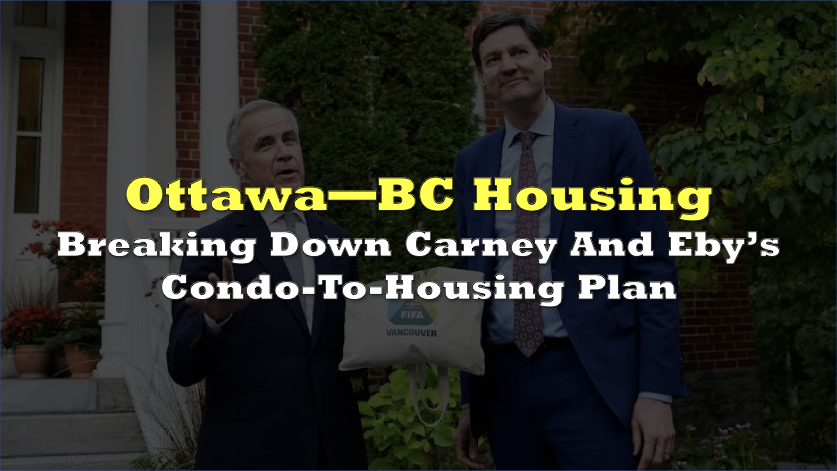

Prime Minister Mark Carney and BC Premier David Eby are trying to solve two housing problems at once: stalled construction economics and empty condos that are already built but not absorbed by the market.
That overlap is what makes the plan politically explosive. The governments say more than 2,200 vacant condo units in priority growth areas will be converted into affordable homes through Build Canada Homes and BC Housing.
They also announced a larger infrastructure and housing-cost package that includes $1.6 billion from Ottawa over 10 years through the Build Communities Strong Fund, to be matched by BC, for a combined $3.2 billion aimed at reducing development charges on multi-unit housing.
 Sponsored · Nord Precious Metals
The public pitch is speed. The hard question is price.
If governments can acquire vacant units below replacement cost, place them under public, non-profit or co-operative control, and lock in long-term affordability, the plan could turn a weak condo market into a housing gain. But if the purchases preserve developer pricing while affordability rules remain thin or temporary, taxpayers may end up absorbing private-market risk without getting durable public value.
The plan
The development-charge piece and the condo-conversion piece are related, but they are not the same policy.
The $3.2 billion pool is designed to lower certain development charges on multi-unit housing by as much as 50% in priority communities, with possible savings of up to $40,000 per unit. Ottawa also said it is introducing legislation for a one-time $284 million payment to BC to reduce barriers to new construction.
 Sponsored · Selkirk Copper Mines
Developers argue that municipal fees make projects harder to finance and eventually feed into home prices. Municipalities argue those fees pay for growth-related infrastructure, including water, sewer, roads and local services.
The Carney-Eby approach shifts part of that burden from municipal fee systems to senior-government budgets. That may help restart projects that no longer pencil out but it may also reduce reliance on charges that have become politically toxic in high-cost housing markets.
But lower costs do not automatically produce lower rents or sale prices. The policy becomes an affordability program only if savings are tracked, passed through, and tied to measurable housing outcomes. Otherwise, it is cost relief first and affordability second.
Why empty condos
The condo conversion plan lands in a market where the ownership pipeline is already flashing stress. CMHC said in March that condominium presales had collapsed and that rising unsold inventories showed today’s supply may not match what buyers need or can afford. The agency warned that ownership-oriented construction had weakened even as Canada posted higher overall housing starts in 2025, driven by rental and missing-middle construction.
That creates an opening for government intervention. Already-built units can be activated faster than new social housing projects that require land, approvals, financing and construction. In a province still facing deep affordability pressure, speed matters.
But, it also creates the trap. Unsold inventory is not automatically affordable inventory. Some units may be too small for families, too expensive to operate, tied to high strata fees, or priced far above what public housing agencies should pay. A vacant condo becomes affordable housing only after the financing, ownership and rent rules make it so.
Carney acknowledged the private-market stress behind the plan, saying higher interest rates and weaker investment demand had left developers stuck with units they did not want to sell at a loss and could not hold indefinitely. He said more program details would come in the fall, including whether the model would involve purchasing units and renting them out or financing them at affordable rates, according to Canadian Press reporting carried by CityNews.
That admission sharpens the policy tension. If developers are stuck because prices are too high for buyers, the public sector should not simply replace missing investors at yesterday’s valuation.
Housing or bailout?
BC needs housing that people can actually occupy, not only future housing starts. Converting vacant units into affordable homes could avoid years of delay and potentially buy units below the cost of new construction. If structured well, the public could capture value from a downturn instead of waiting for private prices to adjust slowly.
The strongest version of the plan would use market weakness against itself. Governments could buy at a discount, remove units from speculative ownership, and place them into permanently affordable housing stock.
That would be very different from a developer rescue. It would be a public acquisition strategy.
However, critics of the plan are not remiss to say the package risks becoming exactly what governments deny: a subsidy for developers whose units are not selling.
The BC Conservatives criticized the plan as a waste of taxpayer money and said it looked like financial aid to developers with vacant units, according to CityNews. That criticism will stick if Ottawa and Victoria do not disclose enough to prove otherwise.
The missing pieces are not minor. The public still does not know the average acquisition price, whether purchases will be below market value, which buildings or developers are involved, how affordability will be defined, who will own the units, how long affordability will last, or whether strata and operating costs could weaken the economics.
Without those details, governments are asking the public to accept a housing transaction before showing the receipt.
Currently, the Carney-Eby plan is not automatically a bailout. But, it is also not automatically affordable housing.
It becomes affordable housing only if the public buys at the right price, controls the units for the long term, and receives a measurable affordability return. Otherwise, empty condos will not become a housing solution. They will become a very expensive group project where taxpayers did the hardest part.