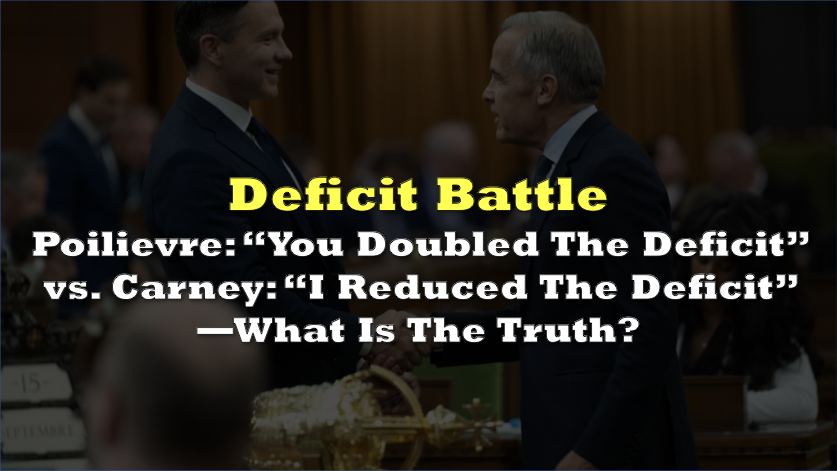

Conservative Leader Pierre Poilievre’s claim that Prime Minister Mark Carney “doubled the deficit” is broadly correct if measured against a $31 billion benchmark, while Carney’s claim that his government “reduced the deficit” is also correct if measured against Budget 2025’s larger forecast.
The fight erupted in the House of Commons after Poilievre accused the Liberal prime minister of taking the federal deficit from $31 billion to $65 billion.
“Mr. Speaker, the deficit [former Prime Minister] Justin Trudeau had provided for this year was $31 billion. Yesterday, the Liberal Prime Minister provided a deficit of $65 billion. 65 Is bigger than 31,” he said. “I’ll speak slowly for the Liberal mathematicians on the other side of the House.”
 Sponsored · Selkirk Copper Mines
Carney countered that “in the face of a tariff war” and “an actual war,” the government had actually been fiscally responsible in reducing debt and tracking savings.
“Mr. Speaker, in the face of a tariff war, in the face of an actual war, this government has reduced the deficit by $11 billion,” he countered. “This government has reduced the level of debt across the entire fore to rising. This government is on track to deliver $60 billion of savings for Canadians. This government’s on track to reduce spending on consultants by 20%. This government will build Canada strong.”
Finance Canada’s Spring Economic Update 2026 projects a $66.9 billion deficit for 2025-26 and a $65.3 billion deficit for 2026-27. The same table shows Budget 2025 had projected a $78.3 billion deficit for 2025-26 and a $65.4 billion deficit for 2026-27. Meanwhile, Poilievre’s $31-billion figure is from the older 2024 Fall Economic Statement in the Trudeau-era.
The huge jump from Budget 2024 to Budget 2025 deficit projection was driven mostly by policy choices and booked obligations: the PBO said Budget 2025’s deficit path more than doubled versus the prior track primarily because of $87.0 billion in new “day-to-day” operating measures, $65.0 billion in higher direct program expenses tied to provisions for contingent liabilities, doubtful tax accounts, environmental liabilities, and other obligations, plus $38.7 billion in new capital investment measures, partly offset by other revisions.
 Sponsored · Altamira Gold Corp.
Finance Canada’s update also says economic and fiscal developments lifted the budgetary balance by an average of about $12.1 billion annually before new measures, helped by stronger nominal GDP, higher revenues, and lower projected expenses. The update says revenues are now expected to be $7.2 billion higher per year on average versus prior projections.
The catch is that the government spent much of that improvement. Spring Economic Update measures carry a net cost of $37.5 billion over six years, starting in 2025-26. Finance Canada says 45% of the package is aimed at affordability, including the Canada Groceries and Essentials Benefit, housing supply measures, and a temporary suspension of the federal fuel excise tax.
The broader numbers favor Carney on near-term revision, but favor Poilievre on scale. The 2025-26 deficit is now expected at 2.1% of GDP, down from Budget 2025’s 2.5% forecast. Federal debt-to-GDP is projected at 41.1% in 2025-26, below Budget 2025’s 42.4% projection. But debt-to-GDP is still expected to rise to 41.9% by 2028-29 before easing to 41.6% by 2030-31.
The economic backdrop is doing heavy lifting. The update says nominal GDP is projected to exceed Budget 2025 by $31 billion per year on average over 2025-2029, partly reflecting stronger second-half 2025 results and higher oil prices. At the same time, real GDP growth was revised slightly lower to 1.1% in 2026 and 1.9% in 2027, down from Budget 2025 forecasts of 1.2% and 2.0%.
The fuller picture is less flattering to either sound bite: Ottawa improved a worse forecast, then used much of the windfall, leaving Canada with a materially larger deficit than the lower benchmark Conservatives are invoking.
Information for this story was found via the sources and companies mentioned. The author has no securities or affiliations related to the organizations discussed. Not a recommendation to buy or sell. Always do additional research and consult a professional before purchasing a security. The author holds no licenses.