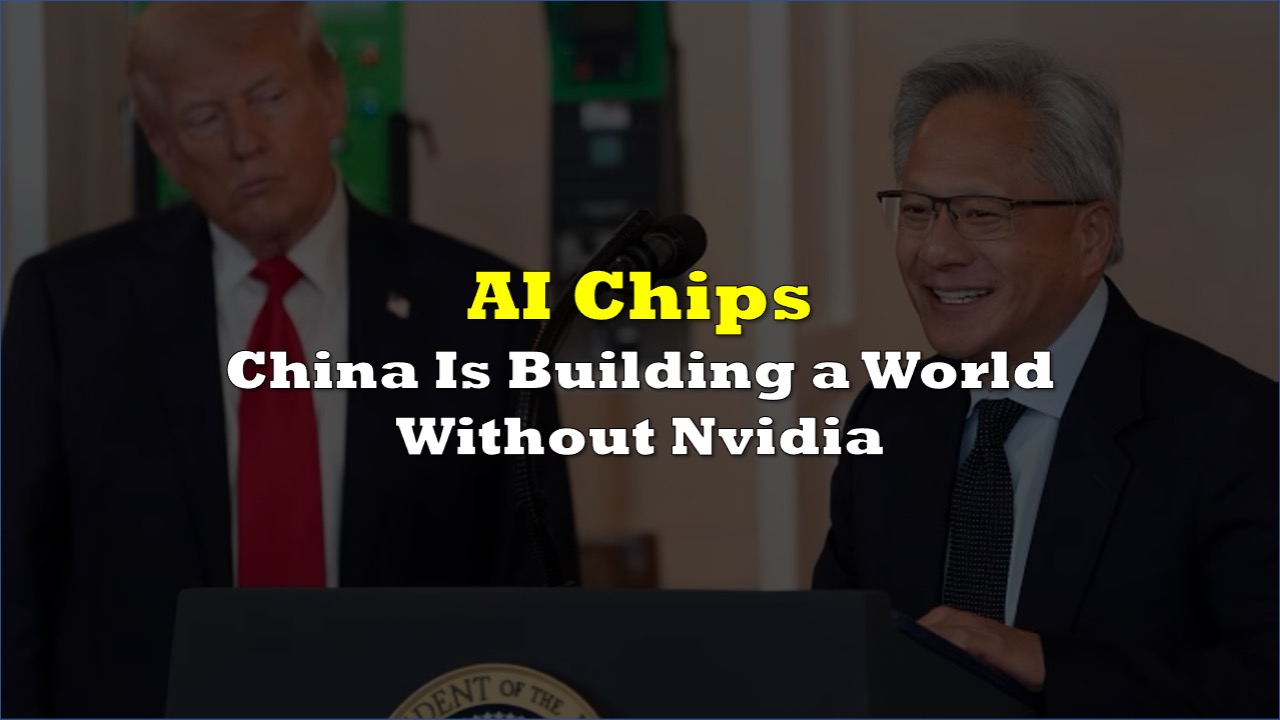

Nvidia (Nasdaq: NVDA) CEO Jensen Huang flew to Alaska to board Air Force One. The White House had left him off the delegation list for Trump’s China trip, worried his presence would invite “awkward conversations” about chip sales. Trump saw the coverage, called Huang, and told him to come anyway.
Beijing made those conversations awkward regardless.
While Trump and Huang were in China for the May 13–15 summit, Chinese authorities added Nvidia’s RTX 5090D V2 to a list of banned goods, according to an FT exclusive published Wednesday. The chip — a gaming GPU Nvidia designed specifically for the Chinese market to comply with US export restrictions — was banned not by Washington, but by Beijing.
A Pattern, Not an Incident
In September 2025, China’s Cyberspace Administration told ByteDance, Alibaba, and other tech giants to stop testing Nvidia’s RTX Pro 6000D — another chip built exclusively for China. Huang called it “disappointing.”
 Sponsored · Altamira Gold Corp.
In January 2026, the Trump administration set the rules framework for H200 exports, requiring Chinese buyers to demonstrate sufficient security procedures and a ban on military use. Chinese customs blocked every shipment that followed.
With no deliveries materializing, Nvidia halted H200 production for China by March and redirected TSMC capacity to its next-generation Vera Rubin platform. Then, on May 14 — the first day of the Trump-Xi summit — the US Commerce Department formally cleared roughly 10 Chinese firms, including Alibaba, Tencent, ByteDance, and JD.com, to purchase up to 75,000 H200s each. The chips still didn’t move — this time, because China chose not to order them.
The Domestic Push
Beijing is not simply rejecting Nvidia — it is replacing it. Thirteen executives from China’s top semiconductor firms, including Yangtze Memory Technologies and Naura, have committed to 80% semiconductor self-sufficiency by 2030, up from 33% in 2024 — a goal enshrined in China’s 2026–2030 five-year plan.
On AI chips specifically, the numbers are moving fast. Chinese companies captured 41% of their domestic AI chip market last year, pulling Nvidia’s share down to 55%. Morgan Stanley projects that figure could reach 76% by 2030. Huawei leads the domestic market at 20%. Cambricon posted its first profit in 2025; Goldman Sachs projects its AI chip shipments will grow from 143,000 units to 2.1 million by 2030.
The export controls have not slowed China’s AI ambitions. Instead, they have funded the competition.
What Nvidia Is Left With
Trump left Beijing on May 15 telling reporters “something could happen” on chip exports. Nothing did. Speaking on Bloomberg TV the same day, US Trade Representative Jamieson Greer confirmed chip controls were not even on the bilateral agenda.
“This was not a major topic of discussion at the bilateral meeting. We did not talk about chip export controls at the meeting,” he said. On China’s reluctance to buy, Greer was blunt: “They’re making their own determinations. They’re very committed to domestic production.”
Speaking aboard Air Force One, Trump confirmed it plainly. “They choose not to buy because they want to develop their own,” he said.
China was roughly 13% of Nvidia’s revenue before the squeeze. It has since fallen to roughly 5%, with Nvidia’s own guidance for the current quarter assuming zero China revenue. That share has eroded as domestic alternatives scale, and Beijing closes off access — even for chips purpose-built to satisfy US restrictions.
Nvidia’s China playbook — build a compliant chip, get Washington’s clearance, hope Beijing follows — has run out of moves.
Flashback: Nvidia Takes $15B Hit as China Chip Restrictions Test US Tech Strategy
Whatever the next-generation Vera Rubin platform offers, it will land in a market that has already decided Huawei is the future.
Information for this story was found via the sources and companies mentioned. The author has no securities or affiliations related to the organizations discussed. Not a recommendation to buy or sell. Always do additional research and consult a professional before purchasing a security. The author holds no licenses.