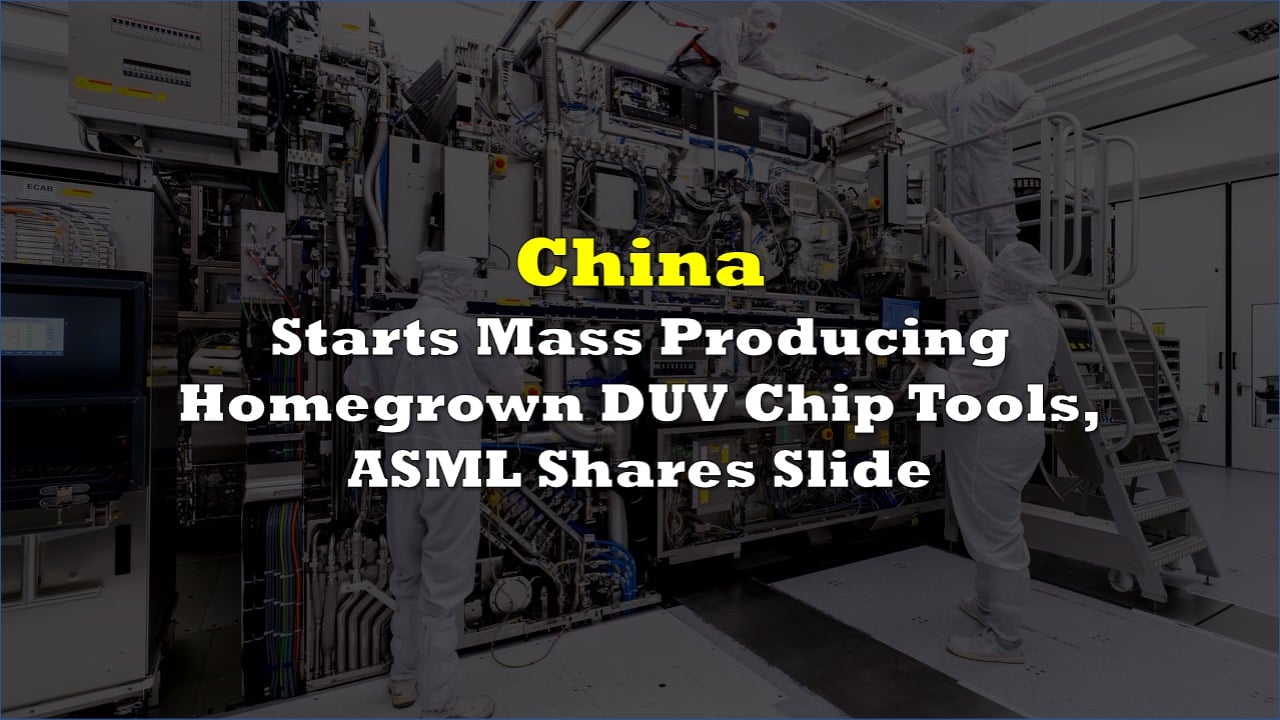

A previously obscure, state-backed Chinese firm has started mass-producing immersion deep-ultraviolet lithography machines, and the news alone was enough to wipe billions off ASML Holding (AMS: ASML) and drag equipment stocks lower worldwide.
Reuters was first to identify the company behind the effort as Aishengna, which assembled its lithography program by pulling in engineering teams from two other Chinese developers, Shanghai Yuliangsheng Technology and Shanghai Micro Electronics Equipment. Yuliangsheng, founded in 2022, counts Huawei-backed equipment maker SiCarrier among its shareholders.
ASML still draws roughly 16% of its revenue from China this year, though that share has fallen sharply in recent quarters.
 Sponsored · Altamira Gold Corp.
Aishengna plans to ship about five machines this year and roughly 20 in 2027 to three of China’s largest chipmakers, Semiconductor Manufacturing International Corp, Hua Hong Semiconductor and ChangXin Memory Technologies, which debuted on Shanghai’s STAR Market this week and briefly became the most valuable company listed in mainland China. That output is a fraction of ASML’s own plans, roughly 130 immersion DUV systems this year, growing another 30% in 2027.
ASML shares sank as much as 10% over two trading days, their lowest levels since early June, and pulled equipment peers down with them. US toolmakers Applied Materials, Lam Research and KLA Corp each lost between 5% and 7%, and Dutch supplier BE Semiconductor Industries shed 8.5% while France’s Soitec gave up 5%.
The market reaction outpaced the technology itself. Aishengna’s tool handles 28-nanometer chips in a single pass. Through multiple exposures, it could reach 7-nanometer or even 5-nanometer production, the same workaround SMIC already uses on older ASML machines to build the chip inside Huawei’s Mate 60 Pro. Analysts say ASML’s real edge is decades of manufacturing know-how, not raw specs.
ASML’s access to China keeps shrinking. The US already bars ASML from selling its most advanced extreme ultraviolet systems to China. Dutch rules limit some DUV sales too. And Congress is now weighing legislation that could cut off ASML’s remaining DUV shipments to China.
Beijing has responded to those curbs by pushing domestic chipmakers toward locally made equipment, including a rule tying subsidies to Chinese-built tools. Sanne van der Lugt, a researcher at Leiden Asia Center, said “US export controls successfully created a business case for Chinese lithography.”
Reuters separately reported that Chinese engineers also built a working EUV prototype late last year, though commercial-scale production of that far more advanced technology remains years away. Most analysts expect the DUV news to leave ASML’s medium-term earnings outlook largely intact despite the stock swoon.