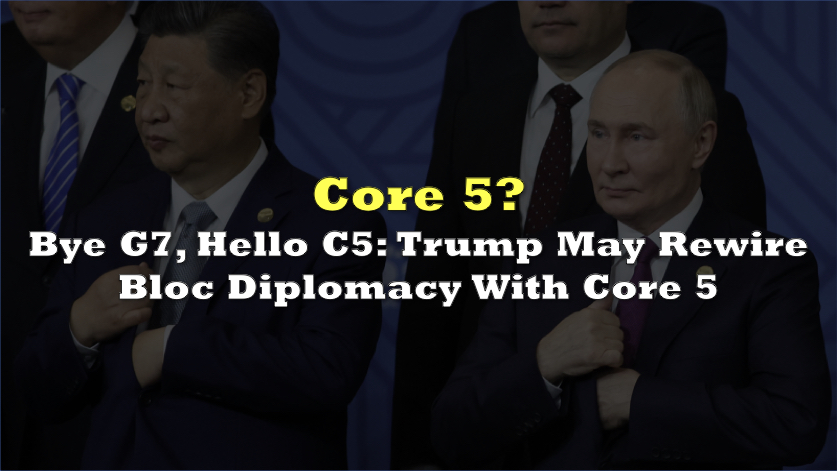

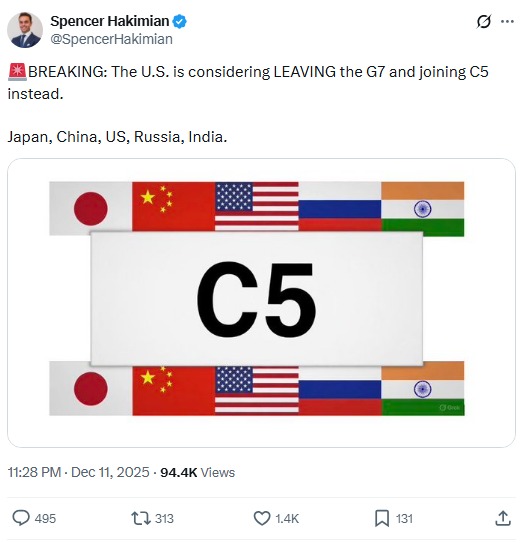
The “Core 5” idea being discussed in Washington would create a C5 forum of the US, China, India, Japan, and Russia that explicitly contrasts with the G7 by placing adversaries in the same top-tier negotiating room.
As described in reporting on an alleged longer National Security Strategy draft, the C5 would function like a recurring summit mechanism with rotating, theme-based agendas, with one floated example centered on Middle East security and “normalizing relations” between Israel and Saudi Arabia.
A former first-term Trump White House official said the idea was “not completely shocking,” framing it less as a formal proposal and more as a reaction to a belief that existing bodies like “the G-structures or the UN Security Council weren’t fit for purpose given today’s new players.”
However, the White House rejected the existence of any longer alternative strategy document, with spokesperson Anna Kelly stating “no alternative, private, or classified version exists” beyond the published plan.
Still, national security practitioners argue the C5 shape matches observable Trump-era deal flow that cuts across rivalry lines, including the White House move to allow Nvidia’s H200 AI chips into China under a 25% fee arrangement tied to US government oversight and licensing.
The same “direct channel” preference shows up in Russia engagement: Reuters reported US envoys Steve Witkoff and Jared Kushner met Vladimir Putin in Moscow, then briefed Trump and Ukrainian officials afterward.
Torrey Taussig, a former Biden NSC official, argued the C5 logic aligns with a worldview that is “nonideologically” driven, comfortable with “strongmen,” and organized around “spheres of influence,” with Europe’s absence likely to be read as Washington implicitly treating Russia as the primary power over Europe’s security space.
The administration’s broader reweighting is also visible in its published National Security Strategy emphasis on the Western Hemisphere and its harsh critique of Europe, including language about “civilizational erasure,” which feeds allied anxiety about whether “great power” frameworks are displacing alliance-centric ones. 
If it pushes through, C5 would involve three of the five nominal members of BRICS. Comparing the two, BRICS operates as a broader “political and diplomatic coordination forum” and has built a “partner country” layer that scales participation beyond a hard inner circle. Brazil’s official BRICS portal has described BRICS as eleven countries including Saudi Arabia.
Information for this briefing was found via Politico and the sources mentioned. The author has no securities or affiliations related to this organization. Not a recommendation to buy or sell. Always do additional research and consult a professional before purchasing a security. The author holds no licenses.