
Canadian Strategic Missions Corporation unveiled three nuclear reactor platforms on Thursday, retiring its earlier reactor concept in favor of separate designs built for the Arctic, the Moon and nuclear research.
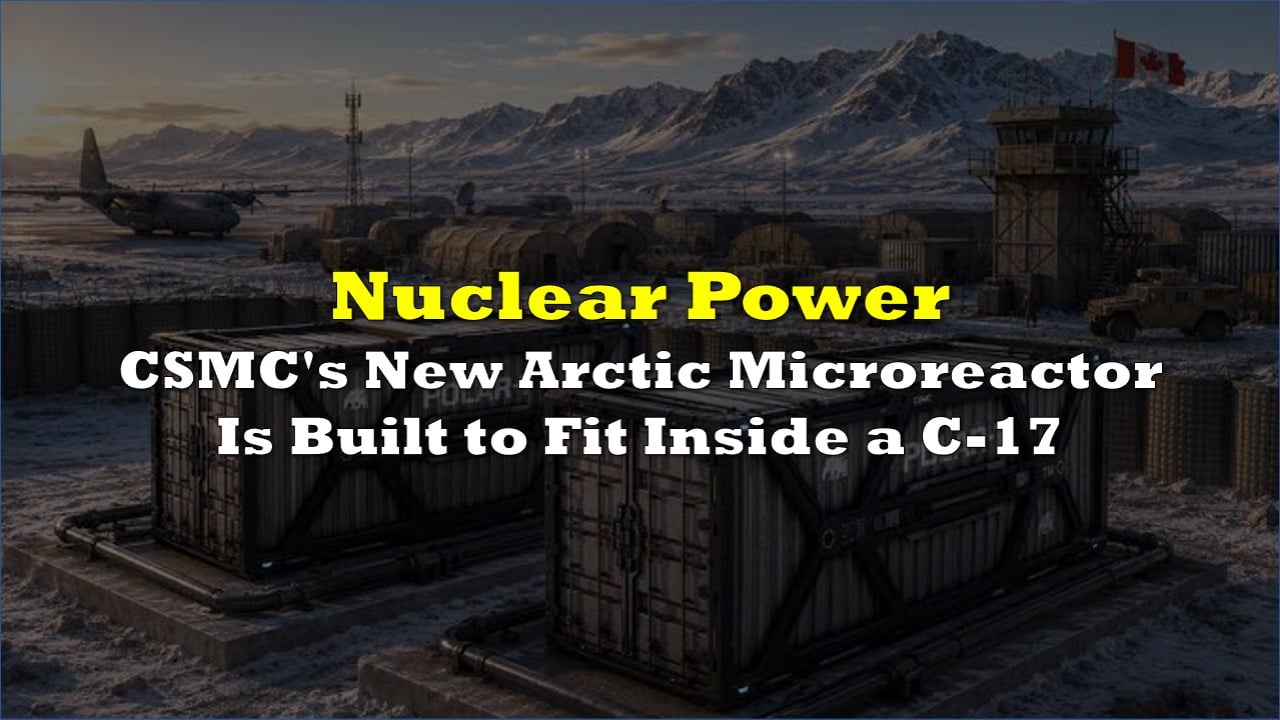
POLAR-1, the most developed of the three, is a scaled-down reactor generating power in the megawatt range, designed to be flown in aboard a C-17 military transport aircraft to power Arctic bases, remote communities and industry currently running on diesel. It’s also the only one with target dates attached — first criticality by 2028, with the company targeting fleet-scale deployment from 2030.
JAY-1 is a smaller reactor built for lunar outposts, able to keep power running through the Moon’s two-week night, building on a $500,000 contract the Canadian Space Agency awarded CSMC in June to research lunar power generation methods. ORCA-1, meanwhile, is meant to give researchers and operators hands-on reactor experience for testing new technology and training staff — filling a gap in Canada, which has only four operating research reactors, at McMaster, Polytechnique Montréal, the Royal Military College and Chalk River.
 Sponsored · Cambria Gold Mines
The reorganization follows a run of government backing — over $17 million in federal and provincial support since 2022, roughly 75% of it tied specifically to nuclear programs, including $4.5 million from FedDev Ontario for Arctic microreactor design, $1.2 million more for manufacturing, and $5 million from Alberta toward an unfuelled prototype at the University of Alberta.
CEO and founder Daniel Sax said the split reflects a technology maturing beyond a single concept, positioning reliable power as “the crucial national strategic capability” for defense, Arctic operations, research and lunar infrastructure alike.
However, civilian programs — not defense contracts — have provided most of CSMC’s funding so far. CSMC has yet to reveal a private funding round, despite saying in December it planned to raise one this year — and hitting the 2028 target for POLAR-1 will take considerably more capital than CSMC has secured so far.
The company also struck a deal with Telesat in May, tying future Arctic reactor sites into the satellite firm’s Lightspeed constellation for connectivity.