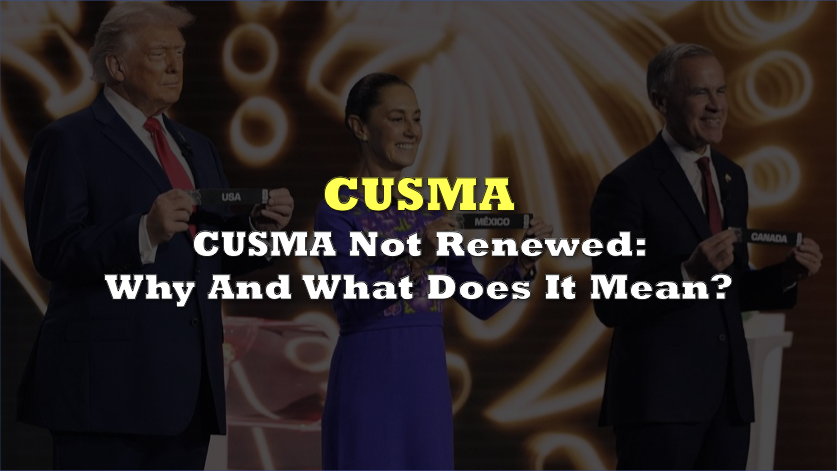

US Trade Representative Jamieson Greer is signaling CUSMA’s next term is not automatic, explicitly tying any 16-year extension to fixes for “specific and structural issues,” with Canada’s dairy policies placed near the top of the list.
In briefings relayed from Greer’s Congressional engagement, the US frames the agreement as “successful to a certain degree,” but argues the gains do not outweigh “structural shortcomings,” naming expanded Canadian dairy access and concerns around exports of certain dairy products.
Mechanically, the fight sits inside tariff-rate quotas: limited volumes can enter tariff-free, then high over-quota duties apply.
 Sponsored · Mercado Minerals Ltd.
READ: How Over 200% Tariffs Prove That Supply Management Must End
Canada’s constraint set is now harder-edged than a typical negotiating posture. Prime Minister Mark Carney publicly ruled supply management “off the table” in US talks, while Bill C-202 received royal assent in June 2025, amending federal law to restrict making certain trade commitments on supply-managed goods.
Polling shows Canadians split, with 29% wanting elimination and 23% supporting maintaining the system.
The economic stakes in the notes are framed as a household tax. One set of estimates says the average Canadian family pays up to $600 more per year because of supply management, while other estimates put the annual cost at $300–$444 per household, with disproportionate pressure on lower-income families.
 Sponsored · Selkirk Copper Mines
READ: Canadian Supply Management Is ‘Economic Suicide,’ Professor Warns
Supply management allocates quota by population rather than operating efficiency, shielding for instance Quebec’s 4,200 small dairy farms, assigning Quebec 37% of national output, and capping western provinces at 16%, alongside structural differences in herd size, with Prairie herds averaging 183–194 cows versus Quebec’s 83.
Arguments against the system also cite large volumes of forced milk disposal, with one report citing 6.8 billion litres dumped worth nearly $15 billion over 2012–2024.
The USTR list is broader than dairy. The reporting also flags Canada’s Online Streaming Act and Online News Act as discriminatory to US tech and media firms, plus provincial alcohol distribution bans, procurement measures in Ontario, Quebec, and BC, “complicated” customs registration for Canadian recipients of US exports, and a push to strengthen rules of origin for non-automotive industrial goods.
On energy, US officials have cited a trade-barrier complaint involving Alberta’s grid operator, the Alberta Electric System Operato, and cross-border electricity flows with Montana. They allege that during periods of surplus supply or transmission congestion, Alberta favors in-province generation over comparably priced US power and has floated additional fees or other constraints on imports.
Alberta’s affordability and utilities minister, Nathan Neudorf, has rejected the claim of differential treatment. AESO’s 2024 Annual Market Statistics report shows Alberta was a net exporter in 2024, averaging 343 MW of exports versus 132 MW of imports, and indicates the Montana tie line accounted for more imported electricity than interties with British Columbia or Saskatchewan.
The same report, however, states that Montana and Saskatchewan “remained net-importers to Alberta,” creating a factual tension with the separate assertion that Montana was a net exporter to Alberta in 2024.
USTR held a public hearing December 3–5, 2025 ahead of the first six-year joint review scheduled for July 1, 2026.
Information for this story was found via CTV News and the sources and companies mentioned. The author has no securities or affiliations related to the organizations discussed. Not a recommendation to buy or sell. Always do additional research and consult a professional before purchasing a security. The author holds no licenses.