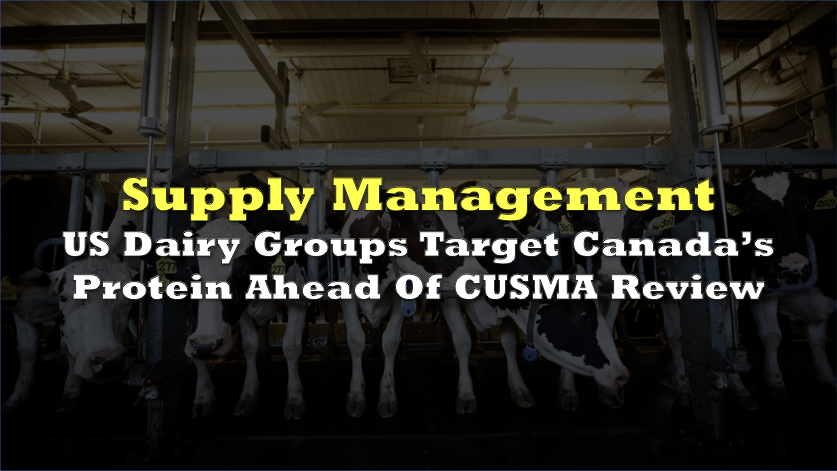

Canada’s next dairy fight with the US may turn on a customs classification problem: a once-small protein-isolate trade line has become large enough to put pressure on CUSMA’s product-specific dairy controls.
The US Dairy Export Council and the National Milk Producers Federation are urging USTR to use the 2026 CUSMA joint review to address Canadian exports of dairy proteins that they say have migrated into tariff categories not covered by the agreement’s surcharge system. The groups cited a new US International Trade Commission factfinding report on nonfat milk solids markets.
The key number is the expansion of imports recorded under a protein-isolate tariff line. USDEC and NMPF said the category totaled only 76 metric tons from 2013 to 2015, then exceeded 32,000 metric tons from 2022 to 2024 after CUSMA took effect. The industry groups acknowledge that the code also covers non-dairy proteins, but said the USITC estimated most of the exports were dairy-based.
CUSMA set export thresholds and surcharge rules for Canadian skim milk powder and milk protein concentrate. The US industry argument is that the economic pressure did not disappear. Instead, it showed up in other high-protein product channels, including isolate and mixed-product categories that are harder to police with narrow product labels.
 Sponsored · Cambria Gold Mines
READ: Carney Rules Out Supply Management in US Trade Talks
USITC’s report gives the US industry a factual base, though not a legal verdict. The commission found that raw milk drives about 80% to 90% of nonfat milk solids processing costs, which means national milk-pricing systems can directly shape export competitiveness. It also said Canada’s system separates high farmgate milk prices from the prices paid by processors for milk components.
The Canadian mechanism starts with butterfat. In a supply-managed system calibrated around domestic butterfat demand, raw milk production can leave more protein solids than the domestic market absorbs. Those solids then become inputs for processors making higher-protein ingredients.
For US producers, that is the commercial issue. They are not only contesting access to the Canadian market. They are arguing that Canada’s regulated system creates a lower-cost protein stream that can compete in the US and abroad even after CUSMA capped certain dairy exports.
READ: How Over 200% Tariffs Prove That Supply Management Must End
The USITC report also places the fight inside a growing global protein market. It found that high-protein nonfat milk solids products are expanding because of consumer demand for protein. The US remains one of the strongest exporters in that market. USITC said the EU, US, and New Zealand accounted for nearly 85% of global exports in 2024, and that the US is a major supplier to East Asia, Southeast Asia, Latin America and the Caribbean, as well as its own domestic market.
That strength is why the US complaint is less about weakness than rules. USDEC and NMPF are effectively asking USTR to treat Canadian dairy protein exports as a classification-risk problem inside CUSMA, not just as a traditional market-access dispute.
USTR opened consultations for the first CUSMA joint review, which is scheduled for July 1, 2026.
The political risk for Canada is that dairy has become a test case for whether CUSMA disciplines products or systems. If USTR accepts the US dairy groups’ position, Washington could push to expand scrutiny from named dairy goods to tariff lines carrying high-protein dairy ingredients.
If it does not, US producers are likely to argue that Canada preserved the economic benefit of its dairy model while staying inside the narrow wording of the deal.
Information for this story was found via the sources and companies mentioned. The author has no securities or affiliations related to the organizations discussed. Not a recommendation to buy or sell. Always do additional research and consult a professional before purchasing a security. The author holds no licenses.