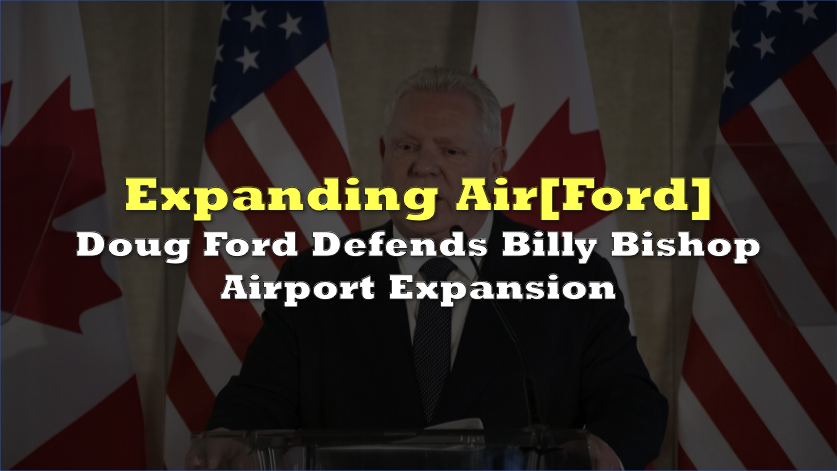

Ontario Premier Doug Ford is defending his government’s plan to expand Billy Bishop Toronto City Airport as an economic development project, but the political fight has shifted from airport capacity to whether Ontario is using provincial power to advance a waterfront plan that could strengthen a privately operated terminal business.
The province’s case is built around scale. Ontario says Billy Bishop currently serves about 2 million passengers a year and that Toronto Port Authority estimates the airport could eventually reach 10 million passengers through modernization. The government has also cited projections that a fully expanded airport could contribute up to $8.5 billion a year to Canada’s economy by 2050 and up to $140 billion over 25 years.
Ford’s defense came as opposition pressure intensified over Nieuport Aviation, the company that owns and operates Billy Bishop’s passenger terminal. Nieuport said in 2019 that institutional investors advised by JP Morgan Asset Management agreed to consolidate ownership of the terminal operator after buying out other consortium partners.
 Sponsored · Silver47 Exploration Inc.
Billy Bishop’s own corporate page identifies Nieuport as the owner and operator of the passenger terminal.
Ontario NDP Leader Marit Stiles has accused Ford of pushing an expansion that would benefit Wall Street, while social media posts from Queen’s Park reporters said Ford rejected the implication by saying he had never spoken to JP Morgan and welcomed investment from around the world.
The government’s legislative move is not a small zoning tweak. Bill 110, the Building Billy Bishop Airport Act, 2026, would allow Ontario to prescribe City of Toronto lands at the airport and vest them in the provincial Crown. The bill also provides that Ontario would take Toronto’s place in the Tripartite Agreement on the prescribed date.
Billy Bishop is not governed by Ontario alone. The airport has long operated under a three-party structure involving the federal government, the City of Toronto, and Toronto Port Authority. Ford’s bill is designed to remove the city from that structure and put the province in its seat, giving Queen’s Park a direct role in future airport decisions.
 Sponsored · Selkirk Copper Mines
The airport itself is owned and operated by Toronto Port Authority, a federal agency, while the passenger terminal is privately owned and operated by Nieuport. A larger passenger base would make the terminal a more important commercial asset, even if the province frames the expansion around public economic benefits.
The legislation has already advanced through a key procedural step. A closure motion on third reading carried 58–41 on May 28, 2026, giving the government a path to push the bill forward despite local and opposition objections.
READ: Who Let The Doug Out? A Rundown Of Ontario’s Ford Government Controversies
Ford’s argument is that Billy Bishop is an underused asset in a growing region. The government says expansion would improve passenger choice, support tourism, create jobs, and ease pressure on Toronto Pearson. It has tied the airport plan to broader economic growth in the Greater Golden Horseshoe, where population is expected to rise sharply over the next 25 years.
The latest airport numbers complicate that pitch. Toronto Port Authority said Billy Bishop handled more than 1.7 million passengers in 2025, down from 2 million in 2024. The airport still posted higher revenue, but the authority attributed that increase to higher Airport Operating Fees, not passenger growth.
Opposition critics are also pointing to lobbying. Posts citing reporting from Global News and other outlets said Nieuport hired Ford’s former deputy chief of staff to lobby on legislative options related to Billy Bishop.
The federal government is now the other major pressure point. Stiles has asked Prime Minister Mark Carney to block the expansion, arguing that the project cannot proceed without federal approval.
Information for this story was found via the sources and companies mentioned. The author has no securities or affiliations related to the organizations discussed. Not a recommendation to buy or sell. Always do additional research and consult a professional before purchasing a security. The author holds no licenses.