
Ontario Premier Doug Ford’s Progressive Conservatives have erased a five-point Liberal lead in one month as the province’s escalating confrontation with President Donald Trump coincides with overwhelming public support for several retaliatory trade measures.
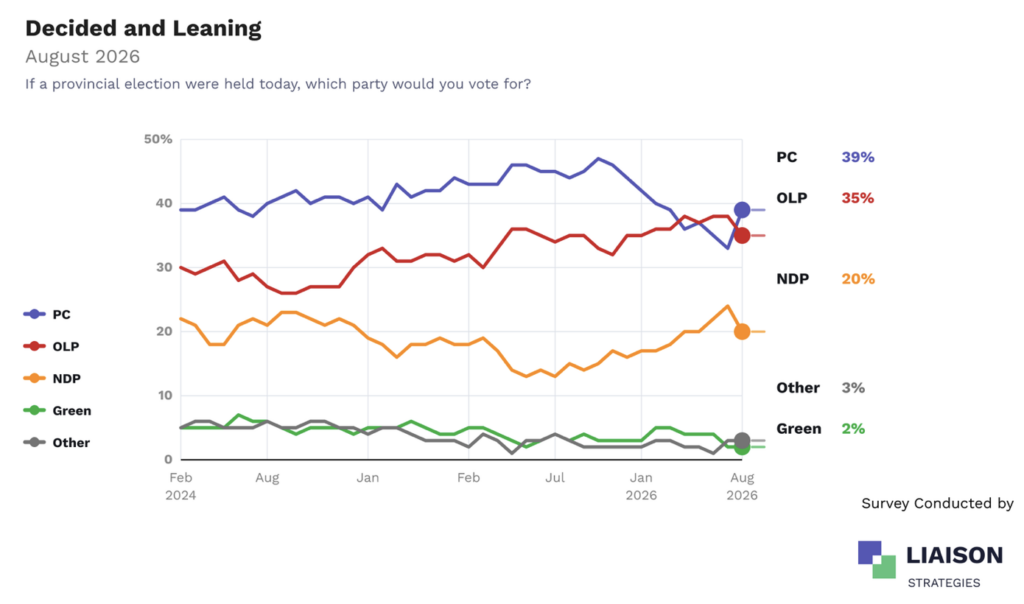
The PCs climbed six percentage points to 39% among decided and leaning voters in the latest Liaison Strategies Ontario tracker, moving ahead of the Liberals at 35% and the NDP at 20%. In July, the Liberals led 38% to 33%, with the NDP at 24%
Ford’s personal numbers moved even more sharply. His approval rating rose 12 points from 24% in July to 36% in August, although 61% of respondents still disapprove of his performance.
 Sponsored · Selkirk Copper Mines
The rebound has also occurred without a broader improvement in perceptions of the provincial government. Just 27% of respondents said Ontario is headed in the right direction, while 72% said it is headed in the wrong direction.
That leaves Ford in an unusual political position. His party has returned to first place and his own ratings have recovered substantially, while a large majority of the province remains dissatisfied with both his leadership and Ontario’s trajectory.
The clearest numbers in the poll were on trade retaliation. Eighty-five percent of respondents supported keeping American beer, wine, and spirits out of LCBO stores until Canada reaches a satisfactory trade agreement with the United States. Another 83% supported Canadian tariffs equal in value to the new US tariffs.
Seventy-two percent supported placing an additional charge on Ontario electricity exported to the US while continuing to supply the power.
The measures overlap with proposals Ford urged Prime Minister Mark Carney to consider in an August 17 letter, including dollar-for-dollar retaliation, restrictions on US alcohol, measures involving electricity exports, and potential leverage involving critical minerals.
Support becomes more cautious when respondents are asked directly about economic consequences. Liaison found 42% wanted stronger measures against the US even if they created additional economic costs in Ontario, while 35% preferred giving equal weight to retaliation and economic risk. Eighteen percent favored limiting measures to reduce those costs.
The poll was conducted immediately after new US duties took effect on August 22. Ottawa says the 50% US tariffs cover $27.6 billion of Canadian goods. Canada plans to respond on September 8 with tariffs of 15%, 25%, and 50% across $27.6 billion of US imports.
The political shift also came as Ford and Trump moved beyond trade policy into direct personal attacks. Trump called Ford a “flunky” and compared him unfavourably with his late brother, former Toronto mayor Rob Ford. Ford responded by calling Trump a “dictator,” a “bully,” and a “loser.”