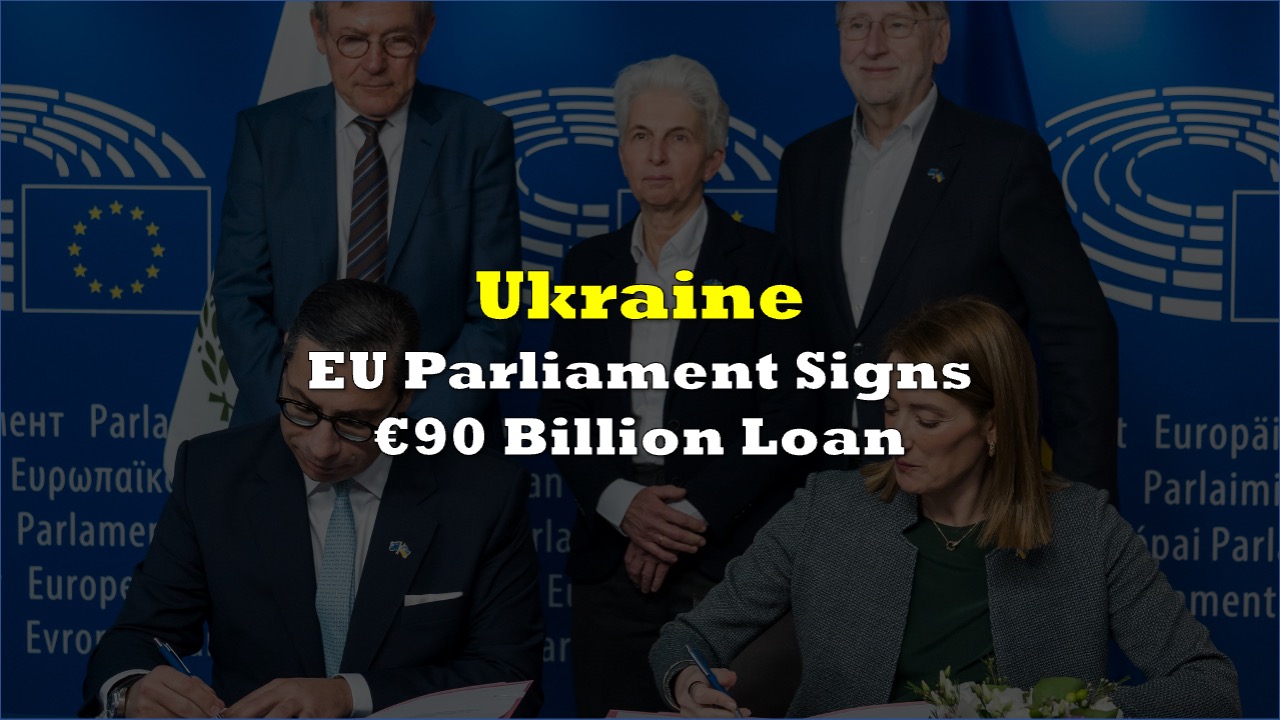

European Parliament President Roberta Metsola signed a €90 billion Ukraine Support Loan on February 24, marking the fourth anniversary of Russia’s full-scale invasion of Ukraine — but the funds remain in limbo as Hungary maintains a veto at the European Council level.
The loan, which covers the 2026–2027 period, represents approximately two-thirds of Ukraine’s estimated financial needs for that timeframe. Metsola announced the signing on X, saying the funds would go toward sustaining essential public services, strengthening Ukraine’s defense, and anchoring the country’s path toward EU membership.
Just signed the €90 billion Ukraine Support Loan on behalf of @Europarl_EN.
— Roberta Metsola (@EP_President) February 24, 2026
• To shore up essential public services running
• To keep Ukraine's defence strong
• To safeguard our shared security & freedom
• To achieve a real & lasting peace
• To anchor Ukraine’s future in… pic.twitter.com/WFDU6bZHbr
Despite the signing, unanimous approval from the European Council remains a requirement before any funds can move. The EU proceeded through the enhanced cooperation mechanism — a workaround that allows willing member states to advance legislation without full unanimity — after Hungary, Slovakia, and the Czech Republic refused to back the loan. Officials expect the loan to take effect around February 27, with disbursements anticipated in the second half of March.
Druzhba Dispute Fuels Hungarian Veto
Hungary’s opposition ties directly to an ongoing standoff over Russian oil. The southern branch of the Druzhba pipeline — the last major Russian oil supply route into the EU — stopped flowing to Hungary and Slovakia on January 27 after infrastructure running through Ukrainian territory sustained damage. Ukraine attributes the disruption to a Russian airstrike. Hungarian and Slovak officials dispute that account, accusing Kyiv of deliberately halting supplies for political leverage.
Before the disruption, the pipeline was delivering an average of 150,000 barrels per day to the two countries. Hungary’s dependence on Russian crude had deepened sharply in recent years, rising from roughly 60% of its oil imports in 2021 to more than 90% by 2025.
With pipeline flows halted, Budapest invoked its EU sanctions exemption and asked Croatia to enable the transport of Russian oil via the Adria pipeline as an alternative supply route. Hungarian Foreign Minister Péter Szijjártó said the request was consistent with existing exemptions that allow landlocked member states to import seaborne Russian crude when pipeline deliveries are disrupted.
Kyiv Visit, Loan Timeline
On the same day as the signing, European Commission President Ursula von der Leyen, European Council President António Costa, and other EU leaders traveled to Kyiv to mark the war’s fourth year and reaffirm European support. Costa told reporters that Ukraine agreed to provide an assessment “in the coming days” on the timeline for restoring the Druzhba pipeline.
EU officials have stressed that both Hungary and Slovakia hold 90 days of reserve oil stocks, meaning no immediate supply emergency exists.
Energy analysts from the Center for the Study of Democracy have argued that phasing out Russian crude entirely by the end of 2026 is both feasible and strategically necessary — and that the current disruption, however it originated, presents an opportunity to accelerate that transition.
Information for this story was found via the sources and companies mentioned. The author has no securities or affiliations related to the organizations discussed. Not a recommendation to buy or sell. Always do additional research and consult a professional before purchasing a security. The author holds no licenses.