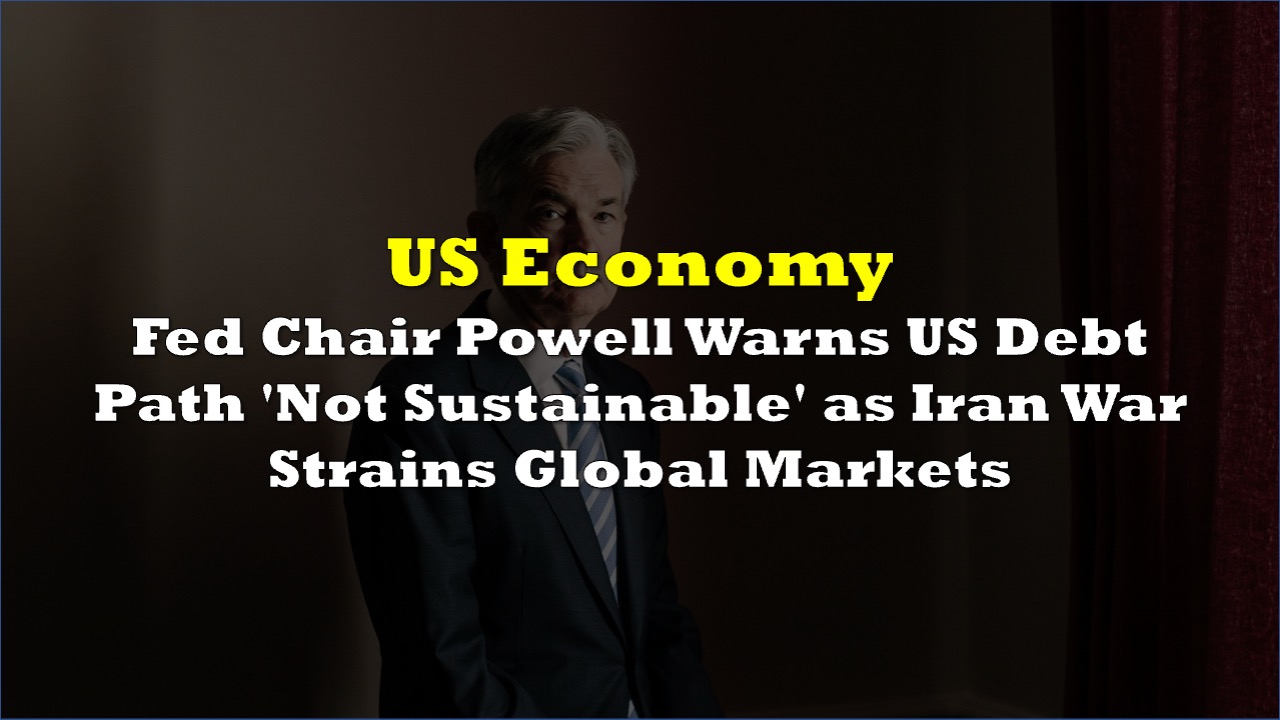

Federal Reserve Chair Jerome Powell warned a Harvard economics class on Monday that the United States’ $39 trillion national debt is on a trajectory that “will not end well” — remarks that landed as foreign central banks accelerate a historic sell-off of US Treasuries in the wake of the Iran war.
“The level of the debt is not unsustainable,” Powell told roughly 400 students at Harvard University on March 30, “but the path is not sustainable. It will not end well if we don’t do something fairly soon.”
Federal Reserve data shows foreign official institutions have cut their Treasury holdings at the New York Fed by more than $90 billion since the week of February 25 — the largest five-week sell-off in over a decade — pushing total custody holdings to $2.7 trillion, their lowest level since 2012.
 Sponsored · Cambria Gold Mines
Oil-importing nations, including Turkey, India, and Thailand, have been forced to liquidate dollar-denominated reserves to defend their currencies and pay surging energy bills as the Strait of Hormuz closure keeps global markets under severe stress. Turkey’s central bank alone has sold approximately $22 billion in foreign government securities — largely US Treasuries, according to analysts — since February 27, the day before US forces struck Iran.
The sell-off has exposed a bond market already buckling under its own structural weight. The government must refinance $10 trillion in debt maturing over the next 12 months while the annual budget deficit runs on pace to hit $2 trillion. Auctions for 2-year, 5-year, and 7-year Treasury notes all drew weak demand last week, forcing yields higher than expected. The 10-year Treasury yield has climbed 35 basis points in March alone — its biggest monthly rise since Trump returned to the White House — touching 4.42% on Thursday before pulling back slightly.
Powell drew a distinction between the current stock of debt and its growth trajectory, noting that the US, as the world’s reserve currency issuer with the deepest capital markets on earth, can sustain debt loads that would overwhelm smaller economies. He pointed to Japan — which carries a higher debt-to-GDP ratio than the US — as evidence that no precise breaking point exists. But he said the direction of travel was unambiguous.
“What’s clear is that our debt is growing much faster — the federal government debt is growing substantially faster than our economy,” Powell said. “And that ratio is going up. And in the long run, that’s kind of the definition of unsustainable.”
The US federal debt-to-GDP ratio has climbed to 124.8%, up from 58.7% in 2000. Net interest payments are now projected to exceed $1 trillion in fiscal year 2026 — nearly triple the $345 billion paid in 2020 — already surpassing quarterly defense spending. The Congressional Budget Office projects debt held by the public will reach 118% of GDP by 2035, eclipsing the World War II record.
 Sponsored · First Phosphate Corp.
The Iran war is set to widen that gap further: the Pentagon is seeking more than $200 billion in supplemental funding for the conflict on top of the roughly $900 billion defense budget already approved for fiscal year 2026. Trump has separately called for a $1.5 trillion defense budget in fiscal year 2027, which the Committee for a Responsible Federal Budget estimates would add $5.8 trillion to the national debt over a decade.
The diplomatic picture offers little relief. Iran rejected the US 15-point ceasefire plan and countered with its own five-point proposal — including a demand for sovereignty over the Strait of Hormuz. Iranian Foreign Minister Abbas Araghchi said the trust level between Washington and Tehran is “at zero.”
Trump extended his deadline for striking Iranian energy infrastructure to April 6, saying talks are “going very well” — a characterization Tehran flatly denied. Money markets are now pricing in zero rate cuts from the Fed for the remainder of 2026, with futures traders last week briefly pricing in a 52% chance of a rate hike by year-end. Morgan Stanley data shows the share of Treasuries held by foreign investors has fallen to 32.4%, the lowest since 1997.
Former Fed Chair Janet Yellen warned in January that the ballooning debt risked “fiscal dominance” — a scenario in which political pressure forces the central bank to hold rates lower than economic conditions warrant, potentially entrenching inflation. Yellen said legislators were not “adequately acknowledging the risks.”
Powell, whose term expires in May, stressed that fiscal policy falls outside the Fed’s mandate and acknowledged that his warnings typically go unheeded. “I usually make a few high-level points,” he said, “which essentially everyone ignores.”
Information for this story was found via the sources and companies mentioned. The author has no securities or affiliations related to the organizations discussed. Not a recommendation to buy or sell. Always do additional research and consult a professional before purchasing a security. The author holds no licenses.