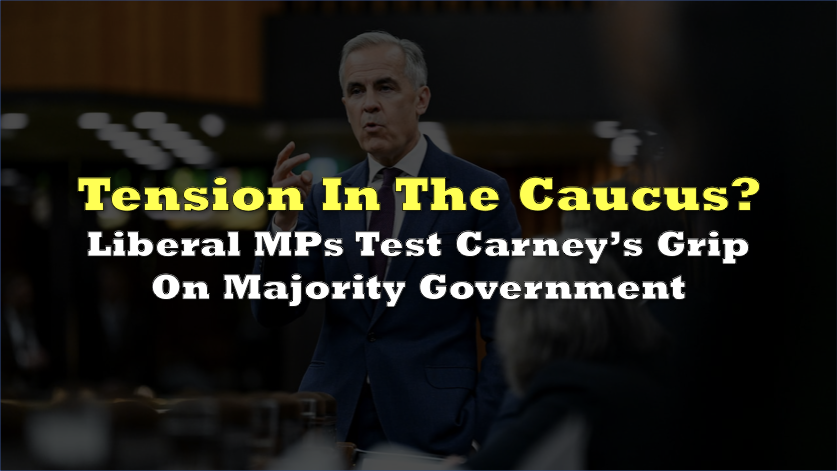

Prime Minister Mark Carney’s narrow Liberal majority has turned caucus discipline from an internal management issue into a governing risk, as anonymous MPs allege that dissent is being squeezed just as the prime minister has gained more room to legislate.
The Liberals’ parliamentary position changed materially in April. Three special-election wins pushed the party to 174 seats in the 343-seat House of Commons, enough to pass legislation without opposition support.
That majority, however, is not deep. Former environment minister Steven Guilbeault’s planned resignation would lower the Liberals to 173 seats and leave Carney with a one-seat majority.
 Sponsored · Power Metallic Inc.
The latest flashpoint is a Toronto Star column by Althia Raj under the headline “‘He yells’: Mark Carney’s focus has Liberal MPs bristling” and includes an excerpt saying Raj’s reporting explored Carney’s concentration of decision-making and alleged impatience with internal challenge.
The harshest allegations come from unnamed Liberal MPs. According to the Star reporting, some MPs alleged that Carney has sharply rebuked caucus members who raise concerns rather than solutions, including complaints involving regional issues, Indigenous policy, Alberta health care, and riding-level requests.
But the most durable risk for Carney may not be the alleged shouting. It may be the reported attempt to control how disagreement is documented.
Raj’s reporting says Liberal caucus chair James Maloney instructed MPs not to speak with journalists or put concerns in writing to the prime minister after leaks, including an email reportedly sent by 13 MPs on climate strategy.
 Sponsored · Selkirk Copper Mines
If accurate, it points to a more structural problem. A government can try to stop internal disputes from spilling into the press, but a pressure campaign against written dissent also changes the paper trail available to voters, journalists, historians, and accountability bodies.
That concern intersects with a separate federal transparency debate. The Treasury Board’s 2025 Access to Information Act review says Ottawa is seeking feedback on policy approaches to address systemic problems in the access regime, with comments open until June 15, 2026.
Critics argue the proposal could move Canada in the opposite direction. The Narwhal reported that access advocates are concerned that a new definition of official records could exclude some “routine communications,” “transitory” documents, and records deemed to lack “business value,” potentially affecting emails, texts, instant messages, drafts, and duplicates.
The Information Commissioner of Canada also criticized the government’s initial review step in March, saying the policy approaches showed “lack of ambition” and did not sufficiently address longstanding weaknesses in the access system.
Taken together, the caucus and transparency debates create a sharper question than whether MPs like Carney’s management style: how many internal objections will remain visible if MPs are discouraged from written complaints while the government is considering narrower access rules for some internal communications?
The Liberal Party’s public nominations page describes the party’s candidate process as a search for local champions who bring community voices to Parliament. The friction arises when MPs or organizers believe that local input is being replaced by leader-approved choices. That is where party efficiency starts looking like political compression.
This also comes after a bill was out forth by NDP parliamentary leader Don Davies to propose that if an MP moves into another registered party, the seat becomes vacant.
Information for this story was found via the sources and companies mentioned. The author has no securities or affiliations related to the organizations discussed. Not a recommendation to buy or sell. Always do additional research and consult a professional before purchasing a security. The author holds no licenses.