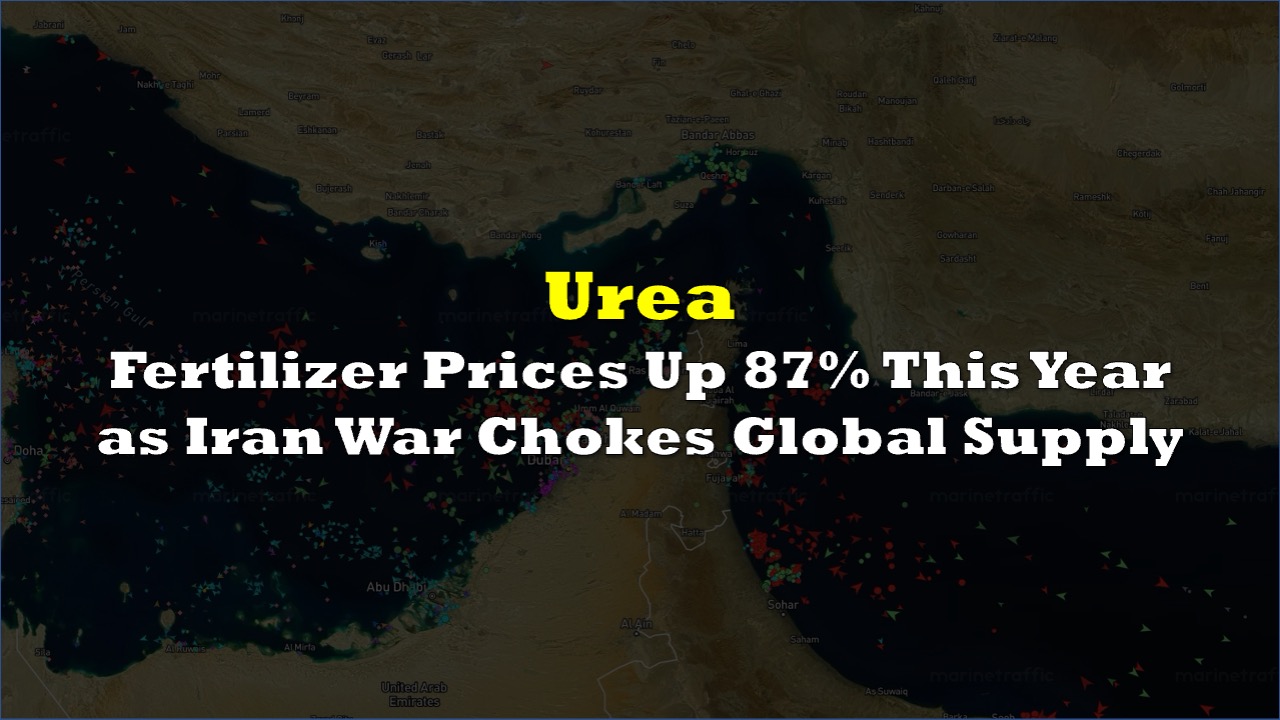

Urea prices have surged 87% since the start of 2026, topping $720 per metric ton, as the US-Israel war with Iran disrupts a supply chain that routes nearly half of global fertilizer exports through the Strait of Hormuz — hitting farmers at the worst possible moment ahead of spring planting season.
Analysts told CNBC that granular urea prices in Egypt — a key global benchmark — jumped from between $400 and $490 per metric ton before the February 28 strikes to around $700 per metric ton in the weeks after. Urea and ammonia prices rose approximately 50% and 20%, respectively, in that window.
Iran, Qatar, Saudi Arabia, and Egypt together account for nearly 49% of global urea exports and around 30% of global ammonia exports — all dependent on Strait of Hormuz shipping. With the strait under threat, roughly half of global urea shipments face disruption.
 Sponsored · Selkirk Copper Mines
China has signaled it may withhold urea exports through August 2026, pulling millions of tons off the market at the height of the Northern Hemisphere planting season. Russia compounded the squeeze further in March, suspending ammonium nitrate exports while Ukrainian drone strikes on major chemical facilities — including the Acron Dorogobuzh plant — cut Russian output by an estimated 11%
Global urea inventories now sit at historic lows. Brazil saw urea imports fall 33% in early 2026 as domestic prices jumped 35% in just two weeks, with major importers across South America and Asia facing similar tightening ahead of their own planting cycles.
Unlike 2022, there is no crop price buffer to absorb the shock. When fertilizer costs spiked four years ago, corn traded above $7.50 per bushel, partially offsetting input costs. Corn now sits at approximately $4.40 to $4.60 per bushel, leaving farmers to carry the full weight of the increase. The American Farm Bureau warned that rising input costs could quickly erase the gains farmers made heading into 2026 after years of operational losses.
RaboResearch’s April 7 fertilizer outlook warned that demand destruction is now unavoidable — farmers will likely cut application rates this season and the next, potentially reducing 2027 crop yields and tightening global food supplies.
“Overall, the fertilizer market faces a prolonged period of tight supply, weak affordability, and heightened price risk,” said Bruno Fonseca, senior analyst at RaboResearch. “Even if geopolitical tensions ease, normalization will be slow.”
Only 60% of US farmers reported securing their full nitrogen supply for the 2026 season, according to a survey for the National Corn Growers Association. Even under the most optimistic scenario — a ceasefire holding and the Strait reopening within weeks — NDSU analysts project fall urea prices will average $636 per short ton, 35% above pre-crisis levels.
Information for this story was found via the sources and companies mentioned. The author has no securities or affiliations related to the organizations discussed. Not a recommendation to buy or sell. Always do additional research and consult a professional before purchasing a security. The author holds no licenses.