
With the majority of the world focused on natural gas shipments from Russia to Germany, France’s increasing struggle with keeping its lights on at night has taken a backseat.
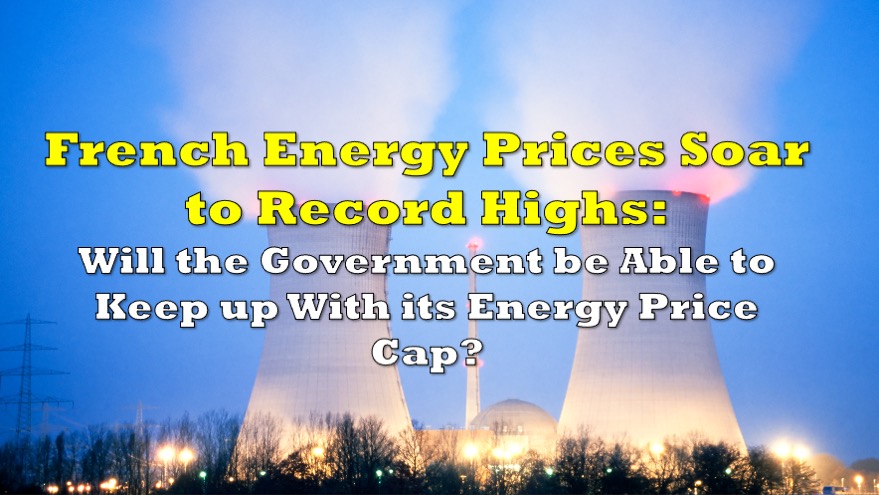
With winter months soon approaching and no end to the energy crisis sparked by Russia’s Ukraine war in sight, France’s electricity outlook doesn’t look very promising. Sure, the French government back in June extended the bouclier tarifaire to the end of the year which capped gas prices at October 2021 rates and slashed electricity price increases to a maximum of 4% until the end of the year, but it appears that the government faces a much larger energy crisis than a price cap can fix.
“The price cap provides consumers in France with guaranteed tariffs and it is the State that pays the difference between market rates, which have obviously risen considerably in France and in other European countries,” the French prime minister’s office said at the time. Think tank Bruegel estimated that the government would end up spending around €38 billion to help alleviate electricity prices for consumers.
 Sponsored · Selkirk Copper Mines
“In absolute terms and as we benefit from liquefied natural gas, we could do without Russian gas, assuming that all LNG deliveries arrive on time and that we can comfortably top up our strategic stocks,” exclaimed France’s energy transition minister Agnès Pannier-Runacher to BFM Business in June, adding that France is even prepared to send gas shipments to neighbouring Germany, Poland, Slovakia and the Czech Republic should they need it.
However, the French government’s assurances that its consumers have nothing to worry about when it comes to the European energy crisis were short-lived. French nuclear company EDF on Wednesday filed a compensation claim against the government seeking €8.3 billion in losses after the partially nationalized company was forced to sell electricity at significantly discounted prices due to the extension of the energy price cap.
Looks like the French government might face a much heftier price tag than the €38 billion it was previously forecast to spend in order to keep households’ wallets from panicking.
But, when it rains, it pours. European electricity prices continue to skyrocket, hitting new record-highs just this week as a prolonged heatwave is causing chaos on the region’s power markets. Germany’s baseload power slated for next year delivery jumped 5% on Thursday to a record-high of €455 per megawatt hour, meanwhile a similar French contract rose another 4%, surpassing €600 per megawatt hour for the first time ever. The abnormally hot temperatures are forcing some of France’s nuclear power plants to reduce power capacity as the rivers used for cooling the reactors become too warm.
EDF’s power stations, which provide almost 70% of France’s electricity, announced last week that output at its nuclear stations situated alongside the Rhône and Garonne would be temporarily restricted. At the same time, state-owned utility company Electricite de France SA is currently running only 26 of its 57 power plants, after uncovering numerous cracked pipes that will now require emergency maintenance.
During the summer, France’s electricity demand sits at an average of 45 gigawatts per hour, which isn’t an overload for utility companies. But, come winter when temperatures dip well below zero during the night, households’ consumption can soar to anywhere between 80 and 90 gigawatts, which could become detrimentally costly. In further context, during severe cold snaps, every degree Celsius temperatures fall below zero, the country’s power demands jumps by approximately 2.5 gigawatts per hour, which amounts to output produced by two nuclear reactors.
Indeed, with such high demand for electricity and such risk posed by insufficient supply, traders are treating the situation very seriously. Baseload French power is trading at more than €1,000 per megawatt hour, while peakload power is trading at a staggering €2,000 per megawatt hour. In theory, markets are anticipating that France’s power demand will be so high compared to supply that hourly prices could hit the €4,000 limit set by the exchange numerous times throughout December.
In practice, the market— which is aware of the dire situation France’s energy supply is in, is attempting to curb consumption beforehand in order to stave off potential blackouts and force electricity-intensive industries such as smelting to shut down operations come December. So, will the government be able to keep up with its promise to pay the premium between market rates and keep electricity cost increases at no more than 4%? Or will French households pay the full brunt of Europe’s failed energy policies?
Information for this briefing was found via the Bloomberg and the sources mentioned. The author has no securities or affiliations related to this organization. Not a recommendation to buy or sell. Always do additional research and consult a professional before purchasing a security. The author holds no licenses.